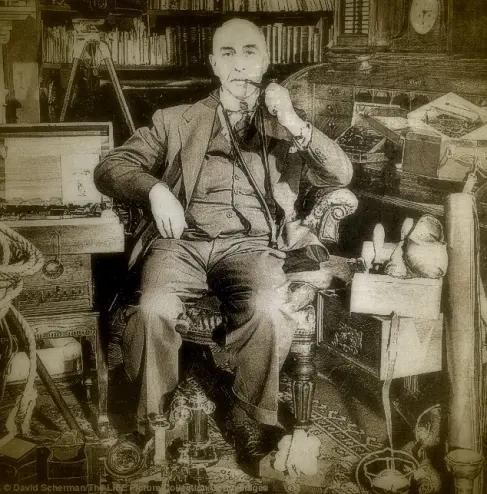
Helen Duncan
Helen Duncan was one of the most notorious and divisive figures in the chequered history of Spiritualism. A reputation helped in part by her prosecution in 1944 under the archaic Witchcraft Act of 1735 for pretending to conjure spirits of the dead for financial gain.
She was born in the picturesque town of Callander in Scotland in 1897 and had a reputation as a child for seeing the deceased as if they were alive, making off-the-wall prophesies and reacting ferociously when challenged. All of which earned her the nickname ‘Hellish Nell’.
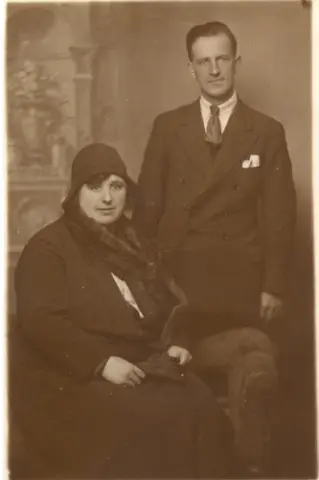
She also had a difficult relationship with her parents after getting pregnant at sixteen out of wedlock and was kicked out, winding up in the industrial town of Dundee where she found employment in the Royal Infirmary.
It was here that she met Henry Duncan, an invalided veteran of the Great War and committed Spiritualist, who was sympathetic to her aptitude for mediumship. They married and he helped fashion her talents into a viable vocation. The interest in Spiritualism was at a peak during and directly after the War, stimulated by the incredible loss of life and the allure of connecting with love ones who had passed on.
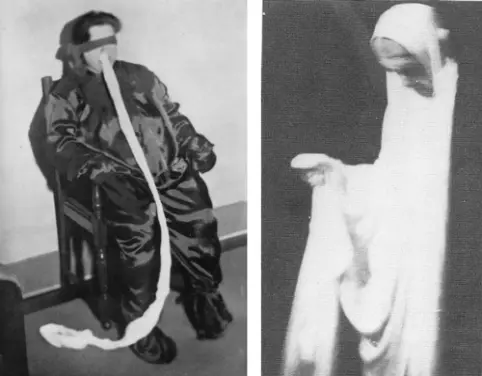
With Henry’s guidance, Helen’s routine went beyond that of a medium communing with the dead. While in a trance, a milky white substance called ‘ectoplasm’ would secrete from her mouth, coalesce into a partially or fully formed figure within a ‘cabinet’ (a makeshift cubicle with a curtain), and then show itself for the benefit of the expectant audience sat in a dimly lit room. The manifestations could, according to witnesses, interact with people verbally and even physically before withdrawing into the cabinet and back into the medium.
These séances became extremely popular; so popular that Helen attracted a significant following including an historian of Shakespeare, a well-known theatre critic and a wing commander of the Royal Air Force. Many of her sitters claimed to be astonished by what they saw and heard.
Harry Price
Harry Price, a pioneer of paranormal investigation, a ghost hunter, innovator, conjurer and no stranger to controversy himself, was born in Holborn, London in 1881. However, he seems to have preferred suggesting that he hailed from Shrewsbury in Shropshire as Holborn was not then the affluent district it is now.
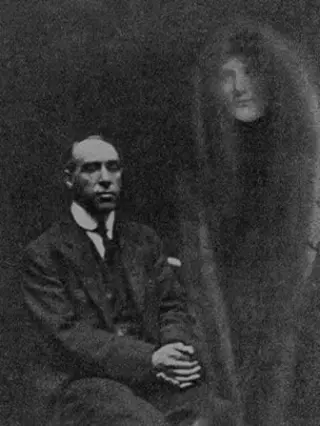
He learned sleight-of-hand magic when he was young and eventually joined the Magic Circle. His interest in the art of conjuring coupled with a curiosity in psychic phenomena made him a natural investigator of the paranormal.
Some of the most effective investigators of the paranormal were not scientists testing subjects under strict laboratory conditions, who are surprisingly easy to deceive, but conjurers and stage magicians with a sharp eye for chicanery and more familiar with methods of deception. This tradition continues into the modern era with famous sceptics such as Penn & Teller and the late John Randi.
Price took quite a scalp when he cleverly caught a famous so-called spirit photographer called William Hope substituting blank plates with ones he had prepared earlier that were already exposed with ‘phantom’ images. This coup helped raise Price’s profile as a paranormal investigator.
After differences of opinion with the Society of Psychical Research (SPR) as to the validity of Spiritualism (Price defended it), he broke affiliation with the organisation in 1925. He went on to establish the National Laboratory of Psychical Research (NLPR) at 13 Roland Gardens, London “to investigate in a dispassionate manner and by purely scientific means every phase of psychic or alleged psychic phenomena.”
As something of a maverick and talented self-publicist, it was typical of Price to go his own way and raise the necessary resources to finance his work. He had also married into money, which offered a degree of financial independence.
Between the wars
In May 1931, Henry arranged for the LSA (London Spiritualist Alliance) to test his wife’s mediumship in return for a healthy fee. They unfortunately concluded that the ectoplasm she produced was in fact cheesecloth swallowed prior to a sitting and regurgitated during the séance.
Henry then made a miscalculated attempt to salvage a somewhat tarnished reputation by taking a punt with Harry Price (who shared the laboratory with the LSA). Price had up until then been snubbed and denied access to any séances. He admitted in due course that the wonder at Helen Duncan’s séances from the faithful, and even by a friend of his, gave him cause for much irritation.
This evident frustration dealing with what Price took to be a cult-like attitude and the size of the sum demanded by Henry Duncan (several thousand pounds in today’s money) may not have made for the most “dispassionate” investigative approach as promised by the newfound National Laboratory of Psychical Research.
The LSA had suggested during their tests that Helen ingest a harmless dye prior to a séance to determine the source of the “teleplasm” (ectoplasm). She refused. Price, obviously thinking along the same lines, requested at the conclusion of one test that Helen submit to an X-ray to determine if there were any foreign objects in her stomach, as a thorough and intimate search before the séance had yielded nothing.
However, rather than complying like her husband Henry suggested, she punched Henry in the face, lunged at a doctor present, ran into the street and clung to a rail screaming.
Price also noted that Henry refused to empty his pockets after mollifying his wife in the street, compromising the test conditions. Price concluded, like the LSA, that the medium was swallowing yards of cheesecloth and regurgitating it, along with other materials with which to create her phantoms such as safety pins, rubber gloves and cut-out faces from magazines.

Helen submitted to one fifth and final séance. A sample taken of the teleplasm produced had the texture and appearance of “sodden paper” (later tested and confirmed) but elicited a scream from the subject and what was left “disappeared down her throat”.
To make matters worse, a maid working for the Duncans contacted Price claiming that she had bought muslin cloth for them and swore to the fact in writing. Price publicly denounced the medium as a “fat crook” and dismissed her supporters as over credulous “cheese-cloth worshippers”. He never lost interest in her career or his frustration with her devotees who seemed impervious to reason.
When Helen produced one of her familiar spirits or “controls”, a small child called “Peggy”, in a séance in Edinburgh in January 1933, an intrepid sitter broke strict séance protocol and grabbed it—a tug-of-war ensued that the hefty medium seems to have won.
The police were called and a torn undervest was found in Helen’s possession, which appears to have formed the basis of her “Peggy”. She was duly prosecuted for this deception by the local magistrates and fined £10. Witnesses tended to be strongly divided between those who were convinced of her authenticity and those equally adamant she was a fraud.
World War II
In 1944 she fell afoul of the authorities again, in Portsmouth this time, which led to the infamous witch trial held at the Old Bailey in London. On this occasion, the police raided the séance midway through. The constable who was tasked with seizing the ‘teleplasmic’ material from the medium as evidence of fraud did not manage to retain it and it was never recovered, making an already bizarre legal hearing much trickier than it ought to have been.
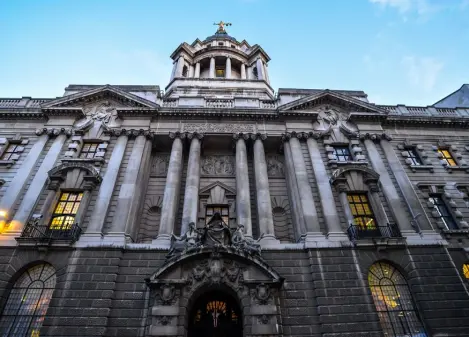
It was also complicated by the somewhat conspicuous involvement of wartime authorities who were keen to shut her activities down before D-Day: Helen had already come to their attention when she disclosed the sinking of the battleship HMS Barham in a séance back in 1941 before the news was officially released to the public. A spirit of one of the drowned sailors called ‘Syd’ ‘came through’ wearing a cap bearing the ship’s name even though the names of the ships were not actually displayed on naval headwear during wartime.
Helen Duncan was found guilty by a jury and sentenced to nine months in Holloway Prison, notwithstanding the lack of material evidence and the procession of respectable witnesses lining up to take the stand and swearing to her genuineness.
Alfred Dodd, a scholar of Shakespeare and Francis Bacon, recounted his experience at a Helen Duncan séance: “[T]he curtains opened once more, and I saw before me the living form—the living form!—of a young lady aged twenty-one … and she was the first sweetheart that I had ever had, and therefore I knew her absolutely.”
The jury took a more common-sense position and agreed with a key prosecution witness (a Royal Naval Voluntary Reserve lieutenant called Stanley Worth) who thought that Helen Duncan’s pretence was risible and told the court so.
Post-war
After release from prison, Helen Duncan gradually resumed her activities but was raided again for the last time in October 1956 at a séance held in the Nottingham area. She died some weeks later before a prosecution for fraud could be brought against her. By then the Witchcraft Act of 1735 had been repealed and replaced by the Fraudulent Mediums Act of 1951.
Ironically, Harry Price also became the focus of intense scepticism when his most famous and protracted investigation into the paranormal goings-on at Borley Rectory (“the most haunted house in England”) came under the scrutiny of the SPR who claimed along with a Daily Mail journalist that Price had faked some of the paranormal phenomena purported to be taking place, surreptitiously tossing pebbles about and such like. This inevitably split opinion as to his integrity and cast a long shadow over his colourful legacy.