
in the beginning
We ought to remind ourselves now and again in all our pomp and glory that we are not gods and that behind our resourceful hominid forebears stands the trusty canid. Because when hunter-gatherer homo sapiens and canids buried their rivalry rather than their teeth into each other, they formed the most dominant interspecies alliances of the natural world.
Two species that were genetically distinct and independently successful transcended the limitations of their respective condition through cooperation and selective breeding and came out top of the food chain. And this sucked for the prospects of rival species, not just those that were considerably larger and more fearsome, such as the mammoth and cave lion, but also for homo sapien’s closest cousin—the neanderthal.
Back then it paid to be a dog person, because all that is left of the neanderthal today is the merest trace of their DNA clinging to the human genome by the slenderest of threads: up to 4% in non-African ancestry, the result of a few wild nights.
Not to put too finer point on it, the individual of any species, however impressive an organism, when it comes down to it is nothing more than a custodian and propagator of genetic information. Important, yes, but the primal imperative has always been the continuum of the genetic code. Instructions actually, that decide the physical capabilities of each successor to acquire the necessary resources and to withstand the environmental challenges long enough to pass the blueprint down to the next generation, ad infinitum.
But there are limits to inherited genetic characteristics. What about the types of skill sets outside the scope of the heredity instincts needed for immediate survival? The ability to make fire, for example? The genetic coding may dictate the development of the organism to the extent that it is physically and mentally capable of creating fire, but there are no instructions within the code on how to spark up tinder and kindling. And that’s where the meme comes in.
the memes of reproduction
A meme is also a means of information transference, a replicator that is free of the rules that bind genetic hereditary protocols. It is 'a unit of cultural transmission, or a unit of imitation....
Examples of memes are tunes, ideas, catch-phrases, clothes fashions, ways of making pots or of building arches. Just as genes propagate themselves in the gene pool by leaping from body to body via sperms or eggs, so memes propagate themselves in the meme pool by leaping from brain to brain via a process which, in the broad sense, can be called imitation... (Dawkins 1989).
The above list is not exhaustive and includes iconography and religious concepts. We needn’t concern ourselves with all of them, but sticking with the canine theme, or rather meme, we can acknowledge how powerful a part canids played in the ascent of humankind by examining Saudi Arabian cave art purporting to depict the interaction of men and dogs hunting game with bow and arrows, possibly as far back as the ninth millennium BC.

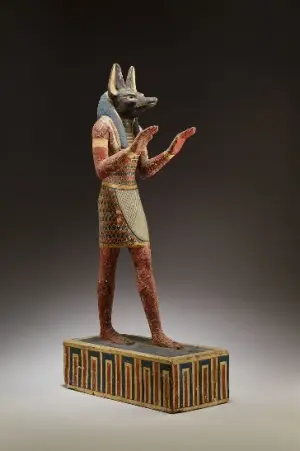
The status of the dog rose to godly heights next door in Egypt, where by the third millennium BC they were physically represented in the pantheon as Anubis, the great dog-headed god. Often taking on the role of protector of graves and guardian of the underworld.
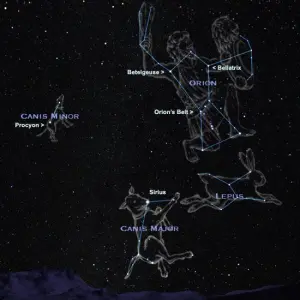
And then elevated to the heavens by the ancient Greeks in the form of Sirius, the luminous Dog Star, situated amid the constellation Canis Major, Orion’s faithful hound. The two can be seen hunting the hare Lepus across the night sky.
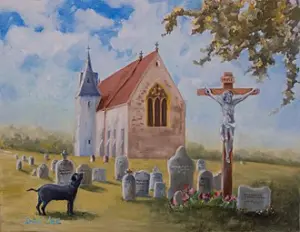
More recently, according to English folklore, a church grim was a guardian spirit, usually a black dog, whose role, much like Anubis, was to protect graveyards from vandals, thieves, witches and even the Devil.
The measure of canine loyalty and other qualities has been amply demonstrated over the years and occasionally immortalised in verse:
Epitaph to a Dog
When some proud Son of Man returns to Earth,
Unknown to Glory but upheld by Birth,
The sculptor's art exhausts the pomp of woe,
And storied urns record who rests below:
When all is done, upon the Tomb is seen
Not what he was, but what he should have been.
But the poor Dog, in life the firmest friend,
The first to welcome, foremost to defend,
Whose honest heart is still his Master's own,
Who labours, fights, lives, breathes for him alone,
Unhonour'd falls, unnotic'd all his worth,
Deny'd in heaven the Soul he held on earth:
George Gordon Byron (1788 –1824)
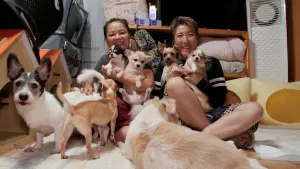
And very recently, in a culinary sea-change, dog is legally off the menu in South Korea.
cryptocurrency
A full node is an essential component of any cryptocurrency network. And is necessary for the communication and validation of transactions. It is also a replicator, not of genes of course or ideas, but of computer code in the form of the blockchain—the timestamped record of all transactions. This is certainly the case for Bitcoin, the first cryptocurrency.
The developer(s) chose the pseudonym Satoshi Nakamoto, supposedly inspired from the ideas of maverick Japanese merchant philosopher Tominaga Nakamoto (1715–1746), without any reference to the theories of evolutionary biologist Richard Dawkins (1941-).
Fair enough, the resemblance of Bitcoin protocol to genetic protocol is probably coincidental rather than deliberate. But the competition for resources (electrical, physical hardware, capital etc) with other Proof of Work cryptocurrencies is unmistakably akin to genetic survival. The weaker coins falling by the wayside, into disuse and obscurity. Try connecting to other nodes and downloading a blockchain when they are few and far between. Nevertheless, people don’t characterise Bitcoin as a gene coin.
Other coins cannot escape the association with Dawkins' theories: specifically, the meme coin. We’ll focus on the first—Dogecoin. If Bitcoin is the first cryptocurrency to exhibit genetic tendencies, then Dogecoin is the first to exhibit memetic characteristics, to the extent that this and a whole subgenre of cryptocurrency are classified as meme coins.
Because meme coins fulfil more or less the same function as Bitcoin without offering much more than that and because providing unique social utility is important for a cryptocurrency to thrive, a meme coin relies on certain other factors for survival. The foremost being an ability to compete for and captivate human attention. And it’s no coincidence that when it comes to attention grabbing, the trusty old canine is champ.
a cat’s chance
For reasons discussed earlier, the canine holds a special place in the affections of humankind. In fact from an evolutionary perspective, there are sound reasons to be attracted to the dog and for dog to fill the role of mankind’s significant other, whether by way of a working relationship, simple companionship or both. The cat, also. Probably the only credible competitor.
Apart from Anubis and pyramids and mummification and hieroglyphics and the sphinx, the ancient Egyptians were also renowned for their devotion to the feline, considered sacred, deified as the cat-headed goddess Bastet, protector of women and the household. Cats were valued in the agrarian context as hunters of granivores (seed eating creatures, such as vermin and birds). They were also able to see off deadly pests such as snakes and scorpions from the doorstep and were treasured as lovable companions.
In Europe, the cat of medieval times was treated with more ambivalence: a pampered, overfed pet of the well-to-do and resented by the poor, or the familiar of choice for the discerning witch but invested with the kind of supernatural powers that disturbed Godfearing Christian folk. A cat prejudice of the time of the Black Death may have helped spread the disease with vermin going unchecked.
Fast forward to now, and judging by the internet, the cat is well and truly rehabilitated. Grumpy Cat, Happy Cat, Crying Cat (Schmuserkadser), Hehe Cat are embedded in the cultural milieu. And it’s just the kind of infantile fetishisation of cutesy that fuelled the marketing phenomenon of Hello Kitty back in 1974 up to the present day. A brand, it has to be said, that shamelessly capitalises on the so-called ‘aestheticization of powerlessness.’ (Nothing new, though, as Disney had been peddling doe-eyed cuteness for decades.)
Now, swap Grumpy Cat for viral Japanese Dog(e) meme, exchange Satoshi Nakamoto for Shibetoshi Nakamoto (care of a few canny marketeers), apply it to a distant Bitcoin cousin (via various hard forks) complete with wallet in comic sans font and within the decade the supposedly subversive parody-joke of a coin grabs a deadly serious market cap of $88 billion. (As of writing, that has dropped back to $11.73 billion.)

 +
+  =
= 
Considering the mass media company Sanrio Co Ltd responsible for Hello Kitty and other franchises only has a market cap of $3.5 billion, it is obvious how radically disruptive meme coins can be to conventional business models. Enough to make any CEO spit out his morning coffee.
by any memes necessary
So Satoshi-san, appropriately enough, has a very expensive and demanding Japanese canine breed for company, a Shiba Inu meme coin named Doge. Not as working partnership or pet companion exactly, but not necessarily a rival resource hunter either, more of a fellow traveller for the time being.
Perhaps, Dogecoin’s ability to reach a wider, technically naïve audience with humour and canine charm, as fluffy blockchain mascot, has turned more people on to crypto adoption rather than just snapping a bite out of Bitcoin’s market share. In that regard, arguably, the ends justify the memes.
Having said that, the crypto space is saturated with ‘puppy farms’ breeding Dodge derivatives, featuring the now iconic Shiba, scrambling over each other—‘Pick me! Pick me!’—vying for the fickle attention of crypto dilettantes and stampeding speculators. Touted as Doge killers, some explode spectacularly if they offer a popular variation of a theme, perhaps occupying a different blockchain and enjoying vibrant community support, others, the runts of the litter, just don’t make it. Some go up like a firework and down like a stick. But extreme volatility is often a feature as these coins live on the shaky foundations of market sentiment and die according to the attention span of the investor and the longevity of any craze, fad or fashion.
the memes of distraction
The meme frenzy is morphing into a wild west freakshow run amok with anything meme worthy, not just dogs, but literally anything crazy and puerile enough to infatuate the general population until the next crypto cartoon plays. Raising the profile, perhaps, but colouring the whole industry, tempting investment into facile get-rich-quick schemes and away from the real solid use cases that challenge the hegemony of blue chip companies. And this is a drag. And it weakens the argument for wider crypto adoption, especially when fingers get burnt. It’s as painful to watch as the proverbial temple falling prey to hawkers and money lenders.
In regard to propaganda the early advocates of universal literacy and a free press envisaged only two possibilities: the propaganda might be true, or the propaganda might be false. They did not foresee what in fact has happened, above all in our Western capitalist democracies - the development of a vast mass communications industry, concerned in the main neither with the true nor the false, but with the unreal, the more or less totally irrelevant. In a word, they failed to take into account man's almost infinite appetite for distractions (Huxley 2011).
the doges of war
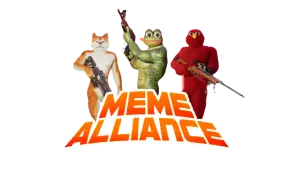
Is there room to coexist or must the meme coin, the inflationary bubble bath of cryptocurrency, be liquidated? Maybe someone has the solution, albeit symbolically: Meme Alliance (MMA) are developing a first person shooter game that plays on the competitive nature of meme coins, the inherent competition between breeds and species of meme coin, and gamifies it, pitting individuals or alliances against each other in death matches and other formats with native tokens as rewards. Tokens that can be spent on weapon upgrades, NFT skins, assets and so on within the Game-Fi ecosystem. If the concept kicks off and coins are somehow burned at an apocalyptic rate, it might actually be fun.
references
Dawkins, Richard. The selfish gene. Oxford: Oxford University Press, 1989.
Huxley, Aldous. Brave New World Revisited. United Kingdom: RosettaBooks, 2011. m
Ngai, Sianne. “The Cuteness of the Avant‐Garde.” Critical Inquiry 31.4 (2005): 811–847. CrossRef. Web. 2 Mar. 2013.
bibliography
Dawkins, Richard. The selfish gene. Oxford: Oxford University Press, 1989
Huxley, Aldous. Brave New World Revisited. United Kingdom: RosettaBooks, 2011.
Kind, / Library. “Understanding Sianne Ngai’s ‘the Cuteness of the Avant-Garde.’” Library Kind, September 27, 2021. https://librarykind.wordpress.com/2017/07/20/understanding-sianne-ngais-the-cuteness-of-the-avant-garde/.
Nani, Albi. The doge worth 88 billion dollars: A case study of dogecoin. Accessed January 19, 2024. https://journals.sagepub.com/doi/pdf/10.1177/13548565211070417.
Ngai, Sianne. “The Cuteness of the Avant‐Garde.” Critical Inquiry 31.4 (2005): 811–847. CrossRef. Web. 2 Mar. 2013.





