
Welcome back to Cryptoinsubria! Today we start the long ride through all the coins that were used for two and a half millenia before Bitcoin in the region known as Insubria, in the wonderful Italian Region of Lombardy.
The first coin that appeared in the Insubrian lands at the very beginning of History was named Dracma. Before telling its characteristics we need to understand which was the social and political situation in the region at those times. According to the most shared historical theory, from the II millennium B.C. until the end of the Bronze era various Celt – Gallic populations migrated from Southern Gaul to Northern Italy, and the Insubres (in latin) tribes were among them. They settled down in the area limited by the Alps in the north, the Po river in the south and the great alpine lakes from west to east.

The first coins started to circulate in the area only in the V century B.C., in the centuries before the Insubri had merged with the pre-existing local cultures (Golasecca Culture in particular) creating a new original culture that is believed to have founded the city of Milan, at the beginning of the VI century B.C. Around the half of the first millennium B.C. the Insubri had built an oligarchic society, they used an alphabet similar to the Etruscan alphabet widespread in northern Italy and they had established commercial routes with the other populations of the area (Etruscan, Venetian and Gallic). As in many other places before, the growth of trades favored the evolution from barter to the use of coins. The coins of nearby southern Gaul were for sure the best example for them to imitate, in fact the Insubrian dracmas, as all the other dracmas circulating in northern Italy, were an imitation of the greek dracma minted in Massalia (Marseilles), a Phocaean colony founded around 600 B.C. in southern France, by people coming from the Greek region known as Ionia. The dracma of Marseilles was in turn an imitation of coins minted in Sicily and Magna Grecia (the Greek colonies of southern Italy). The meaning of the word “dracma” dates back to the period that preceeded the introduction of coins, a dracma was the amount of “obelói” that it was possible to hold in one hand, normally six. An obelói was a metallic spit used as medium of exchange before coins. The insubrian dracma was a silver coin of a decent alloy (more than 600 millesimals of silver), with a diameter of at least 0,6 inches and an initial weight of about 0,03 ounces.
According to the valuable studies of Mr. Pautasso there were almost 10 different types of northern Italian dracmas and they were all characterized by the head of the goddess Diana on one side and a monster lion on the other side. The minters used to copy the Greek letters meaning Massalia but they did a lot of mistakes, due to their poor ability and poor knowledge of the Greek alphabet.
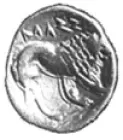
The Insubrian dracmas, as most of the dracmas from the western part of the region, further away from Massalia, were quite rough: the lion often resembled more a dog with a hanging tongue and the face of Diana was not as accurate. The silver roundels were also quite irregular, clearly cut with shears from metal stripes. A large number of Insubrian Dracmas was found in Cornwall, in southern England, they were probably used to pay the pond extracted in the local mines and traded with the populations of Insubria.
Gallic dracmas were used until the first century B.C., when the whole region had been completely incorporated in the Roman Republic and Roman coins started to be used.
Next time we will discover the secrets of the “oboli”, used as fractions of the dracmas by the Insubri and all the other Gallic populations in Italy.
Stay tuned!






