
This sounds weird, but it is a reminder: downsides are not obstacles to keep you from moving, they should be regarded as necessary steps to keep moving. To say you should never sell your crypto is weird though, at least you have a life to live. But, does it make sense to sell? So what's the catch?
You just have to Hodl, it is like closing your eyes and knuckling until coinmarketcap turns green.
Here is why you should never sell that hard earn crypto.
- You believed in the project and how it will redefine the future. For example Vechain.
- You want that "bag", and make money with your investment in that project.
Definitely, those are the two mean reasons people invest in crypto.
Who should judge you, everyone has their goals.
Let us explore some strategies you can take and compare the profitability. This way, you can sleep knowing that crypto deserves to be there. Remarkably, crypto hasn't managed to shake stock market moves. Because fear in the stock market almost always translates to fears in crypto. Recap the last two years. Relatively, altcoins rise and fall based on Bitcoin's performance. So if Bitcoin is the sun, that shone a light on altcoins, so we can still profit from any crypto... but no! hype, FOMO, or a billionaire tweet can moon an altcoin to extreme heights, that will be a big deal, but don't forget it wins in the long run. What's more intriguing, Bitcoin alone is projected to a $200,000 per coin by the end of 2022. But that's not financial advice. Call it a powder keg that could explode to 10X based on the fact that 75% of bitcoin's whole supply is being stored in cool storage. Basically, this is because bitcoin's supply is limited to 21 million coins. A lot of people feel they missed the good old days of bitcoin, studies also prove if you miss out on the ten best performing days in an asset's history, your return is dramatically decreased. Because your return can go from positive to negative. Theoretically, the ten first days of an asset will yield a profitable portfolio in the long run with lesser investments cost than a portfolio one year later. Returns decreases as the value of an asset increases. Undoubtedly, that's why some influencers like Robert Kiyosaki will want to buy way less cheap bitcoin.
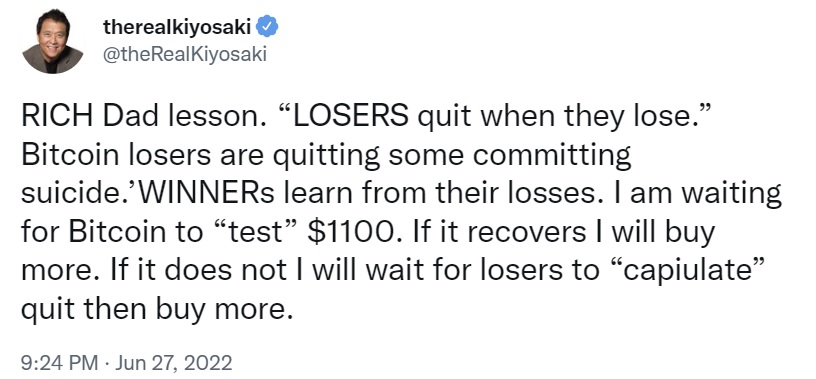
Investors' maximisation of capital is why they turn to buy at cheap prices. Buying and holding at cheap prices turn out to be profitable in the long run rather than buying way up at higher prices. During the first ten days of an asset, a ten-dollar investment could be a golden opportunity when compared to ten-dollar investments after the first year of that same asset, when considering less volatility of that asset.
After this period, investors turn to apply strategies to accumulate more of an asset using the common strategy: dollar-cost averaging, irrespective of currency, unit-cost averaging. This strategy helps an average investor to comfortably invest over time. The dollar-cost averaging strategy turns out to be unprofitable with high volatile markets since an asset can lose ninety per cent of its value within a short period of time.
To this effect, some other investors term themselves traders and will argue day trading is the only way to make a real profit. This can work only when you are familiar with one asset and its price movements. Consider the time to watch and study market movements, what about the stress? This counts a lot, only when they have that dollar amount to be starring on a screen. This will work for some, and the majority will fail since a group of humans will never take the same decisions at one given time. But for most investors, it's just fine fitting into your average Saturday- dollar-cost averaging. Because it takes less work, time, and not timing the market. This will be less work done Saturdays. But there are different strategies for holding.
Some studies challenged the idea that hodling is the best for the long term. Well, it has been true that the dollar-cost averaging theory works because of stock data that has been around for years. But new strategies are out there which may outperform the passive dream of holding.
This study according to Investopedia compares the buy and hold strategy to a strategy called Constant-Mix.
With no ado, read the original setup of the study by investopedia.
How Buy-and-Hold Rebalancing Works
The objective of buy-and-hold is to buy the initial allocation mix and then hold it indefinitely, without rebalancing, regardless of performance. There are a variety of ways to find buy-and-hold stocks. The asset allocation is allowed to vary significantly from the starting allocation as risky assets, such as stocks, increase or decrease.
Buy-and-hold is essentially a "do not rebalance" strategy while acting as a truly passive one. The portfolio becomes more aggressive as stocks rise and you let the profits ride, no matter how high the stock value gets. The portfolio becomes more defensive as stocks fall and you let the bond position become a greater percentage of the account. At some point, the value of the stocks could reach zero, leaving only bonds in the account.
How Constant-Mix Investing Works
The objective of constant-mix is to maintain a ratio of different asset classes (for example, 60% stocks and 40% bonds), within a specified range by rebalancing. You are forced to buy securities when their prices are falling and sell securities when they are rising relative to each other.
Constant-mix strategy takes a contrarian view to maintaining a desired mix of assets, regardless of the amount of wealth you have. You are essentially buying low and selling high—as you sell the best performers to buy the worst performers. Constant-mix becomes more aggressive as stocks fall and more defensive as stocks rise.
Buy-and-Hold vs. Constant-Mix in Trending Markets
The buy-and-hold rebalancing strategy outperforms the constant-mix strategy during periods when the stock market is in a long, trending market such as the 2010s. Buy-and-hold maintains more upside because the equity ratio increases as the stock markets increase. Alternately, constant-mix has less upside because it continues to sell risky assets in an increasing market and less downside protection because it buys stocks as they fall.
The figure below shows the return profiles between the two strategies during a long bull and a long bear market. Each portfolio began at a market value of 1,000 and an initial allocation of 60% stocks and 40% bonds. From this figure, you can see that buy-and-hold provided superior upside opportunity as well as downside protection.
Buy-and-hold vs. constant-mix rebalancing. Image by Julie Bang © Investopedia 2020
Buy-and-Hold vs. Constant-Mix in Oscillating Markets
However, there are very few periods that can be described as long-trending. More often than not, the markets are described as oscillating. The constant-mix rebalancing strategy outperforms buy-and-hold during these up and down moves. Constant-mix rebalances during market volatility, buying on the dips as well as selling on the rallies.
The figure below shows the return characteristics of a constant-mix and buy-and-hold rebalancing strategy, each starting with 60% stocks and 40% bonds at Point 1. When the stock market drops, we see both portfolios move to Point 2, at which point our constant-mix portfolio sells bonds and buys stocks to maintain the correct ratio. Our buy-and-hold portfolio does nothing.
Now, if the stock market rallies back to its initial value, we see that our buy-and-hold portfolio goes to Point 3 (its initial value), but our constant-mix portfolio now moves higher to Point 4, outperforming buy-and-hold and surpassing its initial value. Alternatively, if the stock market falls again, we see that buy-and-hold moves to Point 5 and outperforms constant-mix at Point 6.
Image by Julie Bang © Investopedia 2020
To summarise the set-up, the study split into two groups of investors. Group one; the Hodlers, bought a ratio of stocks and bonds at a 60-40 split, and hold them irrespective of the market movement. Group two, the Constant-Mix, bought also the same ratio of stocks and bonds at a 60-40 split, and would constantly rebalance the portfolio right at 60-40. So when stocks go down, they move some bond money over the stocks to get the value back up to 60%, and vice versa. The end goal is a positive result with rebalancing. Nevertheless, the buy-and-hold strategy is profitable in the long run for a trending market. For an oscillating market, where the market is unpredictable. That is; reversals followed by surges in price and also when the market is unpredictable, Constant-Mix beats out hodling per the study. Treat Constant-Mix like buying dips and selling tops or profits.
This study is applicable in the cryptocurrency market since crypto correlates with stocks and is characterised by a trending and oscillating market. Price surges and reversals have been unpredictable as in the past years and to that effect, crypto has been an oscillating market.
The reason being is we're emotional if your goal is to maximize your profit, it seems like committing to a portfolio balance could be the right way to go.
How could this strategy be applied to crypto?
This strategy is suitable for stocks and bonds because these assets move in opposite directions as seen in the illustrations above. The illustrations indicate one asset consistently outperforms the other, this is because investors put their money where market conditions are favourable. The stock and bond market are two different types of markets reason why they move in opposite directions. The Constant-Mix strategy is suitable for these two markets. This is not the same for crypto as stocks and bonds. But take bitcoin and altcoins, stocks and bonds, it is not still going to fit into a constant rebalancing strategy like stocks and bonds. This is because, as bitcoin moves, altcoins follow in the same direction.
- Let's compare crypto by blockchain since community-led crypto has been the norm in the space and one type of crypto will outperform in a short period. These are just basic thoughts, because, technically it will be difficult to have a basket of crypto that will never correlate in the long run.
- Also, take -Lending and apply the principles of a rebalancing strategy by allocating 60% on stablecoins where you earn a given percentage, and 40% on crypto, simultaneously lending on one protocol, with self-defined goals and rebalancing the 60% and 40% within a defined period. I tried this strategy manually on midas.investments and my goal were to acquire more bitcoin with a minimum amount while not having exposure to my stablecoin holdings and some crypto coins given they appreciate to a maximum level of my goal, then I will swap it for bitcoin. Though, it does work to have more of your preferred asset without losing more of your capital. But crypto is too volatile, and the risk might turn out to be high during surges and reversals. Seems it can be more effective when the market is less volatile.
This Constant-Mix strategy can be applicable in crypto for a random crypto portfolio.
Here is the case with pionex, it has a bot which will auto-rebalance your portfolio with ten different coins. On the pionex dashboard, you just have to click rebalance bot, (then multi-coin mode customise and choose your favourite coins, choose the amount you will invest, click advanced settings and turn on auto rebalance, then your constant-mix will be rolling in per your settings. They also offer a suite of trading bots easily set up with few clicks.
After all these strategies, when should you sell your crypto?
Making money investing has an end goal, which is doing the things you like. But when it comes to assets you believe in like crypto, it doesn't make sense to sell. Crypto is so diverse, that we could sell and still have it. It can be done For example, on crypto exchanges, lock up some crypto and then borrow against it, this is common in DeFi. DeFi is very simple, you can have your crypto and still spent it.
If you learned something new, then don't forget to smash the subscribe button, it's free and you can always change your mind later.
And don't forget, your comment is a treasure for me
Thank you so much for your time and stay tuned for more information.
Support me on cointr.ee
Let's crypto on twitter.
Affiliate Disclosure: Clicking on links on this post and performing a task will get me a kickback, you're indirectly supporting me and it doesn't affect your performance on the site.
Check out my Passive Income Bundle
Invest with the best CeDefi platform👉 Midas.Investment
Stake BFG to earn: BTC, ETH, BNB, UST and TRON
Mine STARS to earn BTC, BNB, ETH and TRON.
Auto rebalancing portfolio bot on pionex






