The Mantra (OM) blockchain cryptocurrency collapsed, losing more than 90% of its value in less than two hours on the evening of April 13. The project team stated that the negligence of the partners or their deliberate actions on centralized exchanges could be behind the collapse.
The drop in the OM price began on April 13 at $6.13 per token. Then, in 2 hours, it dropped by about 8%, to $5.62, according to the Binance exchange. After that, OM quotes lost almost 94% within an hour and a half, dropping to $0.375.
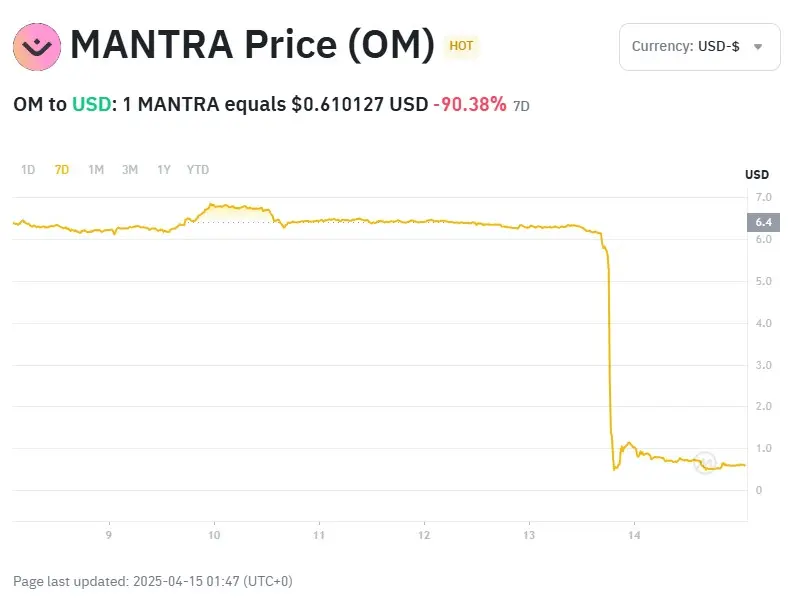
On April 14, the token price recovered to $0.77. The historical maximum of the OM price was fixed at $9.17 at the end of February 2025.
The token is also known for becoming the absolute leader in price growth among the 100 largest coins by capitalization in 2024, with an indicator of more than 6,300%.
"Today's activity was caused by reckless liquidations and is in no way related to the project. We want to make it clear that it wasn't our team. We are studying this and will share the details of what happened as soon as we can," the project team's account on X reported.
Liquidations occur when the exchange forcibly closes a trader's position at a loss if the market goes against his bets. This happens when a trader is unable to meet the collateral requirements for a leveraged position, meaning he does not have enough funds to keep the trade open.
Mantra co—founder Patrick Mаllin suggested that the collapse was triggered by forced closures of trading positions (liquidations) on centralized exchanges:
"When discretionary powers are exercised without proper internal and external oversight, such unrest can and will occur, harming both projects and investors," Mallin quotes Decrypt.
OM representatives also rejected accusations that developers could have been behind the collapse. They added that all the crypto assets allocated to the team are located on blockchain addresses that are accessible to everyone for verification.
"All team tokens remain in storage. We are actively investigating why these massive forced liquidations occurred and will provide additional information as soon as possible. We're here and we're not going anywhere," Mallin wrote.
The developers position the project as a secure blockchain network for applications and for tokenization of real world assets (RWA), which can flexibly adapt to regulatory requirements. The team is targeting the Middle Eastern market and, according to its own data, already has experience in tokenizing investment assets related to real estate in Dubai.
The platform is powered by the Cosmos SDK toolkit, and the team claims that the Mantra blockchain network is capable of processing up to 10,000 transactions per second. OM serves as a management token in the decentralized organization Mantra DAO and can be used to generate additional income from staking.
Who sold it.
Lookonchain's on-chain analysts tracked that 43.6 million OM (about 4.5% of the issue) were transferred to exchanges a day before the collapse, including from addresses associated with the strategic investor of the Laser Digital project. At the same time, the main wallet, which accounts for about 90% of the OM supply, remains inactive. And the unlocking of the team's tokens has not yet begun.
Lockonchain also suggested that the addresses may be linked to the founder of the UAE venture capital firm Shorooq Partners, Shane Shin, who is on the Forbes list of the best venture capitalists in the Middle East in 2024.
A few days before the collapse, Mullin touted Mantra's strategic partnership with Dubai-based development company DAMAC in an interview with crypto.news. He noted that DAMAC "recently committed to tokenize over $1 billion in real estate in Dubai," Mallin told the publication.
The head of the Castle Labs development company, under the name Insomniac, also identified three wallets that have sent millions of dollars worth of OM tokens to the OKX and Binance exchanges in recent days. However, without identifying the names that could be behind the collapse.
The head of one of the largest OKX crypto exchanges, Star Xu, commenting on the incident, said that this was "a huge scandal for the entire crypto industry," noting that all data on the movement of tokens and deposits on exchanges is publicly available. All collateral and liquidation data on centralized exchanges can be examined. Xu also assured that OKX will prepare all the necessary reports.
Experts also point out that a collapse could undermine confidence in the RWA sector as a whole.
According to Hank Huang, head of Kronos Research, "incidents like this test investor confidence and raise the important question of how to ensure greater security of tokenized assets for their mass adoption."
Be careful and please take care of yourself!






