The creator of Ethereum, Vitalik Buterin, has published a new blog post with a long-term plan to "simplify L1," that is, the first-tier Eth network. In general, the developer strives to make the project as efficient as possible with the simplicity of the Bitcoin level.
As part of this plan, Ethereum's EVM needs to be replaced with a fundamentally new system during the four transition phases until 2030.
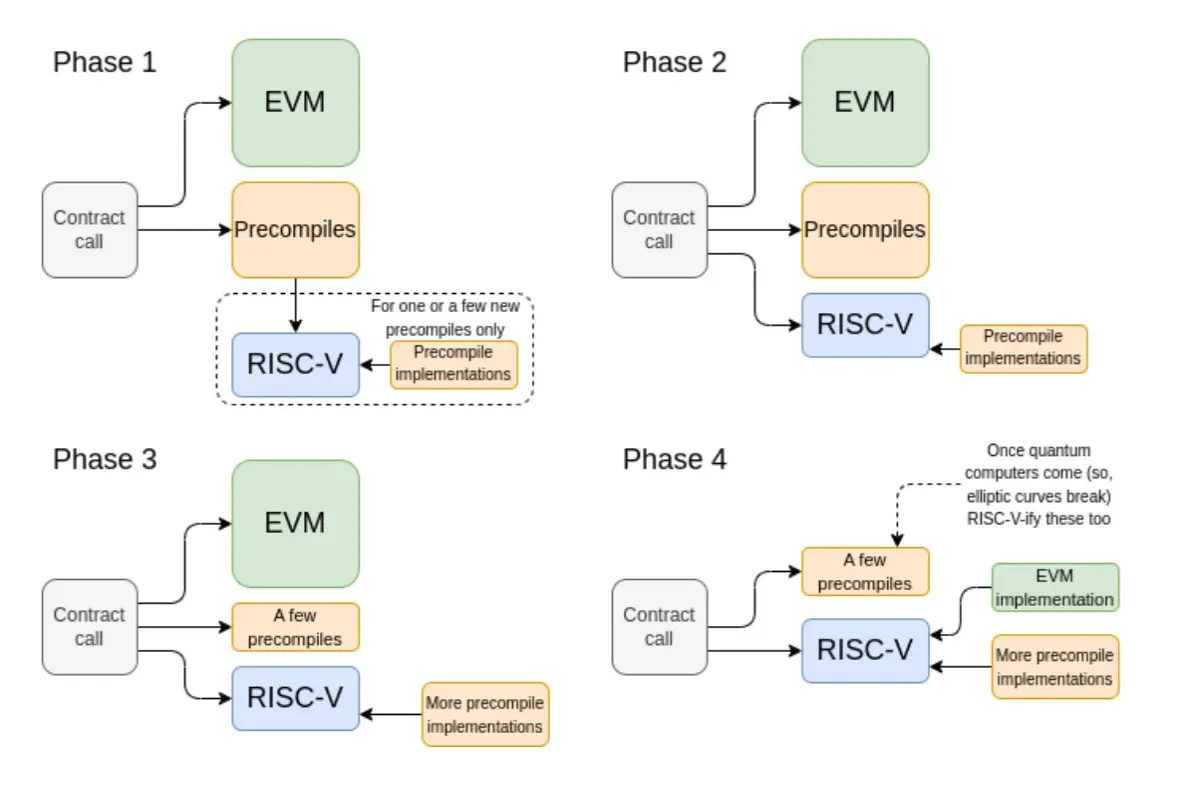
(Phases of the large-scale upgrade of the Ethereum network)
According to Decrypt sources, Vitalik proposed replacing the Ethereum Virtual Machine (EVM) with the RISC-V architecture in order to improve network performance and simplify its structure.
Thanks to these changes, Eth can "become almost as simple as Bitcoin" within five years. Here is the relevant remark about this.
"One of the best qualities of Bitcoin is the simplicity of its protocol. There is a chain consisting of a number of blocks. Each block is linked to the previous block using a hash. The validity of each block is verified using proof of work, which means verifying that the first few bytes of its hash are zeros."
What is EVM and RISC-V: briefly about technologies
EVM (Ethereum Virtual Machine) is a software environment for running smart contracts and decentralized applications on the Ethereum blockchain. It works as a distributed computer without centralized management. EVM is one of the key elements of the success of Ethereum.
Thanks to open standards, other blockchains have also implemented EVM support — BNB Chain, Avalanche, Polygon, Arbitrum, Optimism, and others. This allows developers to easily migrate applications (dApps) between networks. In contrast, blockchains such as Solana, Aptos, and Sui use their own virtual machines and are incompatible with EVM.
RISC-V is an open processor architecture suitable for both smartphones and supercomputers. It is modular, scalable, and gives developers the flexibility to create hardware solutions for specific tasks.
RISC-V has already been used in the development of blockchain networks. One of them is Polkadot (DOT), founded by English computer scientist Gavin Wood. He is also the co-founder of Ethereum and one of the founders of EVM technology, on the basis of which the Ethereum blockchain network operates.

According to Buterin, the simplicity of the protocol provides important advantages such as trust and neutrality on a global level. Switching to RISC-V involves using an open instruction set that defines exactly how the software interacts with the processor.
For Ethereum, this would mean reducing intermediate processing steps, speeding up the network, and allowing applications to run directly at the executive level. Some operations could become a hundred times faster, while existing smart contracts would continue to work.
In contrast, EVM is designed specifically for Ethereum and requires additional conversion steps, which slows down the process.
RISC-V, according to Buterin, is able to process operations directly and is easier to understand, which may increase the number of people able to participate in the development and research of the protocol.
If Ethereum switches to RISC-V, it can also reduce "the cost of building a new infrastructure", reduce "long-term protocol maintenance costs, the risk of critical errors and other vulnerabilities."
Buterin admits that he had previously failed to simplify Ethereum for a number of reasons. His quote was as follows.
«Historically, Ethereum has often been deprived of the aforementioned benefits — sometimes because of my own decisions. This has largely contributed to excessive development costs, all kinds of security risks, and a closed-minded culture of research and development, often in pursuit of advantages that have proven illusory».
However, Vitalik's ambitious plans have found their critics. For example, Kronos Research analyst Dominic John commented on Buterin's post as follows.
"The proposed update may break backward compatibility, require extensive retraining of developers and rely on immature tools. In addition, process management requires consensus among disparate ecosystem participants, which is a major coordination challenge."
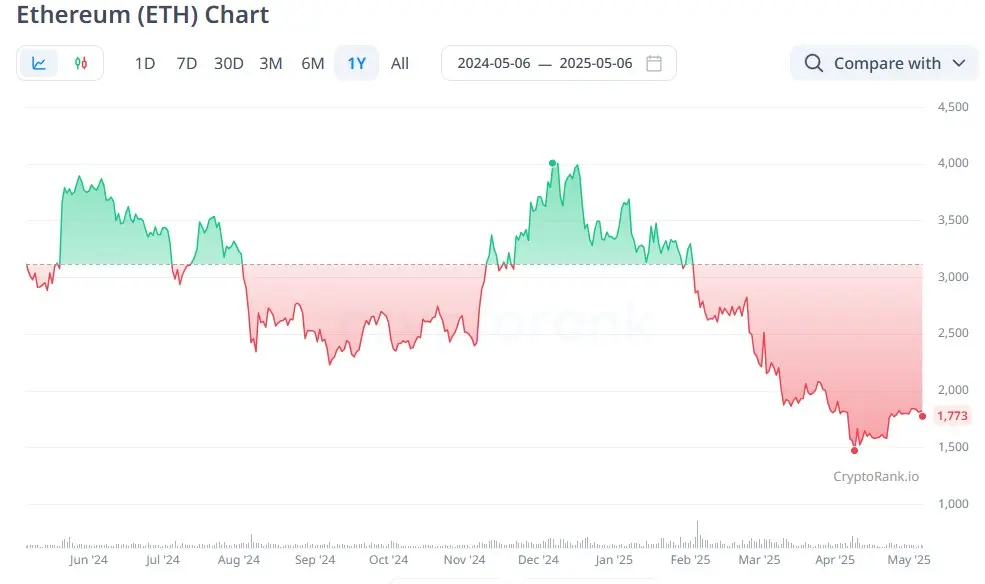
(Changes in the Ethereum exchange rate over the year)
Nevertheless, some experts see the prospects for Ethereum, and they are not even afraid of the weak profitability of the altcoin. One of them was Galaxy researcher Ted Pinakevich. He said the following.
«Price is not an indicator of technological maturity. Ethereum does not fail because of its stable price. He succeeds because he builds an infrastructure that others copy».
Today, ETH is valued at $1,773. Since the beginning of 2025, it has fallen in price by 45 percent, while Bitcoin has grown by 1 percent. Accordingly, the criticism of Ethereum did not exactly form out of the blue.
Vitalik Buterin's new plan
As part of the update, Buterin suggested using "one standard for different parts of the stack" as a way to simplify. For example, he suggested using the same erasure correction code for random data availability verification, P2P relay, and distributed history storage. According to the developer, this will reduce the number of lines of code, increase efficiency and ensure verifiability.
Similarly, he proposed a single serialization format for the three levels of Ethereum: execution, consensus, and the Smart Contract Calling Interface (ABI). It was also suggested to use the SSZ format, which is easily decoded and widely used in development.
Finally, after replacing EVM with RISC-V or another simple language, Buterin suggests switching from a Merkle Patricia hex tree to a binary tree for both consensus and execution levels. This transition, he said, will increase efficiency, reduce costs, and allow the same code to be used to access all levels of Ethereum.
In conclusion, Buterin suggested that Ethereum set an explicit limit on the number of lines of code. More importantly, Ethereum must accept the principle that, all other things being equal, the simpler option is chosen. This means preferring local complexity over systemic complexity.

(Creator of Ethereum Vitalik Buterin)
"The code related to the processing of the historical rules of Ethereum will still exist, but it must be located outside the consensus-critical areas. At the same time, we must adhere to a common approach: choose simpler solutions whenever possible, preferring isolated complexity over systemic complexity, and make design decisions that ensure clearly legible properties and guarantees." - noted Buterin.
Buterin's plans are not just a technical upgrade, but an attempt to rethink the architecture of Ethereum for decades to come. Making the network simpler, more reliable, and more scalable is an ambitious task, but it is quite logical for a project that aims to be a technological benchmark for the industry. Especially considering the difficulties he's facing.
Pectra
In addition, one of the largest updates in the last few years, called Pectra, is scheduled for the Ethereum network on May 7. Although it was originally scheduled for the end of April, it was postponed due to a number of technical difficulties during the testing phase.
The Spectra is divided into two main stages. The first one, which will take place on May 7, will include mechanisms for reducing fees in the main network and the so-called second-tier (L2) networks such as Arbitrum, Optimism, zkSync, and Starknet. It is also planned to include the Account Abstraction function, designed to introduce the possibility of paying transaction fees in tokens other than ETH, such as USDT, DAI or USDC.
The second stage is expected in 2026. It was assumed that the changes would affect the Ethereum virtual machine in order to make smart contracts more efficient, and technologies to increase second-level scalability by reducing network loads. However, it is now unknown how the old plans will be implemented in connection with Buterin's new proposal to radically change the architecture.
Such changes to Ethereum will require a broad consensus among a huge community of stakeholders, which is a major challenge, said Dominic John, an analyst at Kronos Research for Decrypt. And the proposed changes themselves may require retraining of developers.
Despite large—scale plans, since the beginning of January, ETH quotes have fallen by more than 45%, to $1.773 - this price level was observed earlier, at the end of 2023. For comparison, the price of bitcoin increased by about 250% over the same period, to $95 thousand. The capitalization of the entire crypto market as a whole has more than doubled over the same period, according to Coinmarketcap.
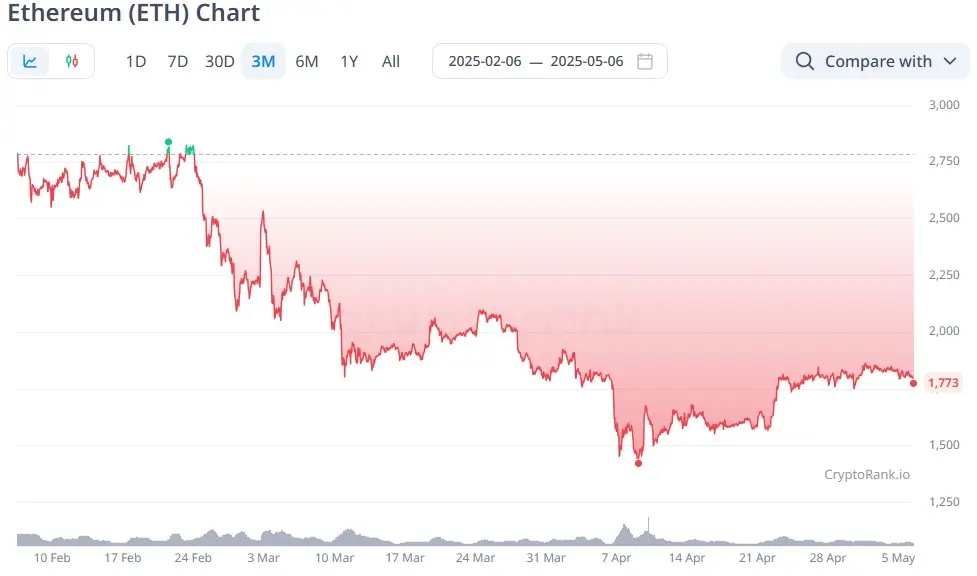
(ETH chart)
However, experts suggest not focusing on the price.
"Price is not an indicator of technological maturity. The fact that the price of [ETH] is not rising does not mean that Ethereum is failing. On the contrary, it [Ethereum] is developing because it is laying down an infrastructure that others are copying," Tad Pinakievich, a researcher at Galaxy investment company, quotes Decrypt.
We'll wait and see.
Be healthy and please take care of yourself.






