
Good day everyone,
I hope you are all well and having a great day, welcome to CryptoGod-1's blog on all things crypto. Today I am doing a write up on what I consider to be an interesting topic amongst the crypto community, and even the global audience. Ponzi schemes. Crypto has been plagued with Ponzi schemes over the last couple of years, especially in the bull market, and with prices having taken an upturn again of late it is important to remind ourselves of these dangers. Moreso, its important to consider alternative solutions to remove these schemes and bad actors from the space, although that is easier said than done.
Ponzi Scheme
Back in the 1920s a swindler by the name of Charles Ponzi marketed a high-returns program to investors. This program promised investors returns of up to 50% within 45 days or 100% interest within 90 days as part of his leveraged postal reply coupons plan. As promised, the first group of investors got their returns, although the money they had been paid was in fact from the next group of investors. A new cycle was created by Charles, where one group is paid their profits from the next groups investment, while the creator takes their bit off the top. The Ponzi scheme. Charles had managed to continually lure in new investors and managed to steal over $20 million, becoming the most famous person to use this technique of theft and fraud.
As noted, a Ponzi scheme is a fake investment program that promises astronomical gains. It does so by using money collected from new investors to pay early investors. This gives the scheme a sense of legitimacy which draws in new investors. To maintain the scheme a constant flow of cash coming in is required, therefore new investors are always needed to keep it going. This means when the new recruits drop or when a large amount of investors withdraw their investment, the scheme often fails.
Ponzi's also have the major issue of the originator disappearing with the funds and remaining assets as investors have issues trying to withdraw funds, finally realising they were duped. These schemes are notorious for enticing victims by leveraging their mastery or superior knowledge of a “new technology” as a selling point for targets, with the promises of getting rich quick too desirable for some to ignore.
Crypto has become a prime target for new age Ponzi schemes. Some of the average investors do not full understand the technology or what they are really investing in. Instead of evaluating a cryptocurrency for its investment potential, many crypto projects are unregulated and having anonymous founders meaning there is no real way for potential investors to do research into earnings, third-party research reports, etc. Scammers can therefore claim to be experts and present themselves as such, capable of 'taking care' of the difficult tech and learning curve. Sky high returns will be promised for ones investment while assuring there is no need for a user to understand exactly how those profits are made. They’ll point to impressively built websites and talk up the intelligence of the team behind the project.

Generic Ponzi Scheme Red Flags
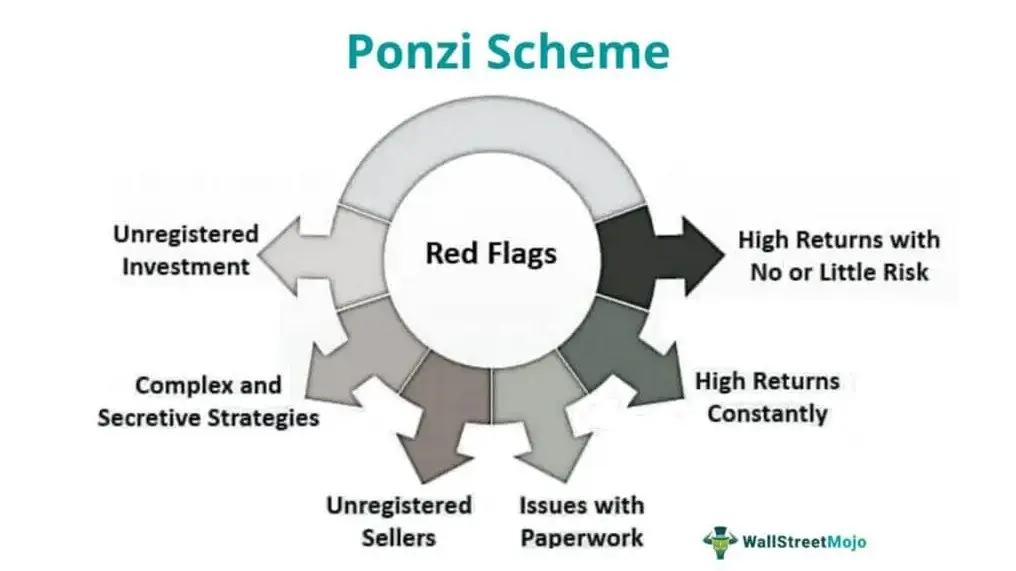
There are certain characteristics which are common to most Ponzi schemes. Some of these warning signs which users should evaluate before investing in a project are:
High Returns With Little to No Risk - All investments have a certain amount of risk, with the higher the return often associated with a higher risk. Those that claim there is no risk or its a guarantee are one to be highly suspicious of.
Overly Consistent Returns - Like the crypto market itself, investment returns are often volatile. Any investment which generates returns regardless of market conditions is worth being sceptical about.
Unregistered Investment - Caution should be taken when considering an unregistered investment. Most Ponzi schemes involve investments which are not registered with the SEC or with state regulators. Registration provides the investors with information regarding the company’s management, products, services, and finances.
Unlicensed Sellers - All investment professionals are required to be licenced and / or registered before engaging in services according to most countries laws. Those who work without the requirements should be treated as bad actors in the space.
Secret and Complex Strategies - It is important to understand what you are investing in and if you cannot understand them, or get the required information to understand them, then it is a dangerous investment to make.
Paperwork Issues - Errors such as account statements can be a tell-tale sign that the funds are not being invested as instructed or promised.
Withdrawal / Payment Difficulty - If a due payment does not arrive and there is difficulty in cashing out, this can be a sign that the investment is a Ponzi scheme as often the promoter prevents participants from cashing out, doing so by offering even higher returns if they remain invested.
Famous Crypto Ponzi Scheme's
There have been many Ponzi schemes in the crypto space over the years, but I will be focusing on some of the more famous and well known ones. Some of the Ponzi schemes to have taken place in the crypto space include:
- Bitconnect
- One Coin
- GainBitcoin
- Plus Token.
- Mining Max
- Terra / Luna (Potentially)
- Anchor Protocol (Potentially)
- Celsius (Potentially)
Bitconnect
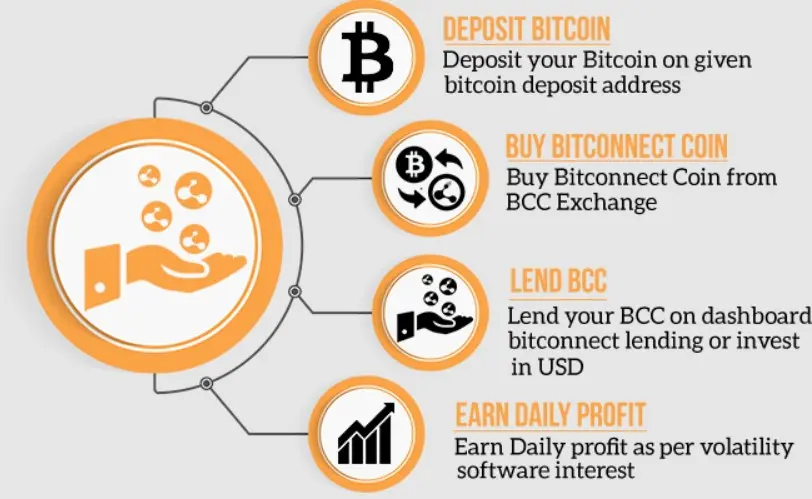
Back in 2016 the Bitconnect Ponzi came on the market. It encouraged investors to purchase its BCC coins and lock them up on the platform. In doing so it allowed its “sophisticated” lending software to trade the funds and promised investors a return of up to 120% per year. Notice and flagged by many, including Ethereum co-founder Vitalik Buterin, the scheme was taken down by the U.S. and British authorities, who declared it a Ponzi scheme. It was closed in 2018 which caused the value of the BCC coin to plummet, and in doing so cost investors billions of dollars in loses.
One Coin
The OneCoin scheme was created by Ruja Ignatova in 2014 and based on a highly centralised network. The scheme was a pyramid scheme which ran until 2019. Investors paid into the idea but the scheme did not do as promised, and relied on its own internal servers to run the ploy and even lacked a blockchain. That made trading of OneCoin difficult, as it could only be traded on OneCoin Exchange, which was its native marketplace. These trades were for cash only, and were done via wire transfer. The marketplace also contained a withdrawal limit, meaning investors could not withdraw all their funds at once. Many members of the organisation were arrested in 2019 when the operation came down, however there is an outstanding federal arrest warrant for Ruja Ignatova, who is still at large.
GainBitcoin
This scheme was created by Amit Bhardwaj along with his seven primary recruiters back in 2015. It made use of a pyramid style system where Amit was at the top and his 'seven stars' just below him. The 'seven stars' were based not only in India but all around the globe and were tasked with recruiting investors into the network. There was a guaranteed 10% return on investments of Bitcoin-on-Bitcoin deposits over an 18 month period. The flaw in the scheme was down to the finite amount of Bitcoin in existence, and while many realised this, it was only clearly apparent after they had invested. Allegedly the scheme collected between 385,000 and 600,000 BTC from investors. Amit died of a heart attack in 2022.
How to Spot a Ponzi in Crypto
This is one of the most difficult things for investors in the crypto space. Like many, the desire to invest and be part of the 'unrivalled gains' is almost too strong to resist at times. However this leads to a dangerous situation where scammers are ready to pounce and exploit those who are not well seasoned in the space, and even some investors who are. There are however some warning signs which any investor in the crypto space, whether brand new or well versed, should spot in terms of avoiding a Ponzi scheme. (many of these are similar to the points as listed above)
- Very High Returns With Little to No Risk
- Low Volatility
- Secretive Strategy
- Lack of Liquidity
Similar to the list earlier in the article, these are clear and obvious warning signs which apply to crypto the same as they apply to any investment. One additional factor which users should look out for is the lack of liquidity. While certain assets are illiquid by nature (start-up investments, real estate, etc.) cryptocurrencies are not. They require liquidity to maintain their value. If there is little to no liquidity in a project, the investor needs to be fully aware why it is like this. There should inform themselves in as clear a manner as possible, while also learning when the investment should expect to be liquid.
Regardless of the technology behind a project, investors NEED to be aware of what they are investing in, and just as importantly how the investment works. Whether it be a locking up period, a staggered release of funds, withdrawal limits, or vesting periods, an investor should be fully aware of the structure they are investing into. There should also be an expectance of volatility, as is often the case with any disruptive and technology-based asset.

How to Tackle and Remove Ponzi's from Crypto
First of all, this is easier said than done, if it is even easier to do at all. Can Ponzi schemes ever be fully removed in life? Don't the scammers just find new ways to scam? I'm not a financial advisor nor would I claim to be one, but I do enjoy researching and learning about these sort of things. There will always be those who look to exploit others, but one thing that is likely to happen with crypto is regulation. Whether in favour of it or not, some sort of regulation is going to be enforced. This will likely reduce the number of bad actors in the space, although not entirely remove them. As always, there are the same red flags to look out for:
-
Zero Downside Guaranteed.
-
Guaranteed xx% yearly ROI.
-
Zero-risk investment.
-
Profits guaranteed.
-
x% profit guaranteed monthly / yearly / daily.
Whether these buzz words or different developed ones replace them, it is always the same minimal risk investment, the minimised downsides, the guaranteed profits, and the lack of volatility which glaringly scream scam.
The best thing investors can do is become wise. The only way to truly beat Ponzi schemes is to be better than them, to spot them and avoid them in advance, and most of all be certain that the product you invest in is legitimate. Looking beyond those generic buzzwords when researching a project can be eye opening. Look at the tokenomics of a project, at the whitepaper, and question it.
What are the on and off ramps into the project for investors?
Is it exclusive and only accessible by those sent 'referral codes' or can anyone participate?
What hoops must be jumped through before purchasing the cryptocurrency?
What has the recent (and expected) market capitalization growth rate of the project been?
Does anything regarding the market capitalization growth rate seem suspicious, or does it feel natural and not inflated?
Finally, remember to always ask 'How? Why? Where? What? when you scan through the information. Consider it yourself from as many angles as possible before deciding if the risk is worth the potential reward.
Ponzi schemes have been around for over a hundred years, and they are unlikely to disappear anytime soon. Crypto has become a hot bed for them, with the unregulated space filled with first time and uninformed investors. Many have benefitted from scamming these investors, while many others have tried. It is therefore extremely important to exercise caution before investing in any project, whether crypto based or otherwise. Only by doing thorough research and being confident and comfortable in the investment can you be more assured you are not part of a pyramid scheme. Question everything and trust nothing without further investigation. There will be regulations, there will be governance, but at the end of the day only YOU can be responsible for your own investments.
Have a great day.
Peace. CryptoGod-1.
*** You can now collect my articles as NFT's thanks to Mirror.xyz. This article will be available as a collectors item for 0.0003 ETH (≈$0.48 at time of publishing prices) with a total supply of 50 available. Any an all support is greatly appreciated and the article is available here: https://mirror.xyz/0xE4e7Fa6b6dcF5551CE96627C819dB3D3266DEbcc/_h2qn7JYeSJi9m3luf6bwL7skZlP6xP7s7R5vgI6lKw ***
Referral Links and Follow Me:






