![Libra vs Bitcoin, the confrontation that makes no sense to exist [opinion]](https://www.publish0x.com/img/30128.webp?action=resize&ar=1&enc=webp&inv=0&ori=1&st=1&up=1&w=1140&signature=7a076f4a59533d8e39ae8e29ccf7d2c157d04efb95a6570e9c8a24310dd16ef7)
A reflection on the foundations of Libra helps us to understand why it makes little sense to associate it with the world of cryptocurrencies
Much has already been said about the new cryptocurrency presented by Facebook, born with the promise of solving the problems of stability, security and scalability of Bitcoin & co., So we will not dwell too much on technicalities. What we want to emphasize with this article are the real differences between Libra and the cryptocurrency ecosystem we know, and the reasons for defining it as a cryptocurrency can be, at least in part, misleading.
To reach this conclusion, we must have a clear understanding of the premises on which Bitcoin is based and then branched off, with different nuances, to many of the virtual currencies born after 3 January 2009 (the day on which the Bitcoin blockchain officially starts).
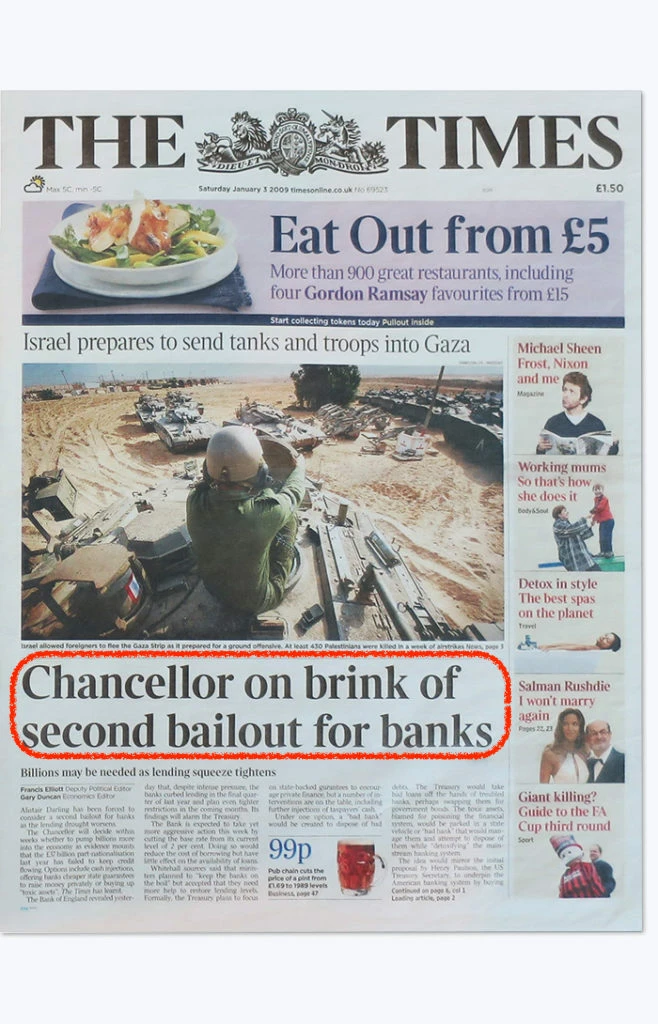
"The chancellor is about to save the banks for the second time" - not everyone will know but it is with these words (in English) that the history of the most famous cryptocurrency in the world opens up. Satoshi Nakamoto - alias with whom the creator of Bitcoin signed, still unidentified - had the brilliant idea of recording the title of the daily edition of the Times on the first block, to indelibly emphasize the reasons behind the creation of this currency: hatred towards banks and, more generally, towards centralized control of money.
The pillars on which Bitcoin is based are five, and we will see how in each of them Libra fails in its attempt to identify itself with the world of cryptocurrencies, in its purest sense.
Public
Each of you can freely participate in the Bitcoin network: from a simple user, with the ability to send / receive value, or from a node, with the burden of taking an active part in validating transactions by registering them in the same blockchain (with the benefit of being able to be rewarded for the work done).
You don't need any identification process, no external consent, no documents, no nothing. The net doesn't even care that you are human. A software can do the job for you and nobody would care.
All this cannot be done with Libra, which has controlled access to the validation part, to which only a few wealthy elected are admitted who exploit their financial power to make money on interest. Furthermore, it will probably be necessary to introduce KYC (customer identification) and AML (anti-money laundering) procedures to participate as a user.
Borderless
As with the internet, there are no borders. Bitcoin can be used anywhere, with a simple internet connection. Countries like Venezuela, Greece, Iran, Argentina and others found themselves discovering this technology to avoid the bad economic conditions of their own country which, in certain circumstances, prevented the citizen from withdrawing their money and / or to convert them into another currency, boosting inflation (in 2016, the Venezuelan bolivar lost 50% of its purchasing power in one day - in comparison, the euro lost on average 2-3% per year ).
It will be difficult for Libra to be equally ubiquitous, given that authoritarian governments (and in general the most nationalists) are usually hostile to the use of foreign coins, whether real or virtual, to maintain control over their own people.
Resistant to censorship (immutable)
With the birth of Bitcoin, money has become information. Some might argue that he had already become one with the first digital payments offered by the banks. True, but between the two there is a substantial difference: if on the one hand we have freedom, on the other we have control and surveillance. The closer the banks are to government agencies, the more there is a risk that they will influence each other.
In a famous media event, Wikileaks suffered the blocking of its bank funds due to the inclusion of the company in the black list (the same one in which Huawei is now located). From that moment on, no American citizen could send economic support to Julian Assange.
Facebook clearly states in Libra's whitepaper that it intends to please all government agencies, respecting the laws and collaborating where necessary. It follows that it will never be resistant to censorship. It couldn't be.
Neutral
The network of Bitcoin validators does not care about who you are, who is receiving your money and what reasons led you to send that amount of money. The only thing that matters is that the transaction is valid and can be inserted into the next block to be completed, so that you can get the reward.
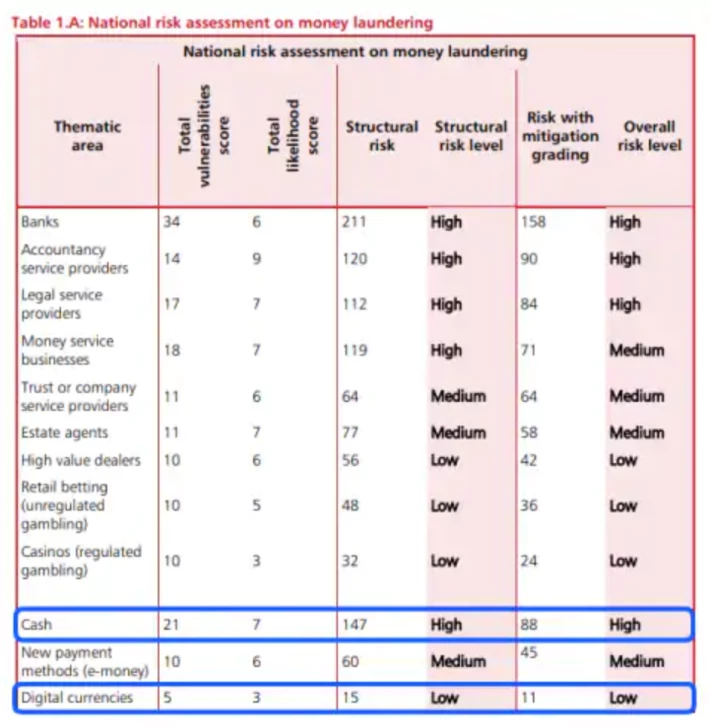
This feature has been one of the most criticized by the media, because it can forage illegal activities such as terrorism and resale of forbidden material on the net. But do not forget that, to date, the most commonly used form of money laundering remains cash, which represents a type of expense that is not traceable and without control. By comparison, Bitcoin can be traced and how, as confirmed by the table below, where digital currencies are placed in the last place as a money laundering risk (British Treasury survey)
For the reasons expressed also in the preceding points, Libra cannot satisfy even this characteristic, since it is obliged to obey the rules present in the countries in which it operates, and to follow the control procedures to identify users and have the power to block them where the law imposed.
Open (decentralized)
This is the central point, and I would very much like to specify: Bitcoin is not just an application for making payments. Bitcoin is a platform. A platform that gives free access to all the source code, so as to allow anyone to build applications on it or to alter its operation at its own discretion.
If you don't like Bitcoins, you can modify it and create a bifurcation in the blockchain. If the majority of users prefer your version, that one will become official, the other will fall into disuse. It's called fork in the jargon.
It is only with this total openness that technological progress can be achieved at the ends (by end users) and not at the center (as happens with proprietary versions of a software). Don't you think it's a benefit? The Internet was born on this principle, and look where it came from.
Libra promises to be open-source and to allow the creation of applications on its own protocol, but this type of opening should not be confused with that which distinguishes Satoshi's currency. Only the nodes of the network can decide if the software needs an update. While in the case of Libra the decision is up to a handful of elected officials, for Bitcoin it belongs to the "people".
Conclusion
Are we trying to discredit Libra? Not at all. What we need to emphasize is that the currency created by Facebook has little to do with Bitcoin and its philosophy. Even the use of the term blockchain is improper if it refers to Libra, since it does NOT have a real chain of blocks, but a simple single structure where transactions are added from time to time, further demonstrating that the Bitcoin blockchain it is important only because of its decentralized and free nature.
If the validators of a network are organized (as in the case of Libra) the chain becomes a redundant and superfluous method for storing transactions, even less than the more classical sequential database.
The real challenge of Facebook and Libra is towards banks, and companies like Mastercard, PayPal and Visa (which, incidentally, we find among the nodes of the network). Once the project is ready to be launched in 2020, the cost to send money between people will drop dramatically.
All this will benefit the end user, who will be able to take advantage of a considerable lowering of commissions for money transmission services, between one country and another, even without a real financial intermediary.
So don't misunderstand me: Libra is a good thing, both because it would lower the final cost incurred by the user, and because it would give some spice and competition in the financial sector, which until now had seen in the banks of players too static and not prone to changes.
The renunciations we mentioned above are all part of Zuckerberg's well-designed plan: less decentralization, less openness and less freedom in favor of greater speed, greater control and greater scalability.
Just give us one pleasure: don't put Bitcoin and Libra on the same level. Purists may get angry. And if you don't trust me, trust its creator, David Marcus.






