
The Blockchain
The system that was invented to order Bitcoin transactions groups transactions into "blocks" and connects them together in the Blockchain.
Blockchain is different from the transaction chain that we have shown previously.
The Blockchain is used to order transactions while the transaction chain tracks the transfer of ownership of the BTC.
In the Blockchain, each block refers to another, and this allows us to identify them according to time: by scrolling the blockchain on the contrary, you can go back up to the first group of transactions that has been performed.

Transactions that are part of the same block are considered to be carried out simultaneously, while transactions that are not yet in a block are considered unconfirmed.
Each node can group transactions into a block and send them to the network by suggesting the newly created block as the next block in the Blockchain.
Since multiple nodes can create blocks at the same time there can be many "next blocks" to choose from.
How do you choose which block is next?
We cannot rely on what comes first because, as with transactions, blocks can arrive in different order on different points on the network.
The order of the blocks is also based here on mathematics.
Each block contains a mathematical problem that needs to be solved.
Computers browse the entire text of a block plus a random number via a HASH until the output is below a certain value.
The HASH function is a mechanism for creating a number (called a digest) from any text.
In our case the generated number is a 32 byte number, generated through the SHA256 function, which is often referred to as a hexadecimal number (these are the numbers that begin with 0x).
Here are some examples from which we can see how the number changes starting from a minimal change of the starting phrase
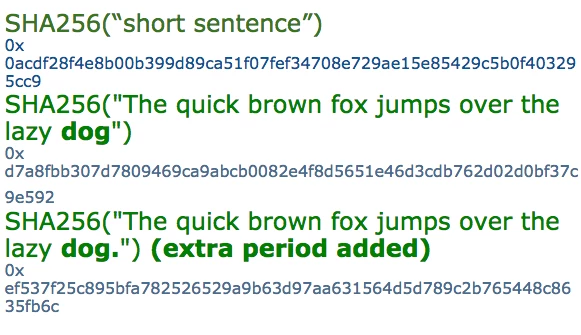
We can see that the output is completely unpredictable, so the only way is to guess.
As with a safe, guessing the random number of a block is not easy and on average it takes many attempts.
In fact, in the Bitcoin network it could take several years for a computer to resolve a single block, but given the large number of computers on the network, the average resolution time of a block is 10 minutes.
The first computer that solves the block forwards it to the rest of the network and that block gets the next place in the Blockchain.
The randomness in the block resolution problem is made in such a way that it is very unlikely that 2 computers will solve the same block simultaneously.
However, it can happen that in different places different blocks are solved at the same time, which leads to the creation of different branches of the blockchain.
In this case, each node behaves normally and continues to insert the blocks following the block they solved.
Everything returns to a single blockchain when the next block is resolved, because as a general rule all nodes adopt the longest blockchain among those available.
It is already difficult for 2 blocks to be solved at the same time, therefore it is very rare that 2 consecutive blocks are.
Let's see an example below:
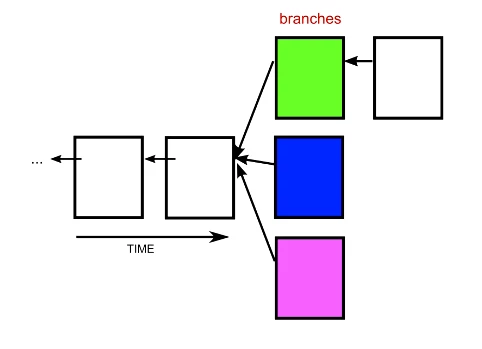
For this mechanism, the blockchain stabilizes and, after a few blocks from the end of the chain, all the nodes agree on the order of the blocks.
Useful/Stonks link ALL TRUSTED:
My Exchange:
- KuCoin Exchange
- Coinbase
- Binance (YOU earn 10% for commission with this link)
Airdrop/Giveaway:
- WinPlay airdrop (multicrypto)
- Coinbase airdrop (50$): EOS- STELLAR
Faucet:
- Free BTC/ETH/DOGE multi-faucet (1 site, three crypto)
- Free Litecoin + Earn interest on holding
- Free Dogecoin + Earn interest on holding
- Free Bitcoin+ Earn interest on holding
- Free Bitcoin Cash + Earn Interest on holding
- Free Ethereum + Earn Interest on holding
- Free Monero + Earn Interest on holding
Cloud Mining FREE:
Earn for internet connection:






