
Proof of work and the generation of new BTC
Nothing we have described so far requires trusting anyone.
In fact, when we receive information on the Blockchain, we can check ourselves that this information is correct.
And since the mathematical problems to be solved are very difficult, we know that there is no way that a single person can attack the network alone.
Solving mathematical problems is proof that the entire computational power of the network has been used, this is called proof of work.
So far we have discussed how BTCs are transferred and how they prove their belonging to a person (address), now let's see where they come from or how Bitcoins are generated.
To transfer the BTCs you have, you have to show as input a transaction where you have been the receiver, but how were BTCs introduced in this transmission chain in the first place?
The block reward
To compensate the node that first solves a block, BTCs are generated, which is why a block's resolution mechanism is called mining.
This is a good way to introduce new money into the system because it is done slowly and gradually but above all well distributed.
Every 4 years the block reward is halved until new Bitcoins are created.
The maximum number of BTC that will be available, when this happens, will be 21 million.
Since the minimum number of transferable BTCs is 1/100 million (or 1 satoshi), the fact that no new ones will be created will not affect the usability of the system.
In addition to the block reward, nodes can optionally also include transaction fees for each block to be processed.
At the moment the transactions are low because the block reward is still high enough to cover the costs of the miners, but in the future the blocks will have different transaction fees and the nodes will probably process the highest ones first, which could lead to transactions with more fees low to be ignored.
Sending money through Bitcoin will not be free but it will probably be even less expensive than doing it through current credit card circuits.
We have already said that a single computer could take years to resolve a block, so the possibility that it will be able to solve it in 10 minutes (which is the average resolution time of the next block by the network) is very low.
What are mining pools
To have a constant profit from the mining activity, many people join groups called mining pools where each contributes its own computational power and the profits deriving from the block reward are distributed according to the contribution made.
This is also reminiscent of the lottery system, where people gather in groups to play together and be more likely to win.
However, some mining pools are very large and can be worth 20% of the computational power.
The fact that they reach such a high percentage can pose safety problems.
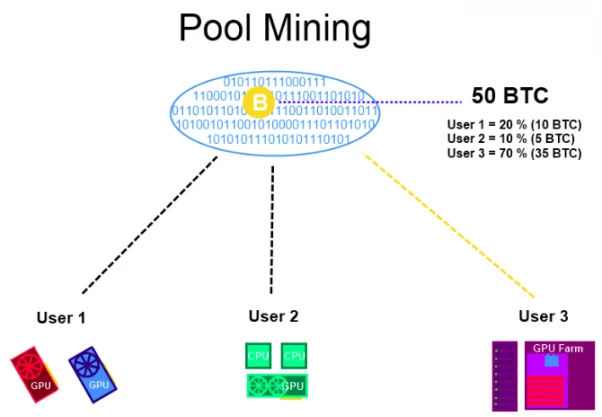
We must always remember that the chance of an attack is infinitesimal by a single person, but increases in proportion to the computational power and this poses a problem with mining pools.
In fact, it has already happened that a mining pool solved 6 blocks in a row, it was the case of BTC Guild which then voluntarily limited its members to avoid security problems for the entire network.
Useful/Stonks link ALL TRUSTED:
My Exchange:
- KuCoin Exchange
- Coinbase
- Binance (YOU earn 10% for commission with this link)
Airdrop/Giveaway:
- WinPlay airdrop (multicrypto)
- Coinbase airdrop (50$): EOS- STELLAR
Faucet:
- Free BTC/ETH/DOGE multi-faucet (1 site, three crypto)
- Free Litecoin + Earn interest on holding
- Free Dogecoin + Earn interest on holding
- Free Bitcoin+ Earn interest on holding
- Free Bitcoin Cash + Earn Interest on holding
- Free Ethereum + Earn Interest on holding
- Free Monero + Earn Interest on holding
Cloud Mining FREE:
Earn for internet connection:






