
You are reading an excerpt from our free but shortened abridged report! While still packed with incredible research and data, for just $20/month you can upgrade to our FULL library of 50+ reports (including this one) and complete industry-leading analysis on the top crypto assets.

Becoming a Premium member means enjoying all the perks of a Basic membership PLUS:
- Full-length CORE Reports: More technical, in-depth research, actionable insights, and potential market alpha for serious crypto users
- Early access to future CORE ratings: Being early is sometimes just as important as being right!
- Premium Member CORE+ Reports: Coverage on the top issues pertaining to crypto users like bridge security, layer two solutions, DeFi plays, and more
- CORE report Audio playback: Don’t want to read? No problem! Listen on the go.
Arbitrum Orbit: Decentralization Unleashed
The foundation unveiled an L3 developer toolkit called Orbit, which is expected to resemble Optimism's OP stack and its vision for a flourishing ecosystem of 'Superchains.' This framework ushers in a new era where developers can craft chains atop Arbitrum One or Nova, known as L3 chains. Its permissionless nature is pivotal, empowering developers to innovate atop Arbitrum's L2 without bureaucratic hurdles.
The suite of use-cases Arbitrum anticipates with Orbit includes:
-
Layer-3 Rollups: Launching chains reminiscent of Arbitrum One.
-
Layer-3 AnyTrust: Launching chains akin to Arbitrum Nova.
-
Customizable Layer-3: Forging unique L3 chains tailored for specific applications, ranging from privacy features to fee tokens and governance.
Arbitrum's focus on adaptability is evident, with Orbit compatibility slated for the impending Arbitrum Stylus upgrade. This will empower developers to create dApps using mainstream programming languages such as C, C++, and Rust. Additionally, the transaction fees on these L3 rollups will be denominated in $ETH, paid to Arbitrum sequencers.
Orbit's Vision for Arbitrum:
Orbit is poised to metamorphose Arbitrum into an Ethereum-like settlement layer. This will accentuate the value proposition of its primary chain and fortify the scalability of the broader Arbitrum ecosystem. Even as Arbitrum continues to explore the best L3 structure, Orbit ensures that dApps leverage heightened throughput and robust L3 bridging alongside Arbitrum's existing network advantages. Initiatives like Xai, a decentralized gaming network, exemplify the burgeoning interest in this direction, with plans to debut as the premier L3 on Arbitrum.
Arbitrum, through its multifaceted product ecosystem and Orbit's innovative thrust, is steering Ethereum's L2 solutions to uncharted territories. It's not just about scaling; it's about crafting a decentralized future where developers have the autonomy to build, adapt, and innovate.
The Optimism team has recently announced the OP Stack, which will allow for the permissionless creation of L2s using a codebase contributed to by Optimism, Coinbase, and other developers. This presents an opportunity for anyone to build modular chains, but it also empowers Optimism's competitors. While the goal of OP Stack is to allow chains to conduct atomic transactions while sharing sequencer sets, there is no guarantee that all chains will opt into this shared security model. This poses a risk to Optimism in that a general-purpose rollup built on its tech stack could potentially steal liquidity and users from the mother chain, and there is no guarantee that these chains will share fee income with Optimism.
In contrast, Offchain Labs, the development team behind Arbitrum, has taken a different approach. Arbitrum Orbit is a development framework designed for creating Layer 3s (L3s). L3s function as "L2s for L2s," meaning they are rollups that settle on another L2 rather than an L1. While maintaining the security guarantees of an L2, L3s have the potential to deliver a significant increase in scalability, as throughput compounds at each layer of the stack. They are granting IP rights for the creation of L2s to the Arbitrum DAO, while allowing for the permissionless creation of L3s with the Orbit program. This approach separates IP between permissioned L2 deployments and permissionless L3 deployments, giving Arbitrum and L3 developers the best of both worlds. The DAO has the ability to dictate terms and may even elect to prohibit L2 competitors from forking Arbitrum tech, which provides a direct value accrual model for ARB token holders. L3s built on Arbitrum must pay fees to Arbitrum sequencers, which is a unique capture mechanism that generates economic benefits from open-sourcing code.
For instance, if an L3 has a 10x increase in throughput compared to an L2, and an L2 boasts a 10x increase in throughput relative to an L1, then the L3 would offer a 100x increase in throughput over the L1. This substantial scalability enhancement makes L3s ideal for high-throughput use cases, such as order-book exchanges, gaming, or other applications requiring rapid and low-cost transactions. Furthermore, Orbit will be compatible with Arbitrum Stylus, an upcoming upgrade that will enable developers to build dApps using conventional programming languages, including C, C++, and Rust.
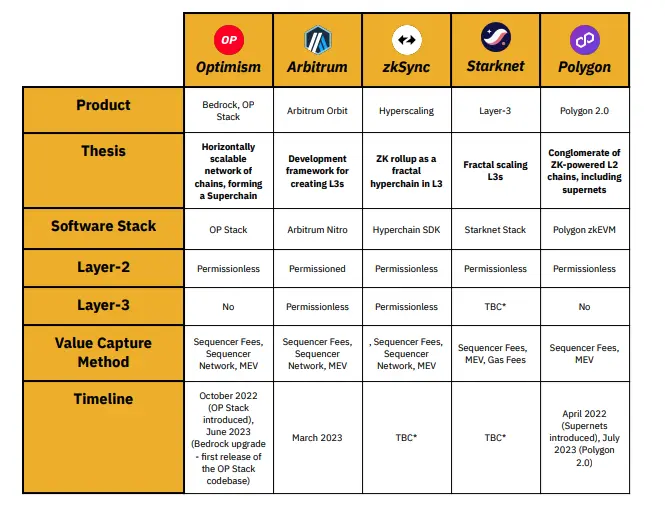
Arbitrum's evolution, mirroring Optimism's, transitioned from a cohesive approach to a versatile, modular framework. The Arbitrum vision hinges on diversifying applications across its general-purpose chains, such as Arbitrum One and Nova. A linchpin in this strategy is the introduction of L3 rollups that reconcile transactions on Arbitrum chains. These L3s, or app-chains, symbolize the future of Arbitrum's scaling pursuits.





