
You are reading an excerpt from our free but shortened abridged report! While still packed with incredible research and data, for just $40/month you can upgrade to our FULL library of 60+ reports (including this one) and complete industry-leading analysis on the top crypto assets.

Becoming a Premium member means enjoying all the perks of a Basic membership PLUS:
- Full-length CORE Reports: More technical, in-depth research, actionable insights, and potential market alpha for serious crypto users
- Early access to future CORE ratings: Being early is sometimes just as important as being right!
- Premium Member CORE+ Reports: Coverage on the top issues pertaining to crypto users like bridge security, layer two solutions, DeFi plays, and more
- CORE report Audio playback: Don’t want to read? No problem! Listen on the go.

Intro to MEV
The phenomenon of Maximal Extractable Value (MEV) in the domain of cryptocurrency, particularly within the Proof-of-Stake network, signifies a pivotal aspect of blockchain operation and efficiency. This report delves into the intricacies of MEV, with a focus on its manifestation within the Solana blockchain ecosystem, highlighting the evolving dynamics and implications for validators, searchers, and the broader community.
In the architecture of Proof-of-Stake networks, the assignment of a leader to a block grants the authority to influence the block's composition through the addition, removal, or rearrangement of transactions. This capability to shape transaction order encapsulates the essence of MEV. The value derived from such operations is not merely theoretical; it has practical ramifications on the network's operation and the financial outcomes for involved parties.
MEV on Ethereum
Maximal Extractable Value (MEV) is a concept that has evolved significantly with Ethereum's shift from a proof-of-work (PoW) to a proof-of-stake (PoS) system, reflecting the changing dynamics of transaction handling and block validation. Originally termed as "miner extractable value" in the PoW context, MEV represented the potential profit miners could gain by manipulating the inclusion, exclusion, and order of transactions. However, with the advent of Ethereum's transition to PoS known as "The Merge," this responsibility shifted to validators, prompting a broader application of the term MEV.
MEV emerges from the unique structure and function of blockchain. Unlike a simple first-come, first-served system, blockchains operate more like competitive marketplaces. Those responsible for adding new transactions to the blockchain, such as miners or validators, prioritize transactions that offer them the highest fees. This auction-like system is the playground of MEV, where block producers strategically choose transactions to maximize their returns.
 Source: BlockNative
This phenomenon is influenced by several factors: the limitation of block space, the transparency of transactions, the existence of transaction fees, and the authority of block producers over transaction sequencing. These elements create opportunities for block producers to significantly influence the order and inclusion of transactions, thereby extracting maximum value.

In practice, MEV accrues primarily to validators as they control transaction ordering, but a notable portion is also captured by "searchers." These independent actors deploy algorithms to identify profitable transaction sequences and submit these to the network. Their success hinges on paying substantial gas fees to validators to prioritize their transactions, particularly for competitive opportunities like decentralized exchange (DEX) arbitrage, often resulting in a significant portion of their MEV revenue being expended.

MEV is a double-edged sword with both beneficial and detrimental effects. Positively, it encourages actors to correct market inefficiencies, thus supporting the stability and accuracy of DeFi protocols. However, it has negative ramifications at both the application and network levels, from worsening user experience through practices like sandwich attacks to causing network congestion and even potential blockchain reorganizations if the MEV outweighs standard block rewards.
 Source: Xangle
The Ethereum community has taken note of the escalating MEV issues, particularly as they contribute to validator centralization risks and disrupt the decentralized ethos of the network. In response, innovations such as Proposer-Builder Separation (PBS) and the Builder API have been proposed. PBS aims to mitigate the adverse effects of MEV by decoupling the roles of block producers and proposers, creating an auction market for block space, and reducing the incentive for validators to engage in manipulative practices like chain reorganizations.
Solana MEV
The discourse around MEV has gained momentum, particularly in light of recent developments on the Solana blockchain. An instance that captures the financial stakes involved occurred on January 10, 2024, when a validator received a tip of 890 SOL, marking one of the largest such transactions in the history of Jito, a protocol associated with Solana. This event underscores the significant economic activities centered around MEV.
Solana's blockchain architecture presents a unique landscape for MEV. Unlike other blockchains, such as Ethereum, Solana operates without a conventional mempool, opting for continuous block production. This design choice minimizes the opportunities for certain types of MEV, notably front-running, by eliminating gaps between block creation where transactions might be manipulated.
MEV on Solana materializes through various transactions, including NFT minting, liquidations, and arbitrage. Each category presents distinct opportunities and challenges. For example, NFT minting can generate substantial MEV during public events when rare or valuable tokens are released. Liquidations and arbitrage further exemplify the dynamic nature of MEV, where market inefficiencies and financial distress offer lucrative opportunities for those able to identify and act upon them swiftly.
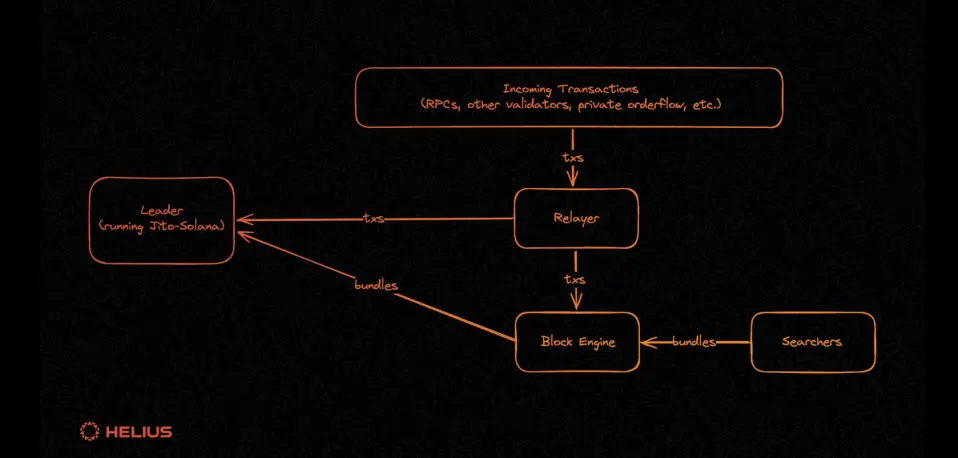
Jito, a protocol developed for Solana, epitomizes the innovative approaches being explored to manage and optimize MEV. Operating outside the traditional blockchain protocol, Jito facilitates auctions for block space, enabling transactions to be bundled and executed with efficiency and predictability. This method aims to mitigate spam and improve the computational resource allocation on Solana, reflecting a strategic effort to enhance network performance.
The discussion of MEV extends beyond the technical and economic dimensions to encompass ethical and strategic considerations. The practice of sandwiching, for instance, has been contentious due to its potential to disadvantage traders by executing transactions at less favorable prices. Solana's ecosystem, through tools like Jito and the development of out-of-protocol solutions, seeks to balance the interests of various stakeholders, aiming for a more equitable distribution of MEV-related benefits.
The role of relayers and validators in Solana's MEV ecosystem illustrates the collaborative and competitive aspects of block creation and transaction processing. These actors, along with searchers, form a complex web of interactions that underpin the functioning of the blockchain. Their efforts to optimize for MEV while maintaining the integrity and efficiency of the network highlight the ongoing evolution of blockchain technology and its governance.
In conclusion, the exploration of MEV on Solana offers insights into the challenges and opportunities presented by blockchain technology. As the ecosystem continues to evolve, the strategies and mechanisms developed to manage MEV will play a crucial role in shaping the future of decentralized finance. This report underscores the importance of ongoing research, innovation, and dialogue among all participants in the blockchain space to harness the potential of MEV in a manner that promotes fairness, efficiency, and growth.





