You are reading an excerpt from our free but shortened abridged report! While still packed with incredible research and data, for just $20/month you can upgrade to our FULL library of 50+ reports (including this one) and complete industry-leading analysis on the top crypto assets.

Becoming a Premium member means enjoying all the perks of a Basic membership PLUS:
- Full-length CORE Reports: More technical, in-depth research, actionable insights, and potential market alpha for serious crypto users
- Early access to future CORE ratings: Being early is sometimes just as important as being right!
- Premium Member CORE+ Reports: Coverage on the top issues pertaining to crypto users like bridge security, layer two solutions, DeFi plays, and more
- CORE report Audio playback: Don’t want to read? No problem! Listen on the go.
Blockchains in General
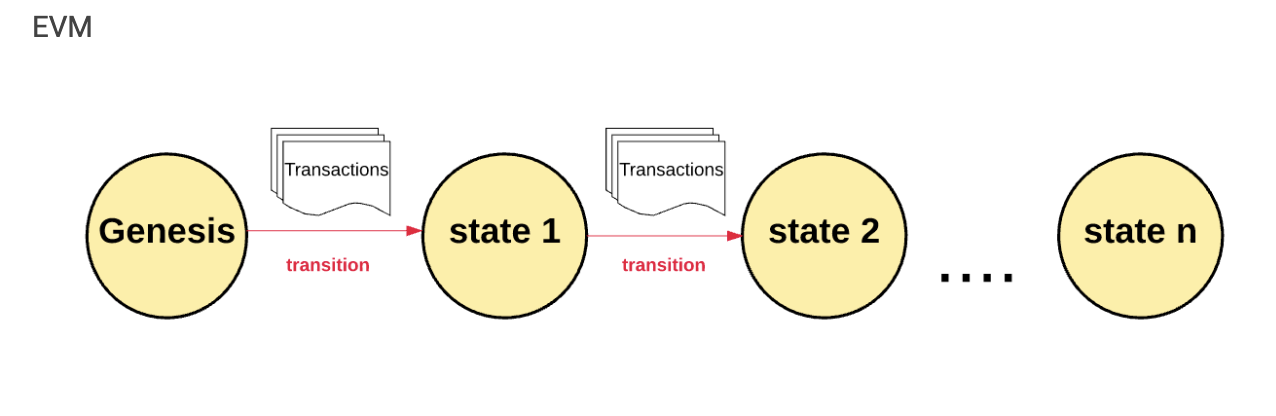
At its core, a blockchain operates as a state machine, facilitating participants on the network to both access (read) and modify (write) data. In the realm of computer science and mathematics, a state machine is conceptualized as a system where only one state is permissible at any particular moment. To effectively capture the essence of a state machine, we necessitate three components: an initial (genesis) state, a set of state transition functions, and corresponding input values.
Dissecting the Components of a Blockchain State Machine
- State: This represents the immediate status of all assets, code, and memory for every address on the blockchain. Depending on a node's nature, it might retain comprehensive state data (as seen with full nodes) or merely maintain a transactional summary within a block, known as the Merkle Root (as in the case of light nodes).
- Transaction: Transactions function as input values responsible for altering the blockchain's state. These can range from asset transfers between accounts to the invocation of smart contracts.
- State Transition Function: This denotes a pre-defined rule set that discerns the subsequent state, given the current blockchain state coupled with transactions. The Ethereum Virtual Machine (EVM) exemplifies Ethereum's state transition function.
Constructing a state machine akin to a blockchain mandates two fundamental capabilities:
- A robust database to execute the operations delineated by the state transition function.
- Comprehensive security to guarantee consistent state sharing among all participants.
Since the blockchain's initiation state and the state transition functions are predetermined by client software, the blockchain's status at any given juncture can be ascertained by consecutively executing them, provided there's a structured list of transactions.
From this perspective, as implied by its nomenclature, recording transactions in block format becomes imperative for deciphering a blockchain's state.
The Imperative of Data Availability and Consensus
Blockchain users, predominantly light nodes, desiring transaction validation should feasibly retrieve the pertinent transaction data. Within the blockchain universe, "data availability" is the provision of transactional data, assuring all network participants can regenerate the blockchain's existing state.
Central to a blockchain's operational integrity is its consensus mechanism. Its primary objective is establishing the transactional sequence for a distributed system's state machine, all the while fortifying against malevolent alterations. As state machines don't generally adhere to a commutative law, the resulting states might fluctuate based on data input sequences.
When delving into consensus mechanisms, the modus operandi and determining entities are stipulated by the blockchain network. For instance, while Bitcoin leverages the Proof of Work (PoW) among its nodes, Ethereum pivots towards Proof of Stake (PoS) among its nodes. Each node's exertion (or monetary contribution) fortifies the network's security.
Bitcoin Blockchain
This blockchain ledger serves as a continuously growing list of records called blocks, which are linked and secured using cryptography. Each block links back to a previous block, containing a timestamp and transaction data. This makes them tremendously resistant to modification, i.e. immutable.
What is remarkable about this boring, immutable ledger is that it consists of every transaction ever executed on the network dating back to its creation (~775 million!) AND it’s completely public and verifiable. Anyone at any time can view/audit/verify these transactions and maintain their own list. This is immensely powerful!
Most blockchains are designed to optimize for different end users and use cases based on what that community finds most important. However, blockchains are arguably only valuable if they can offer a secure, permissionless, censorship-resistant, and credibly neutral alternative to traditional finance. With those principles in mind, networks must strive not to privilege insiders or create a hierarchy within the system e.g. those that can afford to run a validator/audit the blockchain vs those that cannot. Bitcoin is the most secure, permissionless, and accessible financial system in the world.
Blockchain enables an irrefutable record of information that, once accepted onto the chain, cannot be retroactively altered. Because of the cryptography involved, changing just one block alters ALL of the previous blocks in existence. This means that if you want to change the current block (to say, award yourself some bitcoin), you must change Bitcoin’s entire history, which requires an immense cost and collusion of the network.
In an oversimplified analogy, imagine that as transactions are confirmed on the blockchain (more on that in a bit), each Bitcoin user documents every single transaction into a spreadsheet. This means that there are 10,000+ people at all times maintaining an up-to-date written record of transactions. All 10,000+ are cross-checking their records for inaccuracies, creating an incredible amount of redundancy built into the system. This means in order to cheat or alter any transactions in the network, an attacker would need to defraud over 5,000+ people (51%) who are always looking to maintain complete network accuracy because it is in their best (financial) interest to do so.
The built-in default defensive properties afforded by cryptography combined with the costliness to conduct on the blockchain means that Bitcoin is perhaps the first of ANYTHING in which it is more difficult to successfully attack than to build/participate. Think about it. It’s much more difficult to build a house of cards than to knock one down. It’s also much more difficult to build a rocket ship than to blow one up. Cryptography makes the difficulty/cost of an attack much greater than the cost of defense.
So, the blockchain IS the ledger. More literally, a blockchain is a series of time-stamped chunks of data (called blocks) created and verified by the peer-to-peer network of Bitcoin computers, which is secured using cryptographic principles. The time-stamping enables transactions to be audited and provides proof of if and when a transaction took place. The peer-to-peer network and lack of central authority remove the need to trust anyone to process/complete/fulfill your transaction. The cryptography allows users to remain pseudonymous and enables the network to provide immense amounts of security behind each transaction while making them easily verifiable.
Ethereum Blockchain and State Machine
Ethereum is an open-source public blockchain network founded in 2015 by Vitalik Buterin in conjunction with Charles Hoskinson, Anthony Di Iorio, Mihai Alisie, and Joe Lubin. The original vision behind Ethereum was to create “a platform for deploying and executing smart contracts” thereby enabling a decentralized world computer known as the Ethereum Virtual Machine (EVM). The EVM serves as a distributed, permissionless computer that the entire world can access. It updates the global state (transactions, wallets, smart contracts, etc) with each block, ensuring network consensus.
In the cryptocurrency world, something is trustless if users do not have to rely on third parties or intermediaries (like banks) to control their funds. Instead of trusting third parties, users rely on blockchains and smart contracts that run code to execute transactions and protect the funds. Thus, a trustless system does not depend on external actors to facilitate transactions from point A to B.
The goal was to extend beyond Bitcoin’s functionality to a decentralized Turing-complete computing platform for smart contracts, programmable money, and decentralized applications (dApps). These dApps would use the native Ethereum currency, Ether. Ethereum, like Bitcoin, facilitates programmed verification without the need for third parties or without the possibility of interference.
Ethereum has an intriguing and polarizing history that has had a profound influence on the broader cryptocurrency space. In July 2016, Ethereum split into Ethereum and Ethereum Classic as a result of the intense debate following the infamous DAO incident. Since then, Ethereum has solidified its place in the cryptocurrency mainstream as the second-largest cryptocurrency behind Bitcoin and boasts the largest number of developers in the space due to its smart contract functionality, composability, security, and committed community.
Primary Use Case
The primary use of the platform and the reason for its proliferation is the ability to code and run smart contracts on the network. The major advantages of building dApps based on smart contracts on Ethereum are that they are decentralized, permissionless, uncensorable, have removed the need for intermediaries, and can be integrated with open standards for creating provably scarce virtual items.
Smart contracts were proposed by cryptocurrency pioneer Nick Szabo and are programs that run autonomously on the network, exactly as programmed, without any possibility of downtime, censorship, fraud, or third-party interference. A smart contract is written as programming code and deployed to the blockchain so that, instead of having lawyers enforce the contract’s rules, the contract runs automatically following the logic laid out in the code. Smart contracts allow anyone to trustlessly transact while also enabling anyone to trustlessly verify the code.
Relative to Bitcoin, Ethereum is defined in terms of its non-restrictive structure. Bitcoin doesn’t feature Turing complete smart contract functionality in order to prevent miners from working indefinitely on infinite loops (see “Lack of Turing-completeness”).
Turing completeness is a computer science concept that describes a machine’s ability to solve complex computations. A Turing-complete machine can handle any task provided it has time, memory and correct instructions. This means Ethereum can theoretically allow for any type of computer program to run on the network. This has led to the creation of decentralized, uncensorable dApps such as the Augur prediction market, Non-fungible Token (NFT) marketplaces such as OpenSea, NFTrade, LooksRare, and Gem, and Decentralized Finance (DeFi) tools like Dai, Uniswap, and Compound (discussed in Network Effects).
Since Ethereum solves this problem by introducing ‘gas’ (and an associated maximum number of computational steps each block can involve), the protocol is free to support sufficiently generalized programming that one can run pretty well anything they can imagine on the EVM - if they’re willing to pay the associated ‘gas’ fee. In virtue of the generalized nature of the Ethereum platform various open standards have been instantiated and proliferated.
The proliferation of open standards on Ethereum cannot be understated. Open standards are the basis of the Internet and are proven to drive open-source success. Token standards from ERC-20 to ERC-1155 are built to facilitate a standardized interface for smart contracts to interact and exchange value. Standards add convenience and interoperability for developers and dApps, respectively. The two most well-known are ERC-20 and ERC-721. ERC-20 refers to a standard for fungible tokens while ERC-721 specifies a standard for NFTs. The ERC-20 standardization made running an Initial Coin Offering (ICO) on Ethereum incredibly easy, which led to billions of dollars raised in 2017 and 2018 that helped to build out the ecosystem.
Ethereum has also proven a very popular home for NFTs (ERC-721), not least because of its position as the world’s leading smart contract platform. NFTs aren’t presumed to be exchangeable for one another, arbitrarily, as Bitcoin or Ether are (in theory); rather, NFTs represent anything unique in the world as an asset on the Ethereum blockchain. While initially primarily popular among digital artists and content creators, NFTs can represent provable ownership of anything, with an immutable public record of current and previous ownership. In addition to representing ownership of physical or digital assets, NFTs are also being used to prove membership or gain exclusive access to events and groups.
For most of Ethereum's history, ERC-20 tokens have been the most active token type. However, this started to change during the rise of NFTs in 2021 when ‘non-fungible’ went mainstream. But only recently has the data started to show a flip of ERC-721 and ERC-20 tokens in some areas.
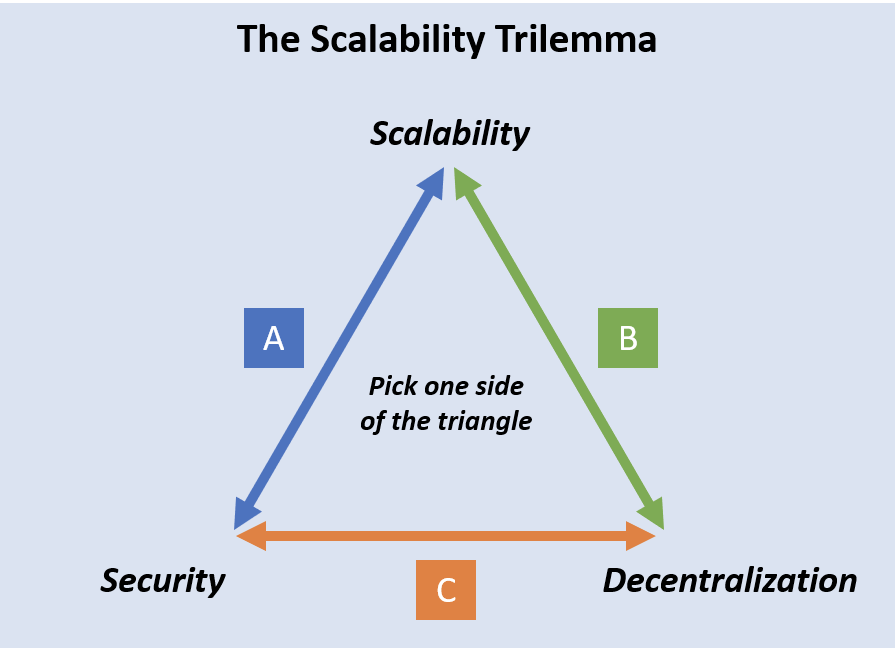
The Scalability Trilemma
Ethereum’s ability to process transactions is (partially) constrained by the amount of computing power, bandwidth, and storage on the network. The scalability trilemma is a well-known issue among all blockchains.

The scalability trilemma, illustrated. Credits: Vitalik Buterin
A blockchain can achieve two of these traits but at the expense of the third. Many alternative layer 1 (L1) chains have chosen to sacrifice decentralization for scalability and security. However, it’s important to remember why decentralization is important. It provides the chain anti-fragility, robustness, reliability, and censorship resistance.
The goal is to increase the number of transactions while retaining sufficient decentralization. What are the decentralization sacrifices (tradeoffs) other smart contract L1s have made? Other chains typically make two sacrifices. They either design their network to be run/secured with high-powered, expensive nodes, which reduces the number of people that may participate in network consensus by pricing them out. Obviously, a network that can only be verified if you have X amount of dollars in computing budget is not an ideal, permissionless system.
Another tradeoff often considered is for the network to use fewer nodes to achieve consensus in less time. However, this makes the chain more vulnerable and centralized. It is easier to corrupt or destroy 10 nodes rather than 10,000 all over the globe.
Although often discussed as such, blockchain scalability does not just pertain to TPS. Many L1s, like Binance Smart Chain (BSC), currently boast high TPS numbers but suffer from “chain bloat” and ever-increasing hardware requirements just to keep the chain running. L1s must be able to process more transactions without creating more problems down the road.
A node in a technically sustainable blockchain has to do three things:
- Keep up with the tip of the chain (most recent block) while syncing with other nodes.
- Be able to sync from genesis in a reasonable time (days as opposed to weeks).
- Avoid state bloat.
Requirement 1 above is a physical limitation based on computing power (RAM, CPU, etc.) and bandwidth. These are bottlenecks for every node which means there are upper, finite limits to how far you can push the network.
One way for Ethereum to increase its workload could be to increase the size of the computers participating in the Ethereum network (participating computers are called “nodes”). But larger, more expensive, and fewer computers in the network (like Solana) is clearly a form of centralization. Having a small number of bigger players involved in maintaining Ethereum is not Ethereum’s goal.
Fewer computers in the network also create security issues. A hacker attacking just a few computers or a single central computer will have an easier time than attacking a huge number of computers all in agreement about the data they are using and creating. Just as with Bitcoin, more computers participating in the Ethereum network enhance the security and permanence of the data on the Ethereum blockchain.