
You are reading an excerpt from our free but shortened abridged report! While still packed with incredible research and data, for just $20/month you can upgrade to our FULL library of 50+ reports (including this one) and complete industry-leading analysis on the top crypto assets.

Becoming a Premium member means enjoying all the perks of a Basic membership PLUS:
- Full-length CORE Reports: More technical, in-depth research, actionable insights, and potential market alpha for serious crypto users
- Early access to future CORE ratings: Being early is sometimes just as important as being right!
- Premium Member CORE+ Reports: Coverage on the top issues pertaining to crypto users like bridge security, layer two solutions, DeFi plays, and more
- CORE report Audio playback: Don’t want to read? No problem! Listen on the go.
stETH
Cryptocurrency enthusiasts who are seeking ways to enhance their investment portfolios and explore exciting avenues for potential returns should take a closer look at wstETH. This innovative offering, known as a permissionless ERC20 wrapper, allows investors to obtain a proportional stake in the total supply of stETH tokens. The primary advantage of wstETH is its ability to enable users to redeem their stETH holdings for an equivalent balance of ETH, securely held within the Lido staking contract. This process involves the allocation of ETH among node operators, who then forward it to designated validators.
While stETH relies on a rebase mechanism to account for staking rewards and penalties, the balance of wstETH tokens remains constant. However, the exchange rate between wstETH and stETH fluctuates depending on staking activity, which generates gains or losses. The primary objective of wstETH is to enhance the interoperability of decentralized finance (DeFi) protocols that do not support tokens subject to rebasing.
An important feature of the wstETH ecosystem is its intended value appreciation over time relative to the rebase amounts associated with stETH. When users deposit stETH or ETH, the wrapper contract seamlessly converts these assets into wstETH. Conversely, during the withdrawal process, wstETH is burned, and the equivalent amount of stETH is returned to the user.
Understanding the Yield Accrual Mechanism
The value of wstETH is reflected by the exchange rate, as determined by the wrapper contract's stEthPerToken rate. This mechanism ensures that the value of wstETH aligns with prevailing market conditions and opportunities for yield generation. The secondary market, including various Curve pools, typically reflects the accrued yield associated with wstETH. Currently, wstETH trades at a premium of approximately 13% over stETH, representing the cumulative yield accumulated since the inception of wstETH.
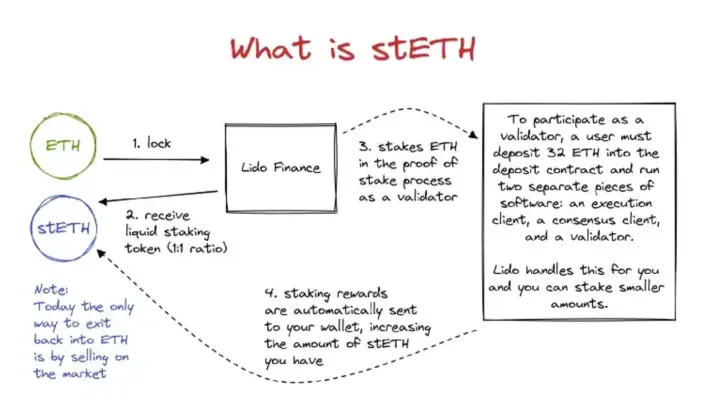
To maintain accuracy and account for staking rewards, the stETH token balance undergoes daily adjustments. These adjustments, facilitated by a rebase token, factor in accumulated rewards while deducting penalties such as validator slashing. This ensures that users can have confidence that their stETH holdings reflect the most up-to-date value, fostering transparency and fairness within the ecosystem.
The emergence of wstETH presents exciting opportunities for cryptocurrency investors seeking increased flexibility and potential returns. By offering seamless integration with DeFi protocols that do not support rebasing tokens, wstETH enables investors to explore broader investment strategies and diversification options. Investors can leverage the benefits of staking and actively participate in various yield-generating activities while maintaining a stable and easily tradable asset represented by wstETH.
Moreover, the upward trajectory of wstETH's value relative to stETH rebase amounts positions investors to capture additional gains over time. This growth potential, coupled with the protocol's commitment to transparency and consistent adjustments, makes wstETH an appealing choice for those looking to maximize their investment potential within the cryptocurrency landscape.
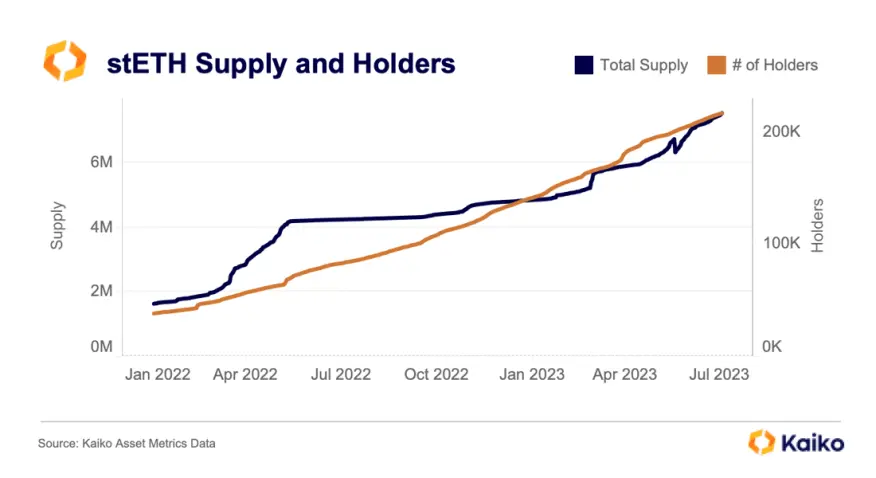
Considerations and Opportunities
It is important to note that stETH is a rebasing token, meaning that staking rewards are automatically accrued by token holders. While this may be convenient, rebasing tokens like stETH have limited interoperability within DeFi protocols.
To overcome this challenge, Lido, the platform behind wstETH, utilizes a cToken model, which allows for fixed token balances with an elastic exchange rate. This cToken design ensures full compatibility with various DeFi applications, expanding the possibilities for utilizing stETH.
It's worth mentioning that Lido charges a 10% fee on staking yields for the services it provides to users. These fees are distributed evenly between node operators and the Lido DAO in the form of stETH. This fee structure ensures the sustainability of the platform and offers the Lido DAO the flexibility to allocate profits as deemed appropriate by LDO token holders.
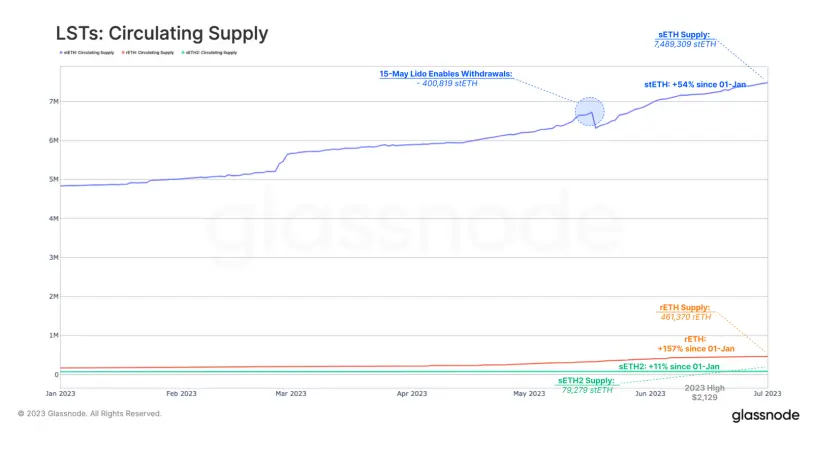
LSDs now represent ~37% of all staked ETH. The primary beneficiary in this space has been Lido, the leading LSD issuer, at ~32% of all staked ETH. Despite the positives, Lido's current setup doesn't eliminate all risks, particularly concerning the influence of LDO holders over the validator set. This power concentration could potentially jeopardize the health, decentralization, and credible neutrality of Ethereum as a whole.
The Lido community has recognized these issues and is taking measures to mitigate them, such as introducing stETH governance and working towards implementing a staking router in Lido v2. At its core, Lido V2 lays the groundwork for the protocol to transition from a single, authorized validator group to incorporating various unique validator subgroups, referred to as modules. The primary infrastructure facilitating this transformation is the staking router, responsible for determining the distribution of new user deposits to various modules. Initially, the Lido DAO will determine the target proportion of active Lido validators that each module can accommodate. Although no specific timeline has been disclosed for Lido V2's activation on the Ethereum mainnet, it's anticipated to be rolled out in stages. Prioritization is expected to be given to withdrawal functionality over the full launch of the staking router.






