

If you want more cryptocurrency analysis including full-length research reports, trading signals, and social media sentiment analysis, use the code "Publish0x" when subscribing to CryptoEQ.io to make your first month of CryptoEQ just $10! Or just click the button below!
Stellar Strengths +
- Low fee, high speed cryptocurrency with heavy focus on corporate sponsorships and bringing open finance to the unbanked
- Capable of smart contracts and ICOs although these use cases have yet to really materialize in any meaningful way
- Above-average amount of exchange listings and liquidity
- Capable of thousands of transactions per second with minimal transaction fees
- Strong partnerships with established organizations including IBM
Stellar Weaknesses -
- Stellar Foundation holds ~60% of all XLM in existence, creating a central point of failure and strong degree of centralization risk for the project writ large
- XLM is similar to XRP in use case, token origination, similar points of centralization, and the fact that a central entity (Stellar Foundation) arguably controls the entire network. As Ripple Labs is currently being sued by the US Securities and Exchange Commission (SEC) for not registering XRP with the agency and illegally selling a security, XLM's regulatory future is a cause for concern.
- The network contains only ~44 validators which are heavily centralized around SDF nodes creating network-wide vulnerability
- Small team (~7) control the majority of the development work which has decreased since 2019
- Questionable response by the Stellar team to disclose a bug that was discovered (and patched) in 2017
- No financial incentive (like a mining reward in the Bitcoin protocol) to become a node, which could lead to a dearth of nodes and node centralization
 Economics
When the Stellar network went live in 2014, 100 billion XLM were created; however, most of the tokens were retained in the custody of the Stellar Foundation (~80%), which only distributed 18.77 billion of the initial 100 billion tokens. Of these tokens, 5%, or 5 billion tokens, were given to the Stellar Foundation. Two billion tokens, 2%, were given to seed investor Stripe, which is a payment processing company that is quite involved with the Stellar network. This 2% of tokens is a part of the partnership program which will ultimately distribute 25%, or 25 billion tokens, to businesses, governments, institutions, or nonprofit organizations interested in Stellar’s technology. 20% of tokens were to be distributed to Bitcoin and Ripple (XRP) holders via several airdrops although only 2 billion were actually claimed. The remainder went into the Stellar Foundation and the Build Challenge fund.
The remaining 50% of tokens—50 billion—were to be given to people directly, particularly people in developing countries with limited banking infrastructure until the SDF had a change in plans in November 2019. At a Stellar conference in November 2019, the SDF announced that they had burned, or destroyed, over half the lumens in existence (55 billion XLM) bringing the new total supply down to 50 billion XLM. News of the burning caused a temporary spike in price but the overall market cap of XLM took a substantial hit (~40%).
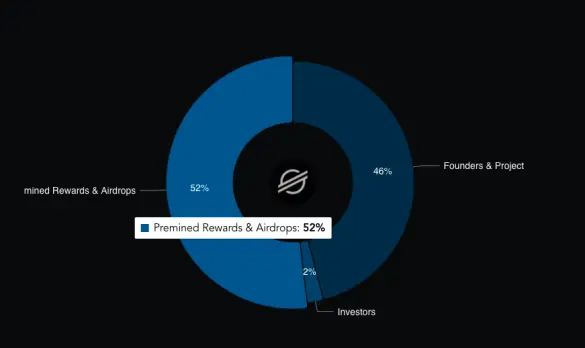
Initial token distribution. Source: Messari
After the burning, the SDF controls ~60% of the total tokens in existence rather than the 80% they controlled beforehand. The foundation now controls 30 billion XLM: 12 billion in their development fund, 2 billion for ecosystem and infrastructure, 10 billion for investments, and 6 billion for user acquisition. Since there is no longer inflation in the network (discussed below), 50 billion is Stellar’s new final total supply. This, at least on some level, is a positive for holders of XLM. There is less XLM controlled by the SDF, less to be given away causing dilution, and less XLM overall. While the added scarcity and small price bump grab headlines, the move does raise questions regarding the power of a central authority in a decentralized network. The SDF still holds the majority of XLM in existence and has thus proven they are willing to make large decisions regarding the entire project without consulting or alerting their users or supporters.
Originally, XLM’s supply would increase by 1% per year but in 2019, the SDF decided to end inflation as well. The original vision for the inflation was that the new tokens along with the 0.00001 XLM fees collected from each transaction, were distributed through voting to projects building on Stellar. Any account that has received votes from more than 0.05% of tokens that exist within the network receives an inflation reward proportional to the percentage of extant tokens voting for the account (i.e. 2% of votes gets 2% of the inflation pool). However, very few XLM were actually distributed with the SDF claiming 98% of them over the 4 year run.
While the initial supply of Stellar Lumens was pre-mined, most of it is still tied up in the custody of the Stellar Foundation, meaning a fairly small proportion of the tokens are actually in circulation but will be released into circulation based on the foundations mandate. The payment processor Stripe provided the Stellar Foundation with initial seed money of $3 million, in return for 2 billion Stellar tokens, but otherwise Stellar has not engaged in any ICO funding. Instead, their token distribution method is to distribute funds as equitably as possible, with a focus on areas that are underserved by traditional banking systems. So far, Stellar has used email and Facebook for most of their direct sign-up program, but they do not outline a specific avenue for distribution, opting to experiment with several methods. They emphasize their intention to “get a small amount of lumens in the hands of as many people as possible with the intention of promoting financial knowledge and access to financial services around the world.” This goal largely went unfulfilled which is why the foundation destroyed 50 billion XLM in 2019.
Within the Stellar ecosystem, the XLM token is used to pay transaction fees on the network. The XLM network uses a default transaction fee of 0.00001 lumens to prevent spam or Denial of Service attacks. In addition, a minimum balance of XLM must be maintained in each wallet, depending on the level of a user’s utilization of the tokenized assets through “trust channels”. This setup doesn’t allow for account creation as easily as is possible with Bitcoin, limiting the effectiveness of identity obfuscation techniques, but this does result in costs to developers and users being much more predictable than the costs of an Ethereum ICO.
In addition, it’s important to note that most use cases of the XLM token do not actually require many tokens, meaning there is very little upward pressure on the token’s price from the demand side. With a 50 billion token supply distributed evenly across the world, each human on earth would be able to receive approximately 6.5 XLM, which allows for ~13 different trust channels and nearly 500,00 transactions. This means that, while the token’s scarcity will likely lead to increased demand, the use case by itself doesn’t put immediate upward pressure on the price of the token. This is evident when one compares Ethereum’s average daily network fees, ~$35M, to Stellar’s daily fees generated, ~$200.
Overall, Stellar suffers from a lack of a clear economic incentive structure. While XLM is a scarce and useful resource, the token’s economics lack compelling incentives for validating nodes, and doesn’t provide the upward price pressure of Bitcoin’s halving periods or Ethereum’s Gas. Also, most tokens are still held by the Stellar Development Foundation, and most use cases don’t require many tokens to complete the transaction. Still, the fee structure and economics are usable enough for most applications.





