

If you want more cryptocurrency analysis including full-length research reports, trading signals, and social media sentiment analysis, use the code "Publish0x" when subscribing to CryptoEQ.io to make your first month of CryptoEQ just $10!
Technology
The Solana network is designed to provide developers with a highly performant Web 3.0 cloud platform that offers scalability at the Layer 1 blockchain level. This approach aims to remove the complexities of Ethereum’s Layer 2 (L2) solutions by optimizing for speed, cost, and decentralization, from a political and geographic standpoint.
Specifically, these features quantify to:
- Speed: 400 millisecond block times
- Cost: 0.000005 SOL (~$0.001) per transaction
- Decentralization: 2,242 global nodes.
Solana uses PoS, specifically “Bonded Proof-of-Stake” (BPoS), meaning that anyone who holds SOL can delegate their votes to any validator that they choose and share in the rewards (or penalties) for validating transactions.
Consensus Mechanism
Solana is unique for its implementation of Proof of History (PoH), the very first use of such a consensus algorithm. Achieving its competitive advantage from PoH, Solana can achieve high speeds and the ability to scale due to PoH acting as a decentralized clock for the network. It, essentially, enables transactions to be time-stamped so that validators within the PoS system can easily arrange the transactions (due to timestamp).
Simply put, PoH is (essentially) a trust-minimized global clock within the Solana protocol. In traditional PoW blockchains, miners hash together blocks, while in Solana with PoH, validators hash the hashes themselves continuously intra-block. The advantage of this approach is a global, trust-minimized concept of time for all of the nodes to use in synchronization and consensus.
Because of this independent “timechain,” the leader in Solana block production is able to propagate timestamped transactions out to the network much faster. There’s no longer any lost time due to some arbitrary order determined by the block producer. The timechain provides a canonical order which can be easily checked.
A key problem with the speeds and scalability of decentralized networks is that nodes cannot rely on a centralized or external source to keep track of the appropriate flow of time. This creates bottlenecks as the “supermajority” of nodes must first concur on the appropriate timestamp which is then propagated back to the rest of the network. Other L1 PoS blockchains require validators to communicate and reach an agreement on time. However, with PoH in Solana, all validators must maintain their own clocks.
PoH represents a way for blockchains to keep time between computers that don’t trust each other. Solana’s website explains: “A reliable clock makes network synchronization very simple. When synchronization is simple, the resulting network can be blazing fast, bound only by network bandwidth.”
PoH provides a solution to this problem as it creates a way for every node to always be able to sequentially compute the passage of time cryptographically between two events without simply trusting the corresponding timestamp of each transaction. This bypasses having to first wait for the majority of the network to verify the timestamp. Essentially, transactions on Solana are verified and ordered without all nodes needing to agree simultaneously, making it quite different and much faster than typical blockchains. It also means that Solana is a monolithic blockchain, serving as a single shard, whereas other chains like Ethereum, Cosmos, Polkadot, etc. have gone with a modular (sharded) architecture. Solana does everything on one single chain, in a single state.
PoH is referred to as a “high-frequency Verifiable Delay Function” which is able to produce a unique, verifiable public output that may be verified efficiently. This occurs by implementing both an upper bound and lower bound on time. By using Verifiable Delay Functions, PoH allows each node to locally generate timestamps with SHA-256 computations. This eliminates the need for the broadcasts of timestamps across the network, improving overall network efficiency.
With the network able to self-verify the passage of time between events, this provides an alternative to the network having to wait for timestamps to be verified. Instead of waiting for other validators, then, Solana validators can use the information encoded in the ledger itself to determine whether a transaction is valid or invalid.
Because PoH enables predictability—there won’t be delays waiting for other validators—validators can take turns in a pre-scheduled “leader rotation.” Only the leader can produce a ledger entry at a given time, based on an algorithmically-generated random order, weighted by each validator’s stake. For example, if you have 10% of all stake, you know you’ll be the leader 10% of the time, but you won’t know which 10% of the time.
With a leader rotation removing delays, the Solana network is able to reach speeds not seen in any other blockchain networks to date. Solana has achieved approximately 50,000 TPS in a testnet environment. However, its execution engine does not delineate between messages such as votes cast in consensus (which nonetheless require payment of transaction fees) and more typical peer-to-peer value transfers and smart contract transactions.
Hence, testnet levels are likely overstated compared to other platforms due to how transactions are defined. Additionally, this throughput was achieved with about 200 nodes, which is about 1/3 of the nodes currently on its mainnet, and communication overhead in a production environment is likely higher.
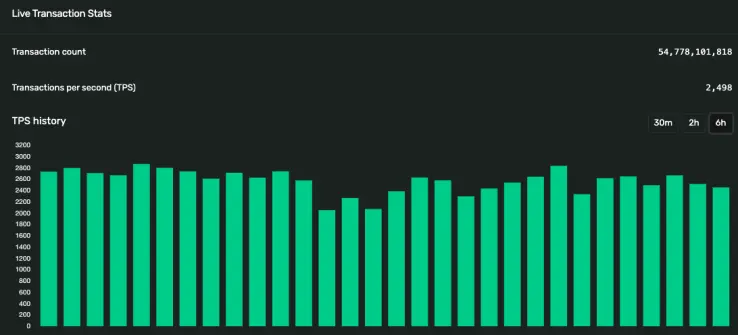
Chart depicting average TPS history for Solana, per Solana Block Explorer
For comparison, here are the speeds of other comparable networks:
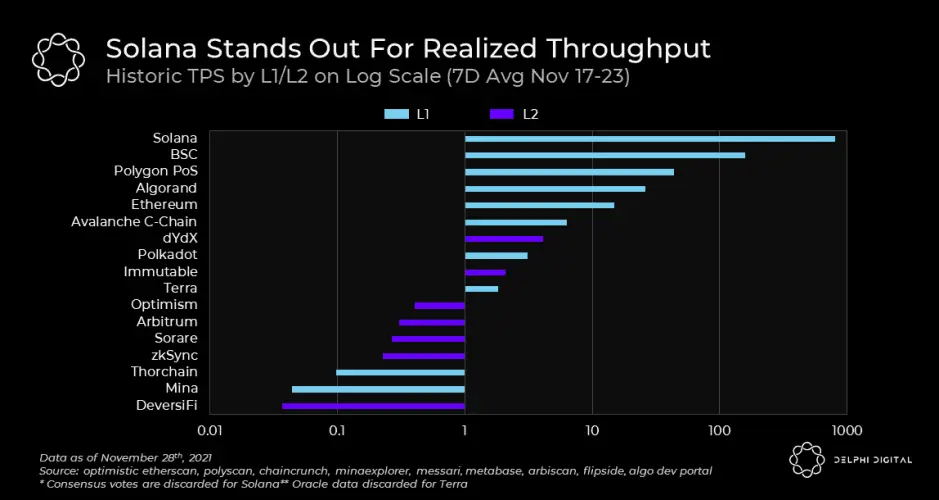
Source: Delphi Digital





