You are reading an excerpt from our free but shortened abridged report! While still packed with incredible research and data, for just $20/month you can upgrade to our FULL library of 50+ reports (including this one) and complete industry-leading analysis on the top crypto assets.

Becoming a Premium member means enjoying all the perks of a Basic membership PLUS:
- Full-length CORE Reports: More technical, in-depth research, actionable insights, and potential market alpha for serious crypto users
- Early access to future CORE ratings: Being early is sometimes just as important as being right!
- Premium Member CORE+ Reports: Coverage on the top issues pertaining to crypto users like bridge security, layer two solutions, DeFi plays, and more
- CORE report Audio playback: Don’t want to read? No problem! Listen on the go.
Use Case
Polygon’s use case is to serve as a hub for scaling Ethereum network transactions. The company Polygon Technology, referred to as Polygon, is focused on building various platforms for blockchain infrastructure to specifically support Ethereum as the overall crypto industry grows. Polygon houses several different teams building crypto scalability products.
At a high level, Polygon competes in the scalable blockchain-as-a-service industry. Alongside competitors, such as Starkware, Arbitrum, Loopring, and Matter Labs, these projects develop methods to improve the scalability of blockchains by increasing network throughput and decreasing transaction fees.
Polygon consists of a flagship proof-of-stake (PoS) sidechain called Matic POS. However, Polygon also consists of a framework known as the Polygon SDK that allows developers to build and connect L2 scaling solutions. Polygon’s SDK (or Polygon Edge) is somewhat similar to how Polkadot and Cosmos created their multi-chain ecosystems with the SDKs Substrate and Cosmos SDK.
Polygon was founded in 2018 by Mihailo Bjelic, who was experimenting with Plasma rollups, and Jaynti Kanani, Sandeep Nailwal, and Anurag Arjun, who were working on plasma rollups and the Matic Network sidechain.
Polygon was rebranded from Matic to serve Ethereum scaling via an L2 aggregation framework and specifically using ZK (zero-knowledge) technologies in February 2021. The team continues to host Matic Network’s Proof of Stake Ethereum sidechain, but in general, they consider this existing sidechain an “out-of-favor L2 solution.” It was shipped as an earlier solution due to the pressing need for Ethereum scaling that made Ethereum unusable for most.
Polygon is developed by Polygon Labs, which is actively developing various ZK (zero-knowledge) scaling technologies such as ZK-rollups, sidechains, and other blockchain architectures, as well as acquiring and incubating such technologies using its treasury. In 2021, Polygon made several aggressive growth acquisitions in the rollup/scalability industry, including Polygon Hermez, Miden, Zero, Nightfall, Avail, and Edge. As long as Polygon can draw more projects to its platform and expand its corporate development with more partnerships, Polygon will remain a formidable industry participant.
 Modular blockchain stack of Polygon, Source: twitter.com\100y_eth
Layer-2 solutions involve scaling that's off-chain, meaning transactions and computations happen off of the Ethereum base chain, keeping the base layer free of congestion. Layer-1 solutions involve scaling on-chain transactions or scaling solutions that keep all transactions on the base layer.
From 2020 to 2021, as transaction throughput on Ethereum slowed and network fees spiked to record highs pricing many out of DeFi, more users onboarded onto the Polygon blockchain seeking a solution to these problems. The Polygon blockchain currently hosts some of the largest decentralized applications on Ethereum, including OpenSea, Aave, SushiSwap, and others.
According to Etherscan, average gas costs on the Ethereum blockchain jumped from 10 gwei in March 2020 to 60 gwei two years later in March 2022. At peak times during 2021, gas consistently hovered around 150 or even 200 gwei, highlighting the need for improved infrastructure, which Polygon is focused on solving.
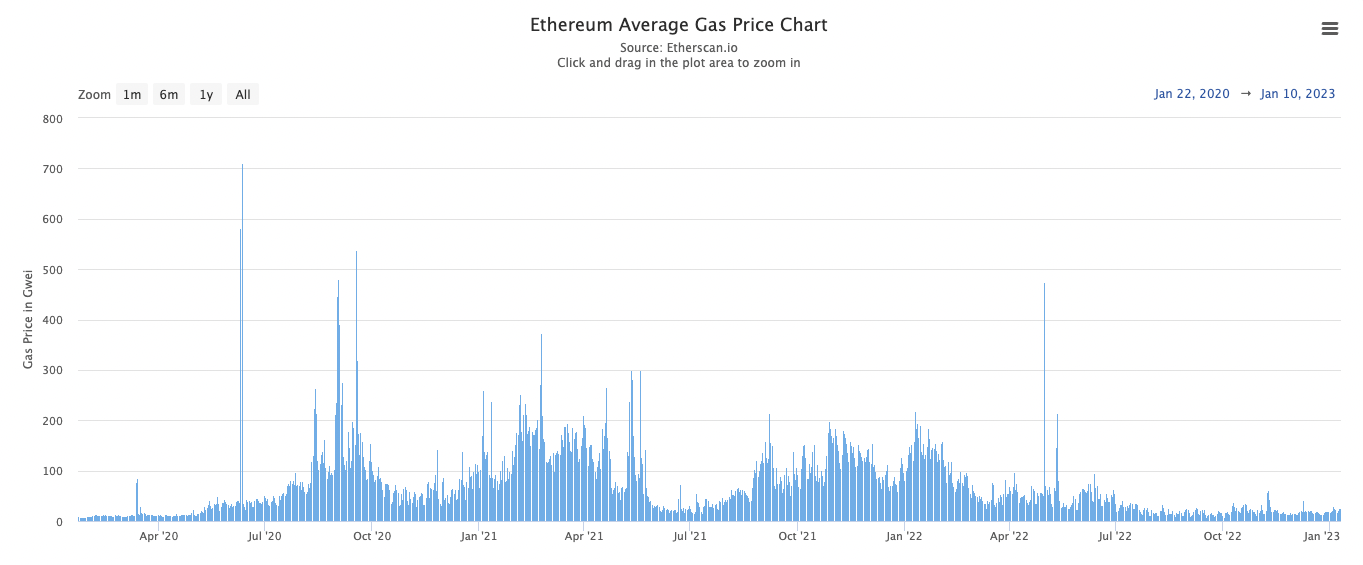 Ethereum Average Gas Price Chart, Source: Etherscan
Polygon, therefore today fills the need in DeFi and the greater crypto market for high transaction throughput and speed with low cost. It has gained a 7,000+ dApp (decentralized application) ecosystem across DeFi, NFTs, the metaverse, and blockchain gaming.
Competitive Advantages
Vitalik Buterin, the creator of Ethereum, noted in 2020 that ZK-rollups may become “the dominant scaling paradigm for at least a couple of years” before the Ethereum consensus layer’s shard chains are implemented. Given that Polygon was largely focused on incubating and expanding ZK technologies during 2021, it maintains a strong future in the blockchain scaling market and has formed a significant moat.
 Tweet by Vitalik Buterin, Source: twitter.com\VitalikButerin
As Vitalik notes in his scenario, the consensus layer’s (ETH2’s) data capacity will be upgraded before its computation power, meaning it'll be more feasible to store more data before it can process more transactions than the modern-day Ethereum mainnet.
Rollups, including Polygon’s technologies, provide Ethereum a path to scalability that can rival the timeline of new Layer-1 solutions (such as Avalanche and Solana) reaching maturity to market, in the sense that Layer-1 competitors are partly in a race against a viable rollup solution.
Polygon has made several aggressive growth acquisitions in 2021 with many different ZK rollup projects that offer different solutions to different users: Polygon Hermez, Miden, Zero, Nightfall, Avail, and Edge. As long as Polygon can draw more projects to its platform and expand its corporate development with more partnerships, notably in the NFT and gaming sector as a focus for 2022, Polygon will remain a formidable industry participant.
To read the entire FREE report, click here.