If you want more cryptocurrency analysis including full-length research reports, trading signals, and social media sentiment analysis, use the code "Publish0x" when subscribing to CryptoEQ.io to make your first month of CryptoEQ just $10! Or just click the button below!
Polkadot Strengths +
- Parity Technologies' Substrate modular framework offers developers the flexibility to select specific components that best suit their application-specific chain.
- Polkadot allows developers to launch chains and applications leveraging a shared security model, without having to worry about attracting enough miners or validators to secure their own chains.
- Polkadot’s parachains can use bridges to connect with external networks like Bitcoin and Ethereum.
- Polkadot has already raised nearly $200 million, become a top ten coin by market cap, and started to be integrated with other networks, like Chainlink.
Polkadot Weaknesses -
- Polkadot is competing with many other general-purpose, smart contracting, Proof of Stake blockchains like Tezos, Cosmos, and Cardano, to name a few, with industry-leading Ethereum already showing entrenched network effects.
- Hackers have exploited code vulnerabilities twice, draining millions of dollars before being stopped.
- A limited number of parachains are available and slots are sold via auction, which may price out some smaller use cases.

Technology
Polkadot is set to begin parachain auctions on the mainchain on November 11, according to the Polkadot Council. This enables projects to be allocated slots to build on the cryptocurrency network and finally realize the parachain vision designed years ago. It also serves as a massive milestone for Polkadot, the team’s credibility, and the vision of a multi-chain crypto ecosystem.
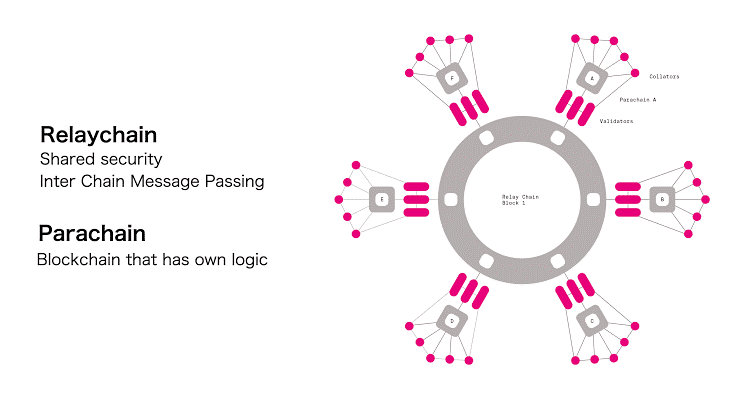
Parachains are Polkadot’s solution to scalability. They are called “parachains” because they are unique chains/ecosystems running parallel to the relay chain with their own governance and token but connect back to the relay chain and share its security. Instead of being incentivized by DOTs, each parachain has its own economics and incentive structures.
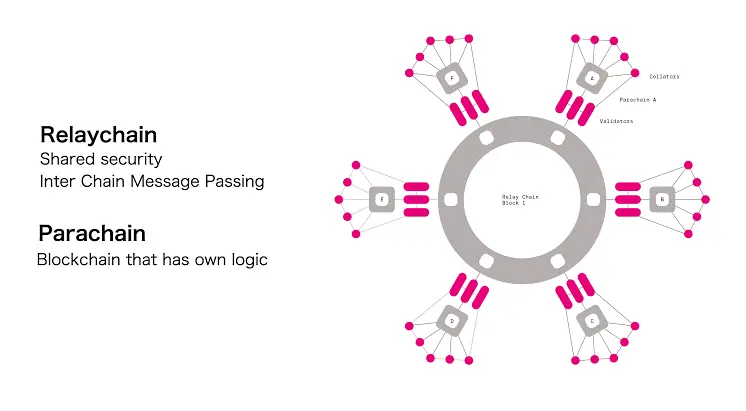
Visual of the relay chain-parachain architecture. Source: TechBullion
Each Parachain built within Polkadot uses the Substrate modular framework that supports developers building applications within parachains to fit their specific needs. This means that individual parachains can be optimized for specific use cases like DeFi, gaming, NFTs, etc. The Parachains connect to the overarching Relay chain that secures the network’s parachains and maintains Polkadots consensus, transaction finality, and voting logic. Parachains periodically submit proofs back to the Relay Chain, which maintains consensus across all parachains and keeps the entire DOT universe in sync. A critical differentiator of Polkadot is that it allows developers to launch chains and applications leveraging a shared security model, without having to worry about attracting enough miners or validators to secure their own chains. Polkadot also has capabilities for bridges that allow parachains to connect and communicate with external networks like Ethereum and Bitcoin.
To obtain a slot on the Polkadot chain, a project must win an auction by locking up more DOT than other bidding projects. If won, your slot is only leased, anywhere from 3 months to 2 years. There is a limited number of parachains available with more to be released in the future. Currently, the Polkadot developers believe ~100 different parachains can be supported in the current status.
The first five auctions would be scheduled to begin on Nov. 11, 2021, running every seven days. A subsequent batch of six auctions would begin on Dec. 23, 2021, and would run every 14 days. (Note that Polkadot has a “canary” network called Kusama that has already held parachain auctions. Those were essentially a testing ground for the rollout on November 11th on the mainchain.)