
You are reading an excerpt from our free but shortened abridged report! While still packed with incredible research and data, for just $20/month you can upgrade to our FULL library of 50+ reports (including this one) and complete industry-leading analysis on the top crypto assets.

Becoming a Premium member means enjoying all the perks of a Basic membership PLUS:
- Full-length CORE Reports: More technical, in-depth research, actionable insights, and potential market alpha for serious crypto users
- Early access to future CORE ratings: Being early is sometimes just as important as being right!
- Premium Member CORE+ Reports: Coverage on the top issues pertaining to crypto users like bridge security, layer two solutions, DeFi plays, and more
- CORE report Audio playback: Don’t want to read? No problem! Listen on the go.
Optimism, once primarily known for their OP Mainnet—an Ethereum Virtual Machine (EVM)-equivalent optimistic rollup—has undeniably been making waves in the Ethereum community. This transition is particularly evident in their strides towards reimagining Ethereum's scalability challenges and introducing innovative solutions.
From Rollup Solution to the OP Stack:
October 2022 was a pivotal moment for Optimism as they unveiled the OP Stack, representing a shift in their perspective from merely being an optimistic rollup solution to visualizing a broader spectrum of Ethereum scalability. This blueprint was not just about scaling; it represented a leap towards creating a more integrated, highly interoperable blockchain environment.
The intriguing concept of the Superchain emerged from this shift. Envisioned as a tight-knit family of L2 blockchains built on the OP Stack, the Superchain promises high integration and a unified ecosystem.
Diving Deeper: What is the OP Stack?
In essence, the OP Stack serves as the backbone of the OP Mainnet. It's a consolidated, open-source software suite designed to power Optimism's L2 rollup. The stack is composed of several software components, which when used cohesively, can assist developers in creating a synergistic network of L2 blockchains. As Optimism flourishes, the OP Stack is also anticipated to evolve, aligning with the entity's growth trajectory.
Aligning with Ethereum: The Core Principles
-
Extensibility: One of the primary ethos behind the OP Stack is its adaptability. Open-sourced and modular, the code is designed for builders aiming to expand upon it. This ensures that EIPs (Ethereum Improvement Proposals) and subsequent upgrades can be smoothly integrated.
-
Simplicity: The belief that intricate code can become a bottleneck in scalability drives Optimism. They focus on streamlining their code, re-utilizing battle-hardened code, which explains their decision to employ a Geth fork as the OP Stack's primary execution engine.
-
Familiarity: Owing to its alignment with Ethereum, developers familiar with the Ethereum ecosystem will find the OP Stack intuitive and user-friendly.
-
Client Diversity: A diversified client ecosystem enhances the robustness of the platform. With multiple client implementations viable across the OP Stack, there's increased resilience and security. The launch of OP-Erigon, a distinct execution client for the OP Stack, and the announcement of Magi, another rollup client for the OP Stack, are testament to this diversity.
More Detail
The OP Stack is a modular and open-source blueprint that enables developers to build highly scalable and interoperable blockchains of all kinds. It serves as the underlying code for Optimism's future architecture and is composed of a series of modules that work together to create reliable and coherent blockchains. The stack is made up of specific layers, each with a well-defined API that can be tailored to the specific layer. As such, developers can modify existing modules or create entirely new modules to meet their application's unique requirements.
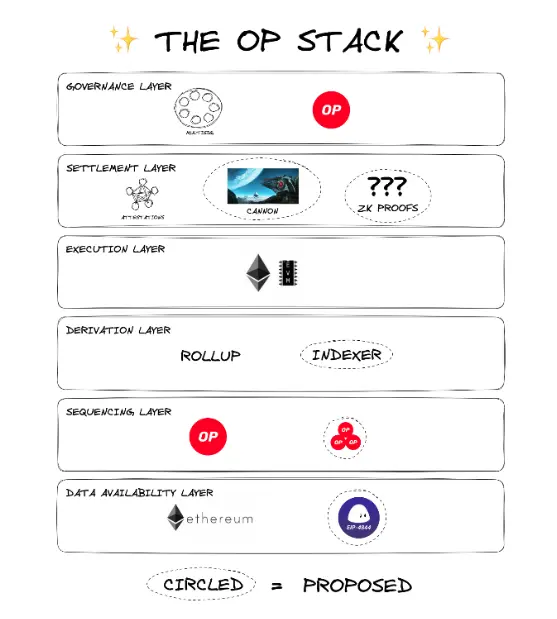
The Execution Node (op-geth) serves as a crucial component for propagating and executing transactions. Meanwhile, the Rollup Node (op-node) is responsible for providing essential rollup-centric functionality. Additionally, the Cannon Proof Scheme is an interactive, EVM-compatible optimistic fraud proof system designed to identify and counteract fraudulent activities.
Both sequencers and verifiers operate execution and rollup nodes in various modes. Sequencers are tasked with processing transactions, constructing blocks, and submitting compressed batches of blocks to Layer 1. Verifiers, on the other hand, monitor sequencers and challenge them with fraud proofs if they detect any invalid outputs.
To derive the canonical Layer 2 chain, both sequencers and verifiers must analyze Layer 1 block data, Layer 2 transaction data, and new deposits originating from Layer 1. Currently, this aspect of the stack relies on a single, dedicated sequencer, resulting in centralization. The Cannon fraud proof engine is still under development, with its release anticipated sometime in 2023.

Optimism has created the OP Stack to future-proof its ecosystem. It does so by abstracting the proof layer used to settle funds onto another chain. This means that as long as the proof layer satisfies the proof API, it can be integrated into the system with no impact on the user experience. This approach allows Optimism to adapt to newer proof systems as they emerge. Overall, the OP Stack is an exciting development that will enable developers to create novel blockchain applications, leveraging the flexibility of the stack to create solutions for unique use cases.
Base
Base is Coinbase's foray into the Ethereum Layer 2 (L2) landscape, aimed at providing a seamless, secure, and cost-effective solution for developers looking to capitalize on blockchain technology. Base is an OP chain built utilizing the OP stack. Data from DeFi Llama reveals that ~45 dApps have been constructed on Base, with DeFi applications accounting for most of the TVL.
Key Features of Base:
-
Coinbase's users: 110 million users with assets surpassing $80 billion.
-
Cost-efficient with Robust Features: As it is built on the OP Stack, Base is Ethereum Virtual Machine (EVM) compatible, ensuring that users get all the features of Ethereum but at a significantly reduced cost.
-
Solid Backing and Recognition: With Coinbase's active involvement, the Superchain vision of the OP becomes more tangible and legitimate. Base's foundation is the OP Stack, which is MIT-licensed and aligns with the Superchain's objectives. With its launch on the Goerli testnet, Base is gathering momentum, with a functional block explorer and numerous teams gearing up to develop on it.
-
User Experience: For both developers and users, interacting with Base is set to be very similar to their experience with Ethereum. The primary distinctions will lie in the reduced fees and slight variations in opcodes, block details, and network specifications. Major players like Infura, Blockdaemon, and QuickNode have pledged support for node infrastructure, fortifying Base's operational foundation.
-
Decentralization Roadmap: Coinbase has charted a clear course towards the radical decentralization of Base in the upcoming years. The initial stages of this plan involve the introduction of a live fault prover and dispersing control over upgradeable contracts. This will be succeeded by the establishment of a shared sequencer that is operational.
It’s important to remember that while rollup technology can be quite technical, at its core, an optimistic rollup chain is simply a smart contract on mainnet Ethereum with some number of block producers that watch for transactions, batch them together into one string of data (rollup), and then post them back to the Ethereum mainnet with a signature attesting to their validity.
An Optimistic rollup moves the heavy computation and data storage that would be normally executed on L1 Ethereum off-chain to a new rollup network. Only a small portion of each batch of transactions is ultimately recorded on the mainnet, creating a much smaller computational impact on the L1. Since only one small data portion is registered on L1 and the majority of computation is handled off-chain, fees can be greatly reduced (compared to if the entirety of the transactions were executed on L1).
Challenge window
By default, Optimistic rollups “optimistically” assume submissions are valid. However, that’s not always the case. To combat this seemingly reckless optimism, checks and balances are put into place. There’s a period of time after withdrawals where anyone can identify and dispute transactions they believe are incorrect or fraudulent. If the whistleblower can mathematically prove fraud occurred by submitting the correct fraud proof, the rollup will revert the fraudulent transactions, penalize the fraud, and even reward the watcher.
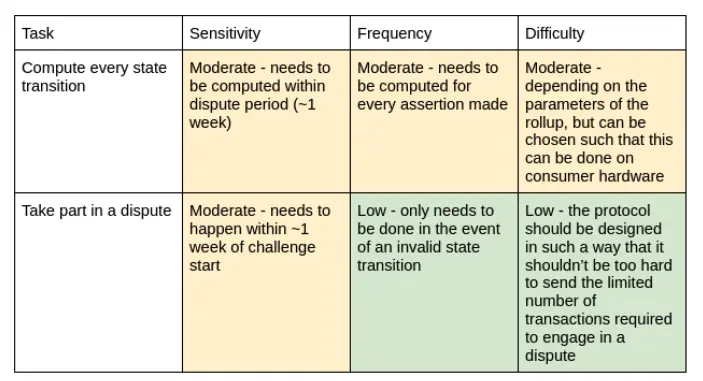
The tasks performed by a single honest party in an optimistic rollup.
The chart above shows the tasks a single party can perform on an Optimistic rollup: either a computation of transaction data, or a dispute. This waiting period is called the ‘challenge period.’ Withdrawals require the user to wait for the one-to-two week period to end before an operator picks up the transaction data and submits it on-chain. This is one drawback of Optimistic rollups: the large waiting period for withdrawals of assets from the L2 layer to the L1 chain. The drawback to this system is the delay when users move funds between the rollup and Ethereum and for transactions to be considered final. Because “watchers” need time to detect fraud, users’ funds typically take a week to be withdrawn and available for further use. ORs can only be considered safe with a ~one week challenge window.
However, the benefit of a challenge period is it allows any invalid transaction on the L2 to be disputed by any party and ultimately helps keep the data valid, increasing safety for users. Note these dispute windows are expected to come down over time and, in fact, some third-party solutions already exist to remove this delay entirely.
Overall, this ability to post L2 transaction data to the L1 is critical because it lets everyone reconstruct the current and historical state of the rollup chain. Many other scaling technologies don’t have this ability and, therefore, are less powerful to a user who’s been wronged.
Conclusion:
Base represents a significant step forward in the blockchain world, combining the best of Ethereum's functionalities with the benefits of Layer 2 solutions. With Coinbase's expertise and the partnership with Optimism, Base is poised to offer the blockchain community a platform that is robust, developer-friendly, and cost-effective. It emphasizes the evolving landscape of blockchain technology, emphasizing scalability, security, and decentralization.






