

If you want more cryptocurrency analysis including full-length research reports, trading signals, and social media sentiment analysis, use the code "Publish0x" when subscribing to CryptoEQ.io to make your first month of CryptoEQ just $10! Or simply click the button above!
Polygon (MATIC)
Polygon’s use case is as a hub for scaling Ethereum network transactions. The company Polygon Technology, referred to as Polygon, is focused on building various platforms for blockchain infrastructure to specifically support Ethereum as the overall crypto industry grows.
Polygon consists of a flagship Proof-of-Stake sidechain called Matic POS. It also involves a framework known as the Polygon SDK that allows developers to build and connect Layer-2 scaling solutions such as Plasma, Optimistic Rollups, zkRollups, and Validium (discussed in later sections).
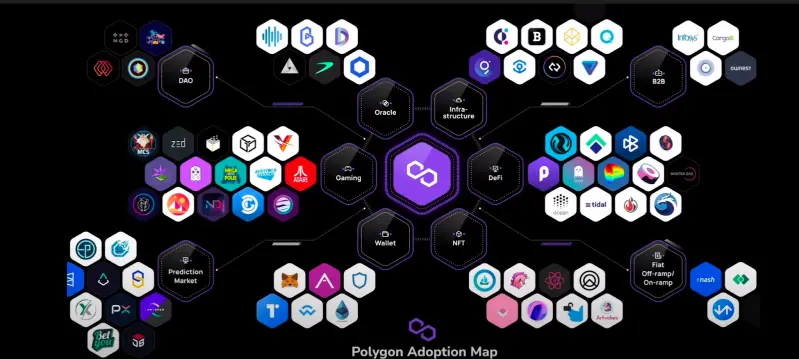
As of Q2 2022, Polygon boasts over 7000 decentralized applications (dApps), over 130M unique users, over 3M daily transactions, and has recorded over 3.4B transactions since inception. But that's not all. Let's take a look at the other scaling solutions the Polygon team are pursuing.
Recently Announced: Supernets
Supernets are essentially sidechains (or in Avalanche terms "subnets") to a mainchain built for specific industry use cases. A central chain that all other Supernets connect to, including a set of professional validators, will be the focal point. If many Supernets are built, the Polygon PoS validator set and the MATIC token could benefit 1) from the added users and transactions and 2) from off-loading some of the computational load.
Polygon Hermez: ZK Rollup
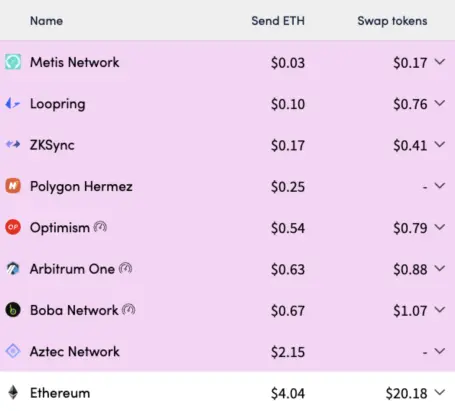
Polygon Hermez is a ZK-rollup on Ethereum that is the product of Polygon acquiring Hermez and merging it into the Polygon ecosystem. Hermez is an open-source ZK rollup designed for token transfers similar to zkSync v1. By utilizing zero-knowledge technology, Hermez claims it is able to increase throughput by ~130x (compared to Ethereum L1) while reducing token transfer costs by ~90%.
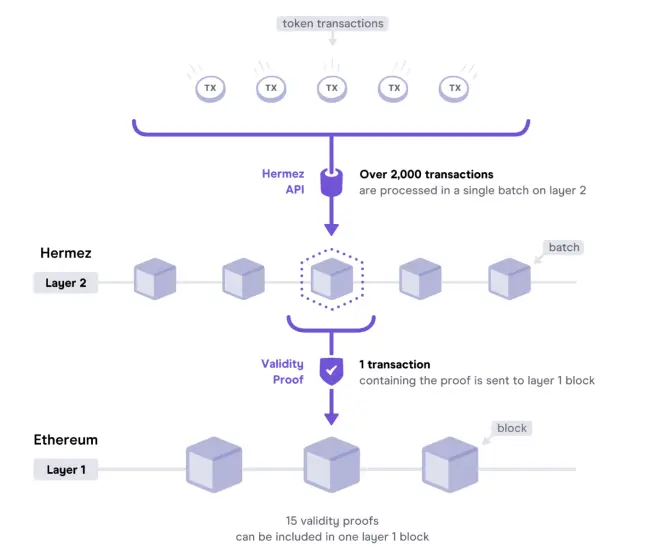
The Polygon Hermez protocol has an off-chain prover that validates transactions and generates a SNARK proof which gets submitted to the on-chain verifier, just like other ZKRs. Provers are selected via an auction process that sees registered network nodes placing bids to become the next prover. The winning bidder gets to process as many batches as they can during a single ‘slot’ that lasts 40 Ethereum blocks or approximately 10 minutes.
Hermez can process up to 2,000 transactions per second, and this will increase with the arrival of Ethereum’s consensus layer Shard Chains. It is not yet EVM-compatible. However, Polygon Hermez has announced its plans for full EVM-support (zkEVM) with a mainnet launch of Hermez 2.0 anticipated in Q2 2022 in which smart contracts will be directly handled on the rollup.
The Hermez team has also developed a novel consensus mechanism: Proof-of-Efficiency (PoE). While the concept is nascent and subject to changes/improvements, the key properties include:
- Permissionless access to the production of transactions batches on the rollup
- Disincentivizing control by any single party
- Total validation effort proportional to the value in the network
Polygon Zero: Formerly Mir Protocol
Polygon acquired Mir Protocol in December of 2021 for $400M in MATIC tokens via the $1 billion Polygon treasury dedicated to acquiring and developing ZK-based projects, with the intention of using Mir’s zero-knowledge proofs to scale Ethereum more efficiently.
Polygon Zero’s emphasis is on speed, through ZK-SNARKS, known as recursive proofs. Polygon also launched Plonky2 in January 2022, which was dubbed the “world’s fastest ZK scaling technology,” 100X faster than alternatives and natively Ethereum compatible. The architecture of Plonky2 combines the best of other solutions known as STARKs, with fast proofs and no trusted setup needed, as well as the best of SNARks, with recursion support, and low verification cost on Ethereum.
The Mir team was the first to implement recursive proofs and in 2021 set an ambitious goal of achieving sub-second recursive proofs, using Plonky2. This means Plonky2 is able to verify a large number of proofs fast and using fewer resources.
A recursive proof using Plonky2 takes only 170ms on a Macbook Pro now, which is a significant improvement that otherwise took 2 minutes on a fast computer in 2019. To get an idea of the level of advancement achieved by Plonky2’s recursion efficiency, consider that recursion was only theoretical in 2014. In 2020, they took 60 seconds to generate, compared to the 0.17 second speed achievable today.
Plonky2 is a major breakthrough for Polygon’s goal to build the future of Ethereum scaling and is natively compatible with Ethereum, making it one of the cheapest ways to verify on Ethereum, besides being the fastest proving system. Its capabilities make it ideal for building an Ethereum-compatible ZK virtual machine. Most importantly, Plonky2 is practical to use on the Ethereum base layer, with 45kb proofs in size-optimized mode, which reduces costs relative to Starkware.
Polygon Miden
Miden is a ZK-STARK rollup that was acquired by Polygon in November of 2021. Miden uses zero-knowledge technology called ZK-STARKS to “roll up” thousands of layer-2 transactions into a single Ethereum transaction, thereby increasing throughput and reducing fees.
STARK stands for “scalable transparent argument of knowledge,” while SNARK stands for “succinct non-interactive argument of knowledge.” Miden VM is a ZK-STARK compatible with EVM, making it a general-purpose ZK Virtual Machine with multi-language support as well for developers.
Polygon Nightfall: Enterprise Privacy
Nightfall is an Optimistic Rollup that is enhanced by the privacy benefits that ZK cryptography offers. Nightfall was created in 2019 by EY to conduct private transactions on Ethereum. Nightfall became a collaboration between EY and Polygon to create a public-facing privacy-focused rollup, ideal for enterprise use, as well as legal and KYC-compliant.
Polygon Avail
Avail addresses the challenges nodes face when processing malicious or incomplete data, which is referred to as a data availability problem. Remember, rollups handle transactions off-chain and then post their batches to the Ethereum mainnet as calldata for efficiency reasons. Therefore, a rollup requires there to always be enough room on the L1 for their data in order to guarantee L1-level security. Data Availability (DA) refers to a measure of how often data is available to be used, typically referring to Ethereum L1 data availability (space) for rollups.
Data availability is critical in this regard because as long as all the execution data is made available on the mainnet, the chain does not require every node to execute every transaction in order to validate transactions and reach consensus. Avail only stores Ethereum’s calldata tracking changes to the Ethereum state machine and does not support smart contracts or applications, essentially serving as a specialized data availability chain. “Data Availability (DA) Layers” are chains built to serve solely as a DA/shared security layer for rollups by specializing in ordering transactions and maximizing the DA capacity. In most cases, they generate a proof for L1 clients that (essentially) guarantees confirmation that all block data has been published on-chain. Polygon Avail and Celestia are examples that only provide high data capacity; the rollups simply optimize execution.





