
You are reading an excerpt from our free but shortened abridged report! While still packed with incredible research and data, for just $20/month you can upgrade to our FULL library of 50+ reports (including this one) and complete industry-leading analysis on the top crypto assets.

Becoming a Premium member means enjoying all the perks of a Basic membership PLUS:
- Full-length CORE Reports: More technical, in-depth research, actionable insights, and potential market alpha for serious crypto users
- Early access to future CORE ratings: Being early is sometimes just as important as being right!
- Premium Member CORE+ Reports: Coverage on the top issues pertaining to crypto users like bridge security, layer two solutions, DeFi plays, and more
- CORE report Audio playback: Don’t want to read? No problem! Listen on the go.
June 2023 Inflation
On Wednesday, the Bureau of Labor Statistics (BLS) released the latest U.S. Consumer Price Index (CPI), which revealed a slowdown in annual inflation to 3% last month. This marks the twelfth consecutive month of declining inflation in the United States, a decrease of approximately 4% from May. The current annual inflation rate is now at a more manageable level, just above the targeted 2%, and a significant improvement from the 9.1% level recorded in June 2022.
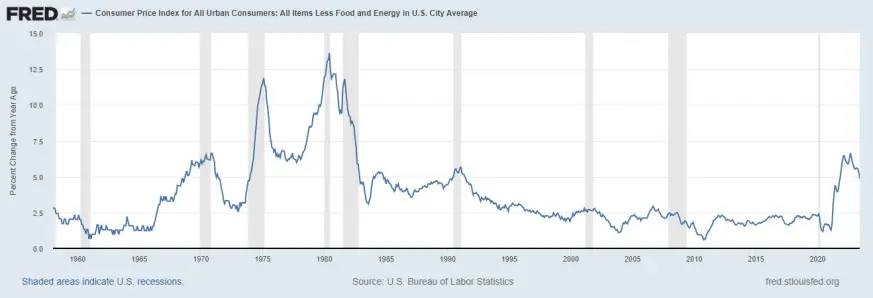
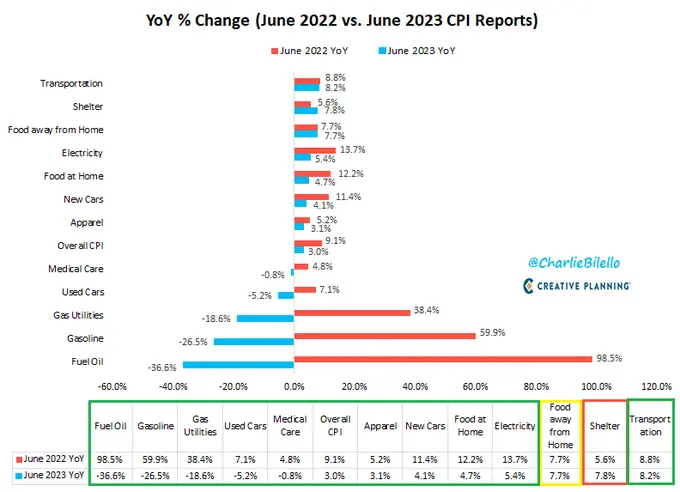
This data suggests that the Federal Reserve's efforts to combat inflation are bearing fruit. The central bank has implemented ten consecutive interest rate hikes to temper the economy, finally pausing last month. The recent cooling of inflation data implies that further monetary easing may be on the horizon, which should be a positive development for risk assets. Energy prices have become deflationary (image below) and are the primary factors contributing to falling headline inflation.
Lower interest rates typically result in increased capital availability, promoting investment over saving. Despite a marginal slide on Wednesday, digital assets like Bitcoin have managed to maintain above key support levels, with BTC remaining above US$30,000.
Simultaneously, stock indices such as the Nasdaq and S&P500 have seen an uptick. This rise may be attributed to the anticipation of the upcoming earnings season, with companies like PepsiCo and Delta Airlines set to release their second-quarter earnings on Thursday.
Interestingly, the correlation between BTC and major stock indices has been decreasing. The 30-day Pearson Correlation Coefficient between BTC and the Nasdaq Composite currently stands at a moderate 0.47. For BTC and the S&P500, this figure is slightly higher at 0.48. This suggests that Bitcoin continues to behave as an uncorrelated asset in 2023, not mirroring the movements of either gold or equities.
In conclusion, the past week has seen Bitcoin and Ethereum experience modest gains amidst a broader economic context of cooling U.S. inflation. The Federal Reserve's efforts to combat inflation appear to be working, and the prospect of further monetary easing could bode well for risk assets. As we move forward, it will be interesting to observe how these trends develop and what implications they may have for investors and users of cryptocurrencies.
Yield Curve and Recessions
The yield curve, in its simplest form, illustrates the difference between the yields of long-term (for instance, 10-year) and short-term (such as 2-year) Treasury bonds. Under normal circumstances, yields on long-term bonds are higher, as investors demand a premium for the uncertainty associated with the distant future. However, an intriguing phenomenon has been observed since 2022: the inversion of the yield curve.
An inverted yield curve, where short-term yields surpass long-term yields, has traditionally been viewed as a dependable harbinger of an impending recession. Since 1955, the United States has experienced ten recessions, and each was preceded by a yield curve inversion occurring between 6 to 24 months prior, with one exception that proved to be a false positive. It's important to note, though, that the brief and minor inversion in 2019, which was followed by the 2020 pandemic recession, can be considered more of a coincidence than a predictive event.
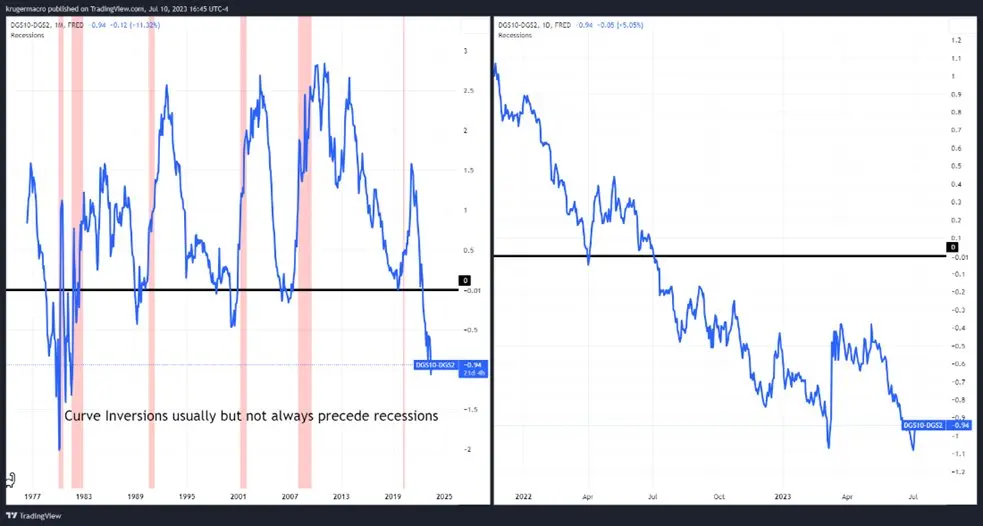
However, the practice of focusing solely on two points on the yield curve, specifically the 2-year and the 10-year yields, offers a rather one-dimensional view of the relationship among interest rates. Drawing broad conclusions about the future of the economy based on these two points is an oversimplification.
Moreover, it's crucial to acknowledge that yield curve inversions do not invariably lead to recessions in all economies, whether developed or emerging. The experiences of Switzerland, Japan, and the United Kingdom serve as noteworthy examples where the correlation between 2s10s inversions and subsequent recessions is not as evident as in the United States.
In conclusion, while the inversion of the yield curve has historically been a reliable indicator of looming recessions in the U.S., it is not a foolproof predictor. The economic future is influenced by a multitude of factors, and relying on a single indicator, especially one based on just two points, may oversimplify the complex dynamics at play. Therefore, a more comprehensive approach to economic forecasting is advisable, one that takes into account a broader range of indicators and the unique characteristics of individual economies.





