If you want more cryptocurrency analysis including full-length research reports, trading signals, and social media sentiment analysis, use the code "Publish0x" when subscribing to CryptoEQ.io to make your first month of CryptoEQ just $10! Or just click the button above!
In order to prevent spam, transactions on AVAX require transaction fees. Avalanche has an active bug bounty program on HackenProof, an advanced bug bounty platform. HackenProof crowdsources the testing, discovery, and resolution of bugs.
There are several unique advantages Avalanche has in terms of security due to its unique consensus protocol. In comparison to classical consensus protocols that can achieve higher throughput and lower latency than Nakamoto consensus protocols, classical consensus protocols can withstand up to ⅓ + 1 of the validators being malicious, Nakamoto consensus protocols are able to withstand up to 50% of the network being malicious, meanwhile Avalanche is secure with up to 60% of the network being malicious.
Avalanche consensus combines the benefits of Nakamoto consensus with its robustness, scale, and decentralization, with all the benefits of classical consensus with its speed, fast time to finality, and energy efficiency without the disadvantages.
All the chains in the primary Avalanche network are secured by the full stake value of the network, and since Avalanche consensus is inclusive and not restricted to a small number of validators like other blockchains, it can scale to millions of validators securing the network. The entire network reaches consensus and transactions are irreversible and final within less than a second in some cases, offering immediate transaction security of the entire network, compared to finality on other Layer 1’s like Solana taking several seconds and that of ETH taking above 5 minutes. Avalanche uses slashing to disincentivize fraudulent or malicious parties.
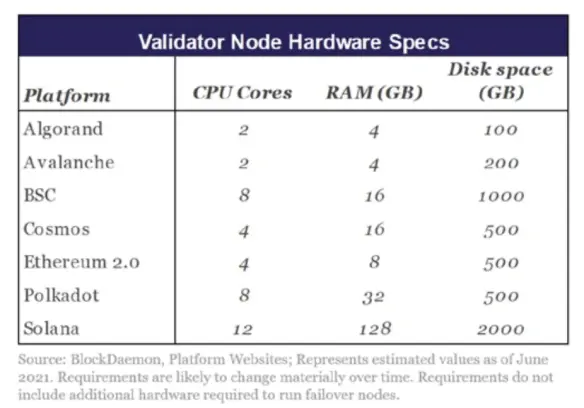
The Avalanche protocol uses repeated sub-sampling of the entire network to quickly achieve consensus with minimal overhead per node for higher performance. Hardware requirements are minimal as compared to other blockchains at just 2 cores, 4GB memory, and 32GB hard drive, enabling many more people to run a validator node. The minimum stake amount is also due to be reduced significantly once governance is implemented, so this should contribute to further decentralization. There are currently over 1000 block producing validators and all participate in consensus on a decision.
The limitation in scaling classical protocols face is that all nodes need to communicate with all other nodes in decision making and this all-to-all complexity is hard to scale beyond 100-200 nodes. Networks that adopt classical protocols that also want to achieve scale in validators need a leader or other complex mechanism to select a sub-committee out of stakers to make decisions.
Further, because validators require votes from some percentage of “all” nodes, voters need to agree beforehand on the precise total number of active validators, meaning changes in validator membership can be difficult. Ultimately such complexities hinder the scale of classical consensus protocols, limiting performance of the network.
There have been no other vulnerabilities relating to security reported in regards to Avalanche. Since Avalanche uses PoS instead of PoW, it is more Sybil resistant than PoW protocols due to the higher ease of renting hash power compared to acquiring stake in PoW chains.
Avalanche recently made headlines due to transaction fees for swaps reaching $20, which raised concerns from the community over the long-term viability of Avalanche if adoption and network activity were to increase even to match Ethereum’s 2021 levels.
Rising fees are to be expected with rising demand in block space and usage, however this brings into question the marketing message of Ava Labs and the CEO and whether or not actual scalability in Layer 1 blockchains has been truly solved in the Avalanche platform (or to what extent). Avalanche’s plan is to introduce an upgrade called “superpruning,” which intends to remove an artificial cap on gas which has caused this high transaction fee spike, which ultimately aims to drop fees in the long run.
Avalanche thus far has been marketed as a cheaper, next-generation alternative to Ethereum by Ava Labs, however the situation is more complex. In order to achieve the scalability that Avalanche has, there are some security and decentralization tradeoffs that have been made. The reality is chains outside of Ethereum thus far have not seen equivalent demand and usage to test their true transactions per second, scalability, and resilience at scale. This brings up the larger debate around the blockchain trilemma (decentralization - security - scalability) and the fundamental problem of cryptocurrency scalability and congestion.
To read further about Ethereum (and blockchains, in general) scaling, check out this report for more detail.