

If you want more cryptocurrency analysis, including full-length research reports, trading signals, and social media sentiment analysis, use the code "Publish0x" when subscribing to CryptoEQ.io to make your first month of CryptoEQ just $10! Or simply click the button above!
GMX
GMX is a decentralized spot and perpetual futures exchange that functions on both the Arbitrum One Layer 2 (L2) network and on the Avalanche blockchain network. The exchange allows users to trade BTC, ETH, LINK, and a handful of other tokens with up to a max of 30.5X leverage. Users can also provide liquidity for the protocol and earn rewards in ETH or AVAX for staking GMX tokens.
Trading in GMX is supported by its unique multi-asset pool. Because GMX is a decentralized platform, it requires users to supply liquidity for market participants to be able to trade on its platform instead of using a typical order book model. Users who supply liquidity receive a portion of the protocol’s fees.
This shared liquidity mechanism functions via GMX’s $GLP token, which is a token that acts as an index of blue-chip crypto assets. GLP accrues 70% of the platform’s generated fees. This shared liquidity model allows GMX to maintain a pool of all tradable assets on the platform as well as attract liquidity by incentivizing liquidity providers without creating inflationary token incentives. The GMX token is the protocol’s governance and utility token and can be staked to earn escrowed tokens (esGMX) as well as ETH or AVAX rewards. It also accrues 30% of the protocol's fees.
This shared liquidity model is unique to GMX in the world of derivatives protocols and combined with the use of Chainlink’s price oracles, the benefit is that it allows trades to be executed with no slippage and zero price impact. The GMX platform has no order book, so trades can be at the current price given by Chainlink’s oracles’ price feeds. This also means theoretically infinite market depth on the protocol for traders. This is in contrast to the centralized exchange model, which requires individual firms to provide liquidity directly on the order book. This ultimately leads to more efficient price execution for trades.
Because centralized exchanges have to operate in each jurisdiction separately, this causes a lot of fragmentation across the various exchanges and can contribute to a worse trading experience for users. It results in users not paying the best price for executing their trades. GMX solves this problem with its shared liquidity pool model, where the liquidity is all in one spot, which is why GMX may one day be the superior decentralized option for active traders.
GLP holders maintain exposure to all of the below index assets and earn trading fees and rewards in the form of escrowed GMX tokens. GLP maintains a target 50/50 split of using crypto assets and stablecoin weighting within the index above. While there are target weights for each asset to make up this index, GMX maintains dynamic trading and borrowing fees to adjust the index weighting towards the shown target ratios. GLP holders also receive collateral rewards when a trader’s position is liquidated. In essence, profitable traders receive their earnings from the liquidity pool while unprofitable traders pay the liquidity providers.
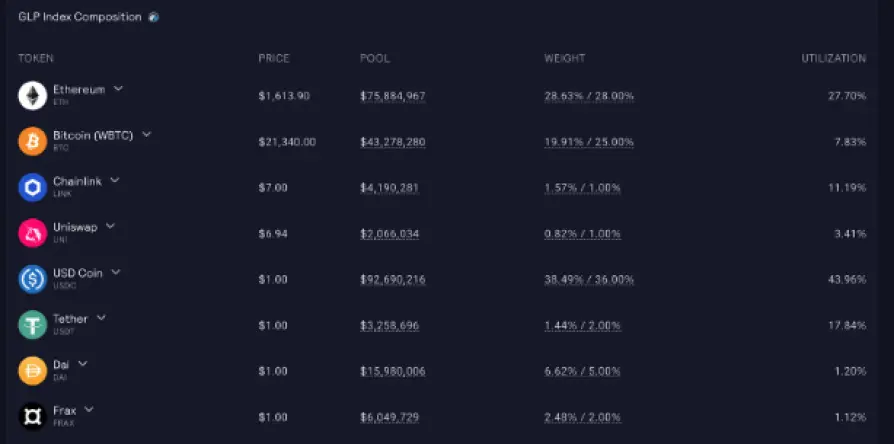
GLP Index Token Composition Source
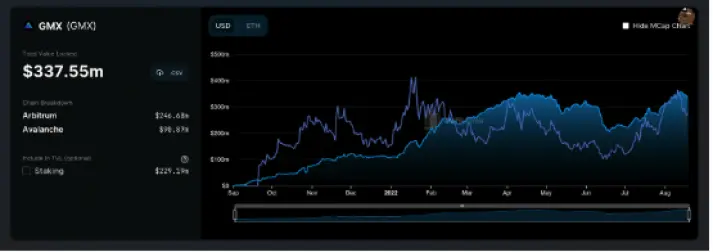
Since the GMX platform’s inception in September 2021, the exchange has amassed over $41.3 billion dollars in total volume and collected over $54.6 million in total fees from activity on its platform as of August 2022. It boasts over 68,000 users as of August 2022, up from around just 10,000 users in April of 2022.
Its 24-hour volume is over $127 million, and this metric can be compared to other centralized and decentralized competitors. For reference, the centralized exchange Kraken has about $633 million of 24-hour volume. GMX, however, is a much newer platform when compared to the established centralized exchange Kraken, so this level of usage just a few months after launch is impressive.
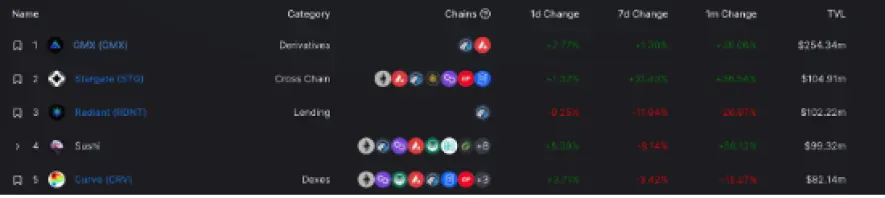
The top 5 dapps on Arbitrum right now per TVL - image via DeFi Llama
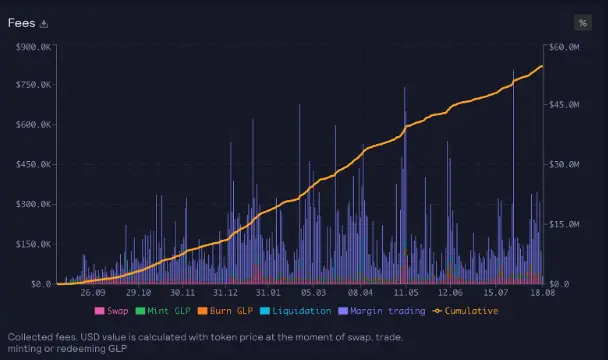
GMX Platform Collected Fees Source: https://stats.gmx.io/
Perpetual Swaps & Trading on GMX
Perpetual swaps are crypto-native derivatives products that effectively function like traditional futures contracts without any set expiry date. A perpetual contract can be traded indefinitely. In crypto markets, traders use perpetuals to speculate on crypto price action as well as to hedge their portfolios without having to use a lot of capital due to the high leverage perpetual trading platforms offer.
GMX allows for perpetuals trading in a non-custodial manner, meaning the user does not need to custody their funds with the exchange and does not even need an account to trade. All trading is done from within the user’s Web3 wallet. GMX also boasts a user-friendly UX. Users can make long and short positions with low swap and transaction fees. Liquidity providers can earn by providing assets to GMX’s multi-asset pool which supports traders in leverage trading and swapping assets.
In order for a user to open a perpetuals trade, the user would need to first post collateral to GMX by providing one of GMX’s supported types of collateral. After this, the protocol’s multi-asset liquidity pool provides the user with the funds to open a long or short position.
A user can use the GMX interface to either enter a long or short position or alternatively to swap assets. For derivatives positions, the user first selects his or her desired amount of leverage by using the leverage slider in the image shown above. The minimum leverage available is 1.1x, and the maximum is 30.5x as of August 2022. Once selected, the interface confirms the user’s entry, liquidation price based on the selected leverage and collateral, and fees charged. GMX charges an opening fee of 0.1% on the user’s position size as well as a closing fee of the same amount.
Lastly, there is an ongoing borrowing fee that margin traders must pay out hourly to GMX liquidity providers. This means that traders are charged this borrow fee every hour rather than the typical 8-hour schedule when trading derivatives on most centralized platforms. This borrowing fee is calculated as such: (assets borrowed) / (total assets in pool) * 0.01%.
GMX Staking
GMX token holders who stake their GMX earn three types of rewards. One is in the form of escrowed GMX (esGMX). Other rewards are in the form of multiplier points and ETH or AVAX reward depending on the blockchain network the user is staking – users using Arbitrum, as we recommend, will earn ETH rewards, and users using the Avalanche network for GMX will earn AVAX rewards.
Multiplier points (MP) are earned every second at a fixed rate of 100% APR. This means that 10,000 GMX staked for one year would earn 1,000 MP. MP can also be staked for fee rewards via the Compound button on the GMX staking dashboard, and in this case, they earn the same amount of ETH and AVAX rewards as a regularly staked GMX token.
30% of the fees generated from the protocol’s swaps and leverage trading are converted to ETH or AVAX, which are then distributed to stakers of GMX tokens. For multiplier rewards, users can either compound rewards or claim them to get their ETH and AVAX. Escrowed GMX (esGMX) can also be staked for rewards similar to GMX tokens or vested to earn liquid GMX tokens over a period of one year.
In summary:
- Staked GMX tokens earn ETH rewards, multiplier points, and esGMX
- EsGMX can be staked to earn ETH rewards, multiplier points
- Multiplier Points can be staked to earn ETH rewards
GMX Potential Risks
The major risk of GMX as a project is that its team is composed of fully anonymous contributors. This brings up the risk of lack of accountability if something were to ever go wrong with the project. However, it should be noted that the GMX team does have a track record of two other protocol launches in XVIX and Gambit.
GMX’s smart contracts have been audited successfully by the same firm that audited Uniswap V3, ABDK. Risks that pertain to users and traders on the GMX platform pertaining to the use of leverage are not unique to GMX but rather to margin trading itself in the crypto market. Leverage can be extremely risky, especially in times of volatility in the crypto market.
GMX’s model of using shared liquidity as a counterparty for perpetual futures is a new model and as such comes with unique and unknown risks in novel market conditions. If an event were to wipe out liquidity providers, it would mean that traders would have no liquidity to trade against. The GMX platform also has much more limited collateral options if compared to a centralized competitor like FTX, which offers coin-margined perpetuals.





