
You are reading an excerpt from our free but shortened abridged report! While still packed with incredible research and data, for just $20/month you can upgrade to our FULL library of 50+ reports (including this one) and complete industry-leading analysis on the top crypto assets.

Becoming a Premium member means enjoying all the perks of a Basic membership PLUS:
- Full-length CORE Reports: More technical, in-depth research, actionable insights, and potential market alpha for serious crypto users
- Early access to future CORE ratings: Being early is sometimes just as important as being right!
- Premium Member CORE+ Reports: Coverage on the top issues pertaining to crypto users like bridge security, layer two solutions, DeFi plays, and more
- CORE report Audio playback: Don’t want to read? No problem! Listen on the go.
The cryptocurrency and blockchain sector thrives on innovation, with each advancement addressing previous challenges and setting the stage for further refinements. In the spectrum of such advancements, Layer 2 (L2) solutions like "Base" have gained prominence, aiming to scale Ethereum without compromising security or decentralization. Let's decode the intricacies of Base and its alignment with the overarching L2 vision.
Base's Foundation on Optimism
Base, rooted in the Optimism tech stack, emerges as a Layer 2 chain where Coinbase has the distinction of being its pioneering development partner. Its compatibility with Ethereum Virtual Machine (EVM) ensures that existing Ethereum smart contracts can seamlessly migrate to the Base chain, negating any need for programming modifications. Signifying its potential, major DeFi protocols have already found a home on Base.
For those in the ecosystem, Base extends the convenience of familiar tools: an Etherscan-like block explorer, Chainlink oracles, development kits such as HardHat, and data insights through The Graph and Dune Analytics. With the primary allure of Layer 2 being reduced gas fees and enhanced transaction speed, Base doesn't disappoint. A transaction costs just about $0.29 on average, and the platform produces a block every two seconds - a notable leap from Ethereum's 12 seconds. With the block gas limit remaining constant, Base promises a throughput six times that of the main Ethereum network.
But for the uninitiated, what are Layer 2 chains? At their core, they are scaling solutions devised to decrease Ethereum transaction fees and amplify throughput. While the infrastructure relies on a third-party operator, the integrity and security of transactions are ensured by Ethereum's foundational Layer 1. Two prevalent mechanisms achieving this are optimistic rollups and zero-knowledge proofs.
The Optimistic Rollup Framework of Base
At the heart of Base's mechanism is the optimistic rollup. Under this structure, every transaction batch dispatched by L2 to the main Ethereum network can be scrutinized. If there's even a single diligent actor in the ecosystem, any dishonest transaction will invariably face a challenge, ensuring its rejection on the main Ethereum network.
Optimism pioneers the innovative concept of the Superchain, a network of interconnected Ethereum-aligned chains that is horizontally scalable and characterized by shared security, a common communication layer, and an open-source development stack, enabled by the modularity of the OP Stack. This groundbreaking approach addresses existing challenges by providing a permissionless framework for launching new chains within a cohesive network. The Superstack system aspires for its chains to seamlessly communicate and transact with each other, thereby unlocking opportunities for substantial scalability, inventive applications, and a unique revenue model that benefits both application and protocol developers.
The Superchain is a harmonious integration of the Optimism Mainnet and various other chains into a single network of OP Chains. At the heart of the Superchain's vision are the OP Chains—Layer 2 (L2) chains that can incorporate distinct design features while preserving interoperability. Contrary to traditional multi-chain designs, OP Chains are standardized, enabling developers to design applications for the Superchain as a whole, simplifying the intricacies of individual underlying chains. Notable entities such as Base, Worldcoin, Zora, and Debank have either initiated their own OP Chain or intend to do so in the future.
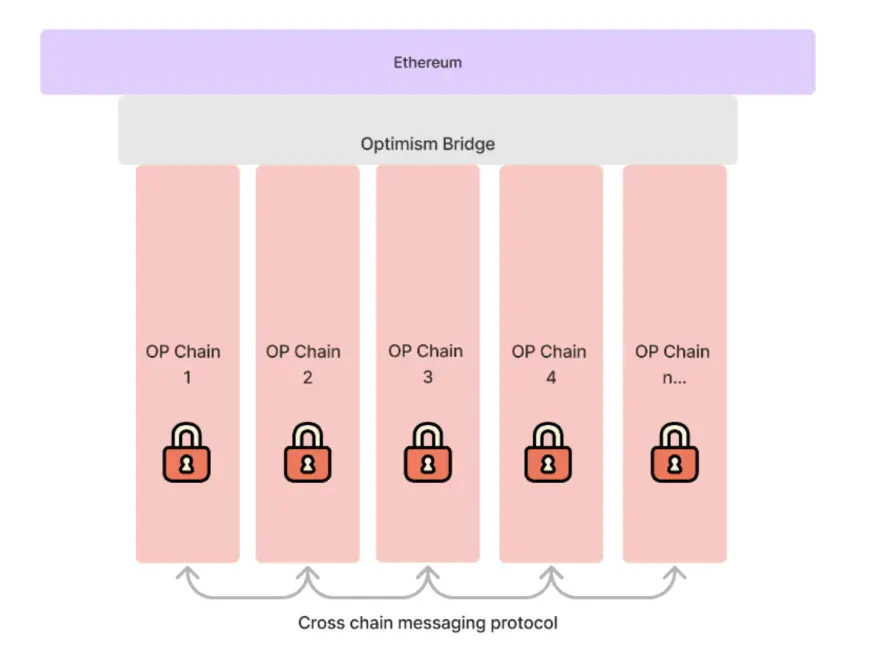
'OP chain' specifically denotes individual chains within the Optimism Superchain domain. Distinguishing itself from multi-chain systems, OP chains adhere to a standardized architecture which includes a shared base layer for Data Availability (DA), a bridge linking the base layer and OP chains, a versatile framework for rolling out OP chains, the OP chains themselves, and a cross-chain messaging protocol for efficient transfer of data and digital assets. This standardized configuration enables transaction ordering across OP Chains, empowering developers to design applications that target the entire Superchain.
Overall, the Superchain and its standardized OP Chains offer a novel approach to mitigating the prevailing challenges in the blockchain space, by facilitating frictionless communication, transaction capabilities, and enabling the development of innovative applications. This not only paves the way for significant scalability but also introduces a new revenue model that is rewarding for both application and protocol developers.
Base's Rapid Ascent
The Base ETH bridging contract on the Ethereum blockchain has witnessed a meteoric rise with inflows amassing over $188 million from a whopping 316k transactions in the past month. When juxtaposed with its outflows— which stand at a comparatively meager $11 million over the same duration — the net gain for the Base ecosystem is a substantial $177 million in ETH.
A multitude of factors have contributed to Base's accelerated growth:
-
Public Mainnet Launch: The inauguration of Base's public mainnet on August 9, 2023, under its evocative "Onchain Summer" initiative, was a pivotal moment. Accompanying the launch was the opportunity for users to create unique, commemorative NFTs, further stimulating engagement.
-
Dapp Expansion: The subsequent flourish of Base's decentralized applications (dapps) ecosystem is hard to overlook. Spearheading this surge is the avant-garde social media platform, friend.tech. With a unique proposition that grants users access to exclusive chats with prominent social media figures upon purchasing their distinct 'keys', friend.tech's appeal is palpable. A testament to its popularity was the August 21st data, showcasing 35.5k users, outstripping the 27.5k users of Fantom.
-
Airdrop Speculation: The financial realm is no stranger to speculation, and in the decentralized domain, airdrops often become the focal point. The flurry of activity on Base's bridge may also be spurred by speculators migrating to the platform in the hope of a lucrative airdrop.
Base: Centralization Concerns and Future Outlook
Currently, Base exudes elements of centralization. With a sequencer under Coinbase's control, any transaction batch can be accepted by the Ethereum Mainnet without an accompanying fraud proof mechanism. Users, for the time being, place their trust in Coinbase for honest transaction processing, non-censorship, and a steady hand on contract upgrades. Yet, questions linger. How would Coinbase, given its US domicile, respond if the chain were exploited for illicit activities, such as processing funds linked to international hackers?
While Base continues its developmental journey, platforms like Arbitrum offer a compelling alternative due to their live interactive fraud proofs, self-sequencing capabilities, and the open proposer system. There's also dYdX, which enjoys trust due to its Starknet-based L2, offering zero-knowledge proofs and secure exit strategies.
In conclusion, as the cryptocurrency landscape matures, projects like Base reiterate the sector's commitment to innovation, user-centricity, and resilience. However, as with all nascent technologies, it behooves investors and users to approach with both curiosity and caution, ensuring their choices align with both their risk appetite and the broader evolution of the ecosystem.






