You are reading an excerpt from our free but shortened abridged report! While still packed with incredible research and data, for just $20/month you can upgrade to our FULL library of 50+ reports (including this one) and complete industry-leading analysis on the top crypto assets.

Becoming a Premium member means enjoying all the perks of a Basic membership PLUS:
- Full-length CORE Reports: More technical, in-depth research, actionable insights, and potential market alpha for serious crypto users
- Early access to future CORE ratings: Being early is sometimes just as important as being right!
- Premium Member CORE+ Reports: Coverage on the top issues pertaining to crypto users like bridge security, layer two solutions, DeFi plays, and more
- CORE report Audio playback: Don’t want to read? No problem! Listen on the go.
What are the Different Types of Aggregators Available Today?
Single-chain Liquidity Aggregators (SLA)
DEX aggregators serve as a layer atop DEXs that source liquidity from many different DEXs (as opposed to just one) in order to provide users with the best possible trade price. In many cases, aggregators can reduce slippage and offer lower swap fees for a lower total cost of execution. In the early days of DeFi, an aggregator oftentimes only operated inter-chain, meaning it only sourced from DEXs from the chain on which it already existed. An overly simplified example would be an aggregator that was able to source liquidity from either Uniswap or Balancer on the Ethereum mainnet, depending on which DEX gave the better trade execution price. This can be thought of as Single-chain Liquidity Aggregation (SLA).
Over time, aggregators evolved to enable one user’s single trade to be split apart across multiple DEXs in order to execute the best totally-complete trade. Today, this is how most aggregators operate, with the only difference being how many DEXs (total liquidity) they can it include in their service.

Multi-chain Liquidity Aggregators (MLA)
The demand for aggregators has grown considerably in recent years. Using specialized algorithms, aggregators identify the most optimal routes for users to successfully and efficiently fulfill trade orders across blockchain networks. This works to substantially reduce the overall burden on DeFi users and investors having to navigate variable pricing due to liquidity fragmentation, making investment processes more desirable.
With aggregators constantly looking for greater and greater liquidity sources, their pursuits eventually led them to look at aggregating liquidity across multiple blockchains, making them Multi-chain Liquidity Aggregators (MLA). Typically, these solutions are interoperable with only EVM-compatible blockchains and can, therefore, only source liquidity from chains such as Ethereum, Polygon, Binance Chain, Fantom, Avalanche C-Chain, and others. An MLA works similarly to an SLA, only now it is able to tap into multiple liquidity sources from previously disconnected blockchain ecosystems. The more blockchains (and therefore DEXs) an aggregator can connect to, the more liquidity it can access in order to execute trades. MLAs are the prominent aggregators in use today, with 1inch, Matcha, Paraswap, Rango, and others leading the way.
At its most basic, an MLA determines which single blockchain and its available DEXs will be the best chain to execute this specific trade. The liquidity an MLA can access for any given swap is still only single-chain liquidity but is the best single-chain liquidity available. For a given transaction, the MLA will:
- Aggregate liquidity across several DEXs on one single chain
- After the swap has taken place, said swapped assets are transferred to the host/user chain (requiring cross-chain interoperability or bridging)
MLAs function by facilitating cross-chain transactions via specialized algorithms that actively scan multiple blockchain networks simultaneously. The aggregator leverages smart contracts to execute these transactions on behalf of the user in a sophisticated, decentralized, and transparent manner. Users simply connect a compatible wallet to the aggregator and request the desired transaction. The aggregator then finds the DEX with the lowest rates and facilitates the transaction. Without aggregators, users would have to manually comb through various exchanges to find the best rates and lowest fees. Through this process, CLAs unite users and investors in a single, universal order book. This creates much deeper liquidity that helps to provide a more stable overall market.
So far, DEXs and DeFi have severely underperformed compared to centralized exchanges (CEX), mostly due to a lack of liquidity and lack of interoperability across chains. The user experience (UX) for performing multi-chain transfers and trades has been far easier, more accessible, and largely more efficient via centralized exchanges than compared to conducting those transactions cross-chain.
However, as we’ve recently experienced with the collapse of FTX, centralized exchanges carry significant third-party risks. Until recently, there were no viable decentralized alternatives for them. MLAs (and CLAs, discussed below) offer a glimpse into the potential future for truly competitive decentralized cross-chain infrastructure. This comes with the necessity for an MLA to perform trades and transfer liquidity cross-chain with enough depth to handle large volumes against reasonable associated fees, minimal slippage, and an intuitive UX. Without these qualities, decentralized aggregators will struggle to obtain market share from established centralized exchanges, even in the wake of the FTX collapse and scandal.
Cross-chain Liquidity Aggregators (CLA)
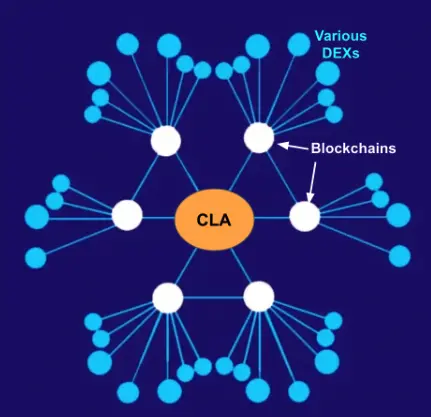
While MLAs can access liquidity from multiple blockchains, they still fall short of truly taking advantage of all the liquidity available across the various chains. It simply finds the best single-chain option, executes the trade, and swaps the assets over. But what if, rather than finding the best single blockchain, an aggregator could split up the trade across multiple blockchains, executing portions of the trade on different chains simultaneously and truly tapping into all the liquidity across chains? Cross-chain Liquidity Aggregators (CLA) like Chainge do just this.
CLAs help to enable financial interoperability for the whole DeFi/crypto financial market, creating seamless connectivity and accessibility to all crypto assets while also improving asset price stability, which has remained a problematic factor in overall adoption. The price volatility in the crypto market has led many institutions and investors to classify the entirety of the crypto/blockchain asset class as significantly risk-on. Price volatility often comes from low liquidity, meaning asset pricing is subject to (at times) extreme volatility. Innovations like CLAs can help mitigate this.
A CLA trade tapping into various disparate blockchains and DEXs for one single trade.
What are the Pros and Cons of an Aggregator?
Aggregators offer seamless, efficient improvements to overall user experiences within the blockchain industry. This comes with many advantages, including time-saving measures for investors and users alike by simultaneously interacting with multiple chains. Additionally, these efficiency improvements also help to reduce costs that fall back onto the user. A single interface that aggregates potential transactions delivers adoptable technology that is more capable than other models for onboarding off-chain, mainstream users. By using available resources, including data, smart contracts, and existing APIs, aggregators offer users far more verifiable transparency.
The major problem associated with CLAs and cross-chain technologies is how early in development these tools are. Novel technologies and new concepts generally don’t have fully fleshed-out technology, nor are they 100% functional as intended in many cases. There are growing pains with new technology, particularly cross-chain technology. There are different approaches to building this technology; some tend to offer expansions and more options to users slowly, while others launch full services. There is a risk tradeoff on the part of the users when considering what to adopt.
Read the whole report for FREE here.