
You are reading an excerpt from our free but shortened abridged report! While still packed with incredible research and data, for just $20/month you can upgrade to our FULL library of 50+ reports (including this one) and complete industry-leading analysis on the top crypto assets.

Becoming a Premium member means enjoying all the perks of a Basic membership PLUS:
- Full-length CORE Reports: More technical, in-depth research, actionable insights, and potential market alpha for serious crypto users
- Early access to future CORE ratings: Being early is sometimes just as important as being right!
- Premium Member CORE+ Reports: Coverage on the top issues pertaining to crypto users like bridge security, layer two solutions, DeFi plays, and more
- CORE report Audio playback: Don’t want to read? No problem! Listen on the go.
Smart Contract Issues
Cryptocurrency and smart contracts have taken the financial world by storm, offering innovative ways of transacting business and managing assets. However, as with any emerging technology, there are pitfalls and vulnerabilities that can be exploited by malicious actors. Here, we explore some common vulnerabilities in smart contracts, which are self-executing contracts with the terms of the agreement directly written into code.
- Re-Entrancy: One of the most common attacks in smart contracts, re-entrancy consists of an attacker calling a function recursively in order to damage the protocol, often by stealing funds.
-
Simple Code/Math Bugs: These occur when there is an error in a mathematical formula or in the calculation process, such as rounding mistakes.
- Faulty Proof Verification: Especially relevant in bridges and other cross-chain protocols, this occurs when there is a faulty verification proof on one chain which allows the attacker to falsify actions on the other paired chain.
-
Incorrect Call Permissions Check: This vulnerability arises when the caller’s ability to execute the function is not properly set. For example, a function that should be executed only by certain roles is left open for anyone to call.
Smart contracts hold great promise for revolutionizing various industries by enabling trustless transactions and automating complex processes. However, it is crucial for developers and users to be aware of these common vulnerabilities and take necessary precautions to mitigate the risks. By doing so, we can build a more secure and efficient decentralized ecosystem.
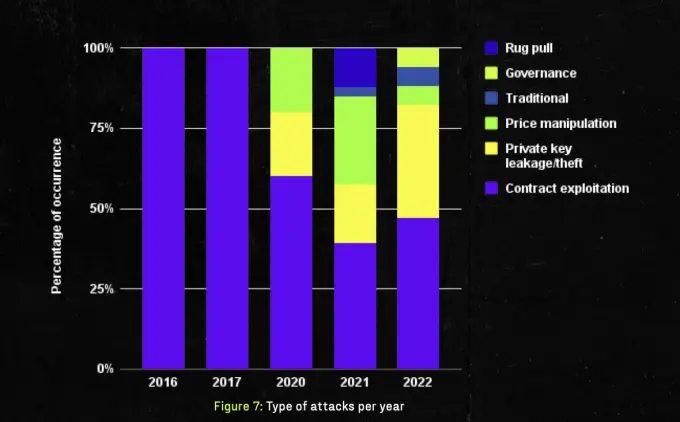
Source: Halborn
DeFi Hacks and Money Laundering
Cryptocurrency, since its inception, has been plagued with hacks and exploits. Like most frontiers of technological advancement, the DeFi sphere is not without risks. Indeed, the explosive growth and innovation in DeFi have also amplified the associated challenges. DeFi platforms, for instance, are routinely besieged by cybercriminals who abscond with their funds. According to a study by Elliptic, a whopping $3.3 billion was purloined in 2022 alone as a result of these protocol breaches.
In addition, the DeFi ecosystem inadvertently provides an alluring avenue for money laundering activities. The DeFi ecosystem's architecture, which permits unverified access to Dapps, offers a convenient conduit for cybercriminals to launder stolen crypto-assets. Moreover, DeFi offers users the flexibility to effortlessly transition funds across diverse crypto-assets and blockchains. This feature accelerates the phenomenon of "chain-hopping", a money laundering technique aimed at disrupting the traceability of funds on the blockchain by swapping ill-gotten funds into other assets or coins.
Contrary to the custodial nature of centralized exchange platforms, DEXs, underpinned by Ethereum and other blockchains, use smart contracts to facilitate real-time peer-to-peer crypto-asset swaps. The popularity of DEXs has skyrocketed in recent years, enabling users a new non-custodial trading venue but also giving criminals a new venue to launder their stolen funds.
Elliptic's research unveiled that to date, cybercriminals have laundered more than $1.2 billion of funds pilfered from DeFi protocol breaches through DEXs. The regulatory status of DEXs in many jurisdictions remains nebulous, leaving room for these platforms to be exploited as mechanisms for laundering criminal proceeds, particularly through crypto-asset swaps, without regulatory or legal interference.





