
You are reading an excerpt from our free but shortened abridged report! While still packed with incredible research and data, for just $20/month you can upgrade to our FULL library of 50+ reports (including this one) and complete industry-leading analysis on the top crypto assets.

Becoming a Premium member means enjoying all the perks of a Basic membership PLUS:
- Full-length CORE Reports: More technical, in-depth research, actionable insights, and potential market alpha for serious crypto users
- Early access to future CORE ratings: Being early is sometimes just as important as being right!
- Premium Member CORE+ Reports: Coverage on the top issues pertaining to crypto users like bridge security, layer two solutions, DeFi plays, and more
- CORE report Audio playback: Don’t want to read? No problem! Listen on the go.
Ethereum Gas
Understanding Ethereum’s fundamental operational concept, the “gas fee,” is an essential requisite for every trader or DeFi participant seeking to transact on the Ethereum base layer. In the most straightforward way, Ether is digital money on the Ethereum network. It is required when a user interacts with the network to pay network fees in the form of “gas.”
Gas is the allocative internal pricing mechanism in Ethereum used in every transaction. Gas fees that users pay represent the cost of executing transactions, operating smart contracts, or performing any activity on the Ethereum blockchain. The idea to require gas to perform any action on Ethereum was designed to mitigate spam attacks on the network and efficiently allocate computational resources. Transactions on the network must have some cost, otherwise, malicious actors could send millions of transactions a day for free, congesting the network.
Much like a car consuming fuel, each computational operation on the network consumes 'gas.' However, the capacity of the blockchain—the 'tank' in our analogy—is finite; each block can only hold so much data. Hence, users compete through bids to ensure their transactions or operations secure a spot in the upcoming block.
A critical point to note is that gas fees are dynamic, fluctuating based on the network's activity. Gas fees can reach exceptionally high price levels during periods of network congestion. Users can even prioritize their transactions by paying an additional fee, essentially enabling them to 'jump the queue.'
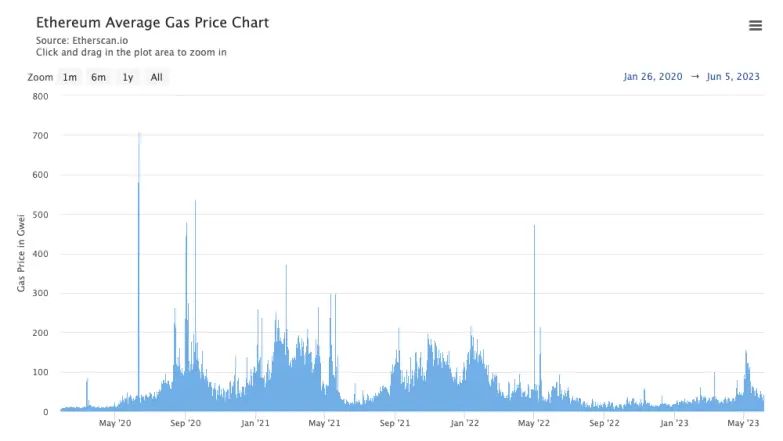
For a better grasp of numbers, we denominate these gas fees in Gwei, a tiny fraction of Ethereum's native currency, Ether (ETH). By dealing with Gwei instead of decimals of ETH, we encounter more relatable, whole numbers, simplifying calculations and estimations.
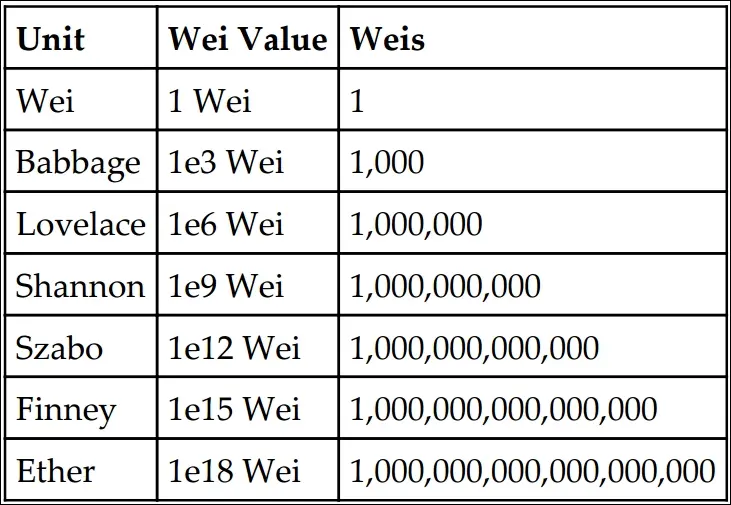
The mechanism that determines the gas fee relies on two key elements: gas limits and gas price. The gas limit is essentially the transaction's maximum cost, capping the computational power that a smart contract can utilize. The gas price, measured in Gwei, is the amount the user is willing to pay for each unit of gas consumed, changing with the network's availability at a given moment. Furthermore, an optional 'priority fee' can be paid to ensure faster transaction processing.
A simple equation calculates the gas fee:
Gas Fees = Gas Limit * Gas Price
Different Transactions = Different Amounts of Gas
Users pay different amounts of gas depending on the type of transactions they are looking to execute. The more complex the transaction, the more gas is required. Sending 1 ETH to a friend (an ETH transfer) is far simpler (computationally speaking) than minting an NFT. A standard ETH transfer, for instance, uses 21,000 units of gas irrespective of the transferred amount. In contrast, more intricate operations such as DeFi transactions or NFT minting demand a higher number of gas units due to the computational resources required. Similarly, storing data on the blockchain—a particularly resource-intensive process—has a high gas cost, with a single kilobyte of data set the user back by 640,000 units of gas.
 ETh gas market. Source
  ETH gas usage by sector, May 2023. Source: Galaxy Digital Research
Fees
The economic model of Ethereum encompasses three critical components: total transaction fees, the portion of transaction fees that are burned, and staking rewards. Transaction fees are based on the supply and demand for the network's block space. Staking rewards are inflationary and add to the total ETH supply, while transaction fee burns introduce deflationary pressure on the native token. Over time, the reduction in supply can contribute to increasing the token's value.
The TL;DR of a hypothetical Ethereum transaction goes accordingly:
- Users initiate a block by paying 1 ETH as transaction fees, which includes Miner Extractable Value (MEV).
- Of the transaction fees, 0.8 ETH undergoes 'burning,' a process akin to a share buyback benefiting all ETH holders equally.
- The validator then garners 0.2 ETH from the transaction fees and an additional 1 ETH from block rewards. These rewards consist of newly minted ETH.
- If the validator received half of its stake from delegators, the validator is obligated to share 50% of its revenue with those ETH holders.
This process results in 0.8 ETH being burned, the validator receiving 0.6 ETH, and the ETH holders who participated in staking via delegation receiving 0.6 ETH.
 Source: TokenTerminal
Fees that users pay as part of their transactions, in addition to newly minted ETH each block, are rewards for Ethereum validators. As block rewards decrease over time, fees must grow to continually financially incentivize validators on Ethereum (figure below). Etherscan provides useful metrics on Gas and other components of the Ethereum network.
 Source
  Users of Ethereum are willing to pay nearly 20x more for its blockspace. Source: Token Terminal





