If you want more cryptocurrency analysis, including full-length research reports, trading signals, and social media sentiment analysis, use the code "Publish0x" when subscribing to CryptoEQ.io to make your first month of CryptoEQ just $10! Or simply click the button above!
After the collapse of FTX, Binance and CZ will become more powerful, more influential, and come away looking like, at the very least, the "responsible" ones in the crypto space. There's no denying CZ and Binance's success. You don't become and remain the world's top crypto exchange over multiple market cycles by accident. It's truly incredible.
However, just because SBF allegedly conducted grossly inadequate risk management and possibly engaged in less-than-lawful behavior, that is merely a reflection on him and FTX. It says nothing about CZ and Binance! Lucky for us, CZ and Binance have been around a long time and have given us several instances from which we can draw our own conclusions about their ethics, character, and trustworthiness. Spoiler: there are red flags abound.
The TL;DR, in a sense, is the age-old saying in crypto, "not your keys, not your coins." One of the very reasons blockchains and cryptocurrencies have any value whatsoever is that they enable self-sovereignty, remove middlemen, and allow users to "don't trust, verify." I know there are always exceptions to the rule but.... if you're "in crypto" and are keeping funds on an exchange, you're missing the entire point and not actually "in crypto." It would be like buying a new car but using a bike to pull it around town. You're simply doing it wrong, and many would question whether you truly understand what you have in your possession.
That said, let's look at a few key things in CZ and Binance's past that should give everyone pause. Just because Binance is one of the last entities standing in this brutal 2022 bear market doesn't mean they deserve your trust, either.
BNB Chain Centralization and Misleading Marketing
In February 2022, the Binance Chain rebranded as BNB Beacon Chain, and the Binance Smart Chain rebranded as BNB Smart Chain. They were unified in a modular system called BNB Chain. Directly from the Binance website, they state BNB Chain is "permissionless" and "decentralized."

Now, stop me if you've heard this before, but this blockchain is neither permissionless nor decentralized. This isn't anything really new in the crypto world, but usually, there's at least a debate to be had. Maybe it's somewhat decentralized or falls somewhere on a spectrum of decentralization. However, in the case of BNB Chain, it has just 21 walled-off, non-permissionless validators that are run by Binance. It could not be any more contradictory to their statements above.
In what sense of the word can a blockchain that is 100% controlled by a single, for-profit company be considered "decentralized"? By this logic, every corporation to ever exist is decentralized.'
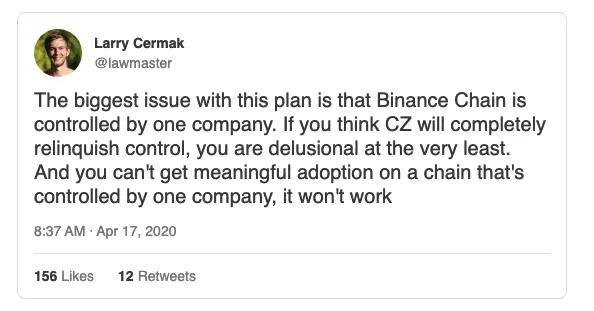
In what sense of the word can this blockchain be considered "permissionless" if you literally need permission from Binance to be accepted into the limited validator set?
And below is an example of Binance Research promoting "DeFi" on BNB Chain. But again, this is a Proof of Authority (PoA) chain fully controlled by one company, Binance. One company is allowing you to transact. That's a bank.... that's literally just a bank.
Binance is 100% being misleading with the terms used to describe and promote its chain. If that's the case, what else would they be willing to be "misleading" about? Glad you asked...
Binance and CZ "Burn" Users' Trust
Highlighting BNB’s centralization risks was the discovery in January 2020 that Binance discreetly edited the original wording in the BNB whitepaper to remove the “20%” burn benchmark without publicly disclosing the change. Binance made the publicly unannounced edits back in March 2019. The new wording states, "Every quarter, we will destroy BNB based on the trading volume on our crypto-to-crypto platform until we destroy 50% of all the BNB." To put it bluntly, Binance unilaterally altered a fundamental aspects of the project and the token's value accrual mechanism without asking, polling, or telling the community. It does not get any more centralized OR untrustworthy than that. Binance has shown the willingness and ability to change how the blockchain works at its discretion.
Many investors shrugged at this change as the same amount of BNB will be burned, but then again, that, too, is at Binance’s discretion. The lack of transparency surrounding the changes to the monetary policy highlights the trusted nature of an exchange token and should serve as a red flag for future investors.
In another example of Binance going back on their own word, in May 2020, Binance reneged on their original stance concerning the controversial Justin Sun-supported Steem hardfork and began supporting the fork essentially controlled solely by Justin Sun. Binance originally declined to support the network upgrade, saying they “do not condone this type of behavior,” and then announced support a few days later.
As described above, Binance has proven itself to be untrustworthy on at least two major occasions, confirming its willingness to devalue its own customers in the pursuit of profit. It remains unlikely that these two events were the exception rather than the rule.
So, we've covered one extreme and explicit example of BNB Chain's centralization, are there other ways this centralization could rear its ugly head?
The Risks of Being Tied to an Exchange
Thanks to FTX, this one should be obvious. Even the biggest companies in the world fail. And if your entire network/token are tied to the success of one business in one of the most unpredictable, nascent, and heavily scrutinized industries in the world during a looming global recession, then you should be concerned.
Binance supports the BNB blockchain development with significant funding and team resources. BNB is not an open-source blockchain and is controlled by a private company. There is no argument that BNB users incur extreme centralization risk when holding BNB or utilizing the BNB Chain. BNB’s future is ultimately tied to Binance’s success as a profitable company, including financial, cryptocurrency, and Binance-specific regulatory risks. And while the token sale wasn't the worst we've seen in crypto, still 50%+ went to insiders and team.

With greater than ~90%+ of BNB either owned or custodied by Binance, the potential catastrophic downside risk for the token becomes even greater. Exchange hacks are an ever-constant threat, as are failed crypto businesses. The BNB token is exposed to both of these (regular) downside events, unlike a traditional cryptocurrency like Bitcoin or Ethereum. And it's not like Binance has never been hacked....
Hacks
Hackers stole $40 million USD in a single transaction from high-net-worth accounts on Binance in May 2019. The funds were not recovered. Additionally, a hack of Binance’s former third-party Know Your Customer (KYC) provider leaked 60,000 users’ sensitive personal data, including photos, physical addresses, and crypto amounts, putting many in potential harm’s way as future targets for theft cyber or physical. In response to the negligence, Binance gave lifetime VIP memberships to those affected for their very site that just proved itself irresponsible and unsafe to use.
In Q4 2022, an attacker stole 2 million BNB (about $560 million) from the cross-chain bridge of the Binance network, BSC Token Hub. After investigating the situation, the pseudonymous researcher "samczsun" uncovered a flaw in how the bridge validated security proofs, allowing attackers to fake arbitrary messages. In this instance, the attacker fabricated two messages "persuading" the bridge to send them each 1 million BNB. Validators suspended the chain for several hours in order to limit the vulnerability until a solution could be discovered. The Binance team will hold an on-chain governance vote to choose what to do with the stolen assets and whether or not to develop a "white hat" program for future bugs.
Beyond Binance, the exchange, being hacked, the BSC chain, due to its unsophisticated user base and ease of deploying centralized projects, has become a playground for scam coins, hacks, exploits, and "rug pulls," a term used for when founders run off with user's money. As of Q4 2022, several BSC DeFi protocols have suffered major exploits raising a debate about whether the low fees are worth the lack of security. Examples include Venus Protocol, in which over $200 million was lost due to price manipulation associated with its native XVS token, Pancake Bunny losing $50 million in a flash loan attack and the token price falling 95%, $11 million lost in bEarn, $30 million in the Spartan protocol, and a $1.8 million on Uniswap clone, PancakeSwap.
Ok, so you probably get it by now, BNB Chain is a less-than-ideal blockchain with real centralization concerns and a questionable track record about a few things. But, the chain works and it enables cheap fees, right? Here's the thing about that...
BNB Chain: Its Lazy Origins and Gloomy Future
In yet another example of "this should surprise no one," I regret to inform you that BNB Smart Chain is simply an Ethereum clone with a few short-term parameter changes to juice throughput at the expense of decentralization and longevity. Shocking right? While not Binance's most egregious act, I cannot pass up the opportunity to try and educate readers on why "Ethereum Killers" like this were always doomed to fail/further centralize over time.
The original BSC chain was/is, essentially, a direct copy of Ethereum's code and EVM with a different, more centralizing consensus mechanism to make the chain cheaper and faster. It is a Geth fork written in the Go programming language. BNB Chain did, quite literally, the most obvious and lazy changes that anyone could make to enhance performance. Meaning, yes, Ethereum could do the exact same things tomorrow and essentially become just as "performant" and cheap as BSC. They don't do this because it 100% negates the entire value proposition of a decentralized blockchain. They
- reduced the validator set to 21
- made the validator set permissioned
- required validators run highly-performant (and expensive) hardware not easily accessible to anyone
- raised the gas limit allowing for more transactions per block
Binance didn't innovate or crack the "Scalability Trilemma" where others couldn't. They did the equivalent of a marathon runner sprinting at 100% capacity to gain an early lead, only to fall on their face at mile number 2. And now they are trying to patch over their mistakes....
Unsustainable Scalability
BNB Chain enables faster transactions and cheaper fees by increasing the gas limit in each block (120M versus 15M in Ethereum) and having faster block times (5 seconds versus ~15 seconds in Ethereum). This approach has seemingly helped create cheap fees, leading to BNB Chain being the number one chain based on transactions/day. However, even just briefly evaluating the transactions, it becomes clear that a large portion of transactions is simple spam/spoof transactions meant to boost network usage metrics.
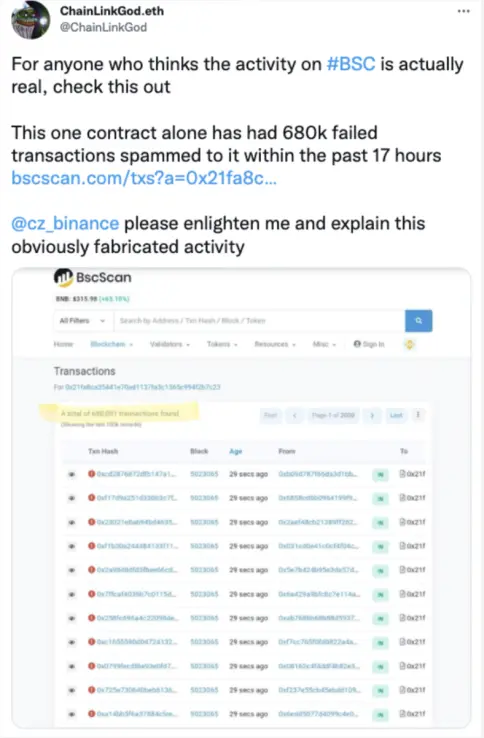
Additionally, the combination of these two scaling approaches only improves performance in the short term (at the expense of decentralization) but has long-term consequences. Over time, the blockchain state size becomes so large that only a few mega-corporations can afford to run a node due to hardware constraints. This is fundamentally no different than a centralized data center or Amazon Web Services. The "decentralization" is gone and with it, all the benefits of an actual blockchain. The active state size of the chain (state that smart contracts need access to) and hardware computer performance have physical limitations and can create a bottleneck down the road.
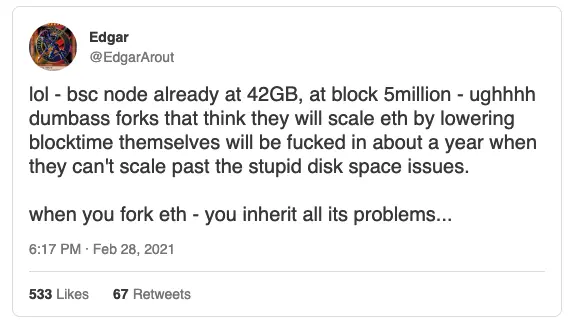
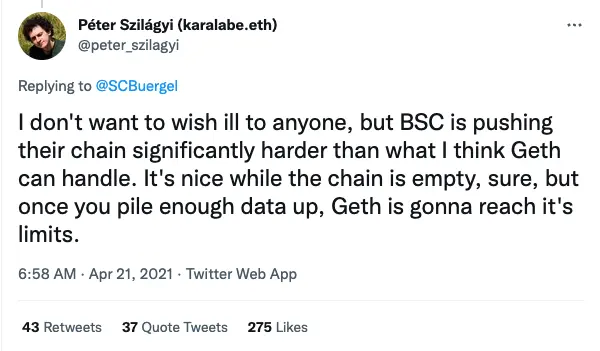
Because of this, Binance Chain has experienced synchronization issues, validator-sponsored front-running, and network spam attacks (highlighted in the examples below).
https://github.com/bnb-chain/bsc/issues/911
https://github.com/bnb-chain/bsc/issues/338
https://github.com/bnb-chain/bsc/issues/658
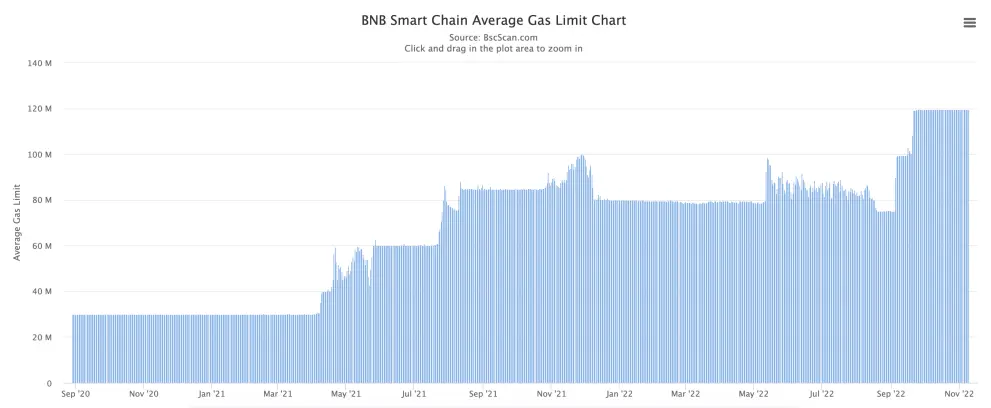
For now, Binance just continues to increase the gas limit whenever the chain gets congested, but there will come a time when that is not an option. And it seems like that day may have already come. Earlier in 2022, Binance announced side chains to help alleviate some of the congestion issues. Sidechains are nothing new, original, or sophisticated. They are even less secure, "sister chains" that provide less security, less decentralization, and fewer censorship-resistant guarantees. Again, another band-aid rather than doing the hard work to try and find a route to sustainable scaling.
Finally, there's just that little topic of regulations and whether BNB constitutes a security.
To Be or Not to Be..... A Security
The SEC's laws on the marketing and sale of securities are intended to prevent a certain mischief: insiders and promoters of a business will have more information than investors (information asymmetry). This is remedied by the SEC requiring truthful and comprehensive disclosure in a regulated format.
The Howey test, the main case law on the features of a security, remains the best measuring stick despite its many shortcomings when applied to crypto assets. For the purposes of this analysis, understand that the degree of decentralization of a protocol is a significant factor in determining which, if any, United States securities regulations apply.
“When a promoter, sponsor, or other third party (or affiliated group of third parties) (each, an “Active Participant” or “AP”) provides essential managerial efforts that affect the success of the enterprise, and investors reasonably expect to derive profit from those efforts, then this prong of the [Howey] test is met.
There are essential tasks or responsibilities performed and expected to be performed by an AP, rather than an unaffiliated, dispersed community of network users(commonly known as a “decentralized” network).”
-SEC guidance “Framework for ‘Investment Contract’ Analysis of Digital Assets
The BNB token was launched in an initial coin offering, which the United States Securities and Exchange Commission has viewed unfavorably and has yet to rule broadly. Some ICOs have been retroactively penalized for violating US securities law.
BNB can be deemed a security if it satisfies certain properties based on the common definition and interpretation of the Howey Test, the most common legal test applied to securities. The four component questions of the test are listed below:
- Is there an investment of money?
- Is there an expectation of future profits?
- Is the investment of money in a common enterprise?
- Do any profits come from the efforts of a promoter or third party?
As of Q2 2022, the Securities and Exchange Commission (SEC) is allegedly probing Binance’s native token BNB for potential violation of securities regulation.
The biggest argument for BNB being classified a security according to the Howey Test is its dependency and centralization around the “common enterprise” and “third party” company, Binance. As detailed in this article, Binance (the company) controls nearly every single aspect of this chain from the validators to holding most of the tokens to conducting the ICO to maintaining the development. And let us not forget, to even secretly changing the underlying code/burn mechanism without consulting anyone. These are all clear examples of how the BNB token is reliant on the efforts of a central third-party.
Other tokens created by large centralized companies have recently run into opposition from the US regulators, such as Telegram abandoning its project entirely after a multi-year battle with the SEC. Additionally, the buyback and burn procedure creates a deflationary nature, uses language indicative of an equity buyback. While the actual buyback is not actually a buyback, the use of the word buyback could bring unwanted regulatory scrutiny.