You are reading an excerpt from our free but shortened abridged report! While still packed with incredible research and data, for just $20/month you can upgrade to our FULL library of 50+ reports (including this one) and complete industry-leading analysis on the top crypto assets.

Becoming a Premium member means enjoying all the perks of a Basic membership PLUS:
- Full-length CORE Reports: More technical, in-depth research, actionable insights, and potential market alpha for serious crypto users
- Early access to future CORE ratings: Being early is sometimes just as important as being right!
- Premium Member CORE+ Reports: Coverage on the top issues pertaining to crypto users like bridge security, layer two solutions, DeFi plays, and more
- CORE report Audio playback: Don’t want to read? No problem! Listen on the go.
The Polygon PoS Commit-Chain: Formerly Matic Network
The flagship product of the Polygon ecosystem is the proof-of-stake (PoS) chain, an independent, monolithic, Layer-1 blockchain. The Polygon PoS chain has transitioned from a traditional sidechain (consensus was entirely independent of the main chain) to a commit chain that rests on top of the Ethereum mainnet. The commit-chain model works via validators staking Polygon’s native token MATIC on Ethereum in exchange for Ethereum’s own network security.
PoS Consensus Mechanism
Since the Polygon commit chain is a separate, monolithic chain altogether, it must be secured by a separate proof-of-stake (PoS) consensus mechanism whereby validators stake MATIC tokens to secure the network. Polygon employs the Plasma framework and the More Viable Plasma (MoreVP) consensus method. MoreVP is a PoS consensus algorithm alternative. Within MoreVP, block validation consists of a hierarchical structure with numerous levels of block validators jointly working together to guarantee the network’s security and reliability. This enables Polygon to achieve fast transaction throughput and cheap transaction fees while maintaining the security and decentralization of a PoS blockchain.
However, MATIC is staked in smart contracts on the Ethereum main chain. Validators secure the chain through Ethereum-based staking contracts in collaboration with checkpoints that monitor the state of the Polygon network. In theory, this provides additional security to Polygon. The Polygon PoS chain uses this process with a capped value of 100 validators and ⅔ consensus instead of a typical 51% consensus. With only 100 validators, it's possible that collusion can occur, meaning the network is not necessarily as secure as the additional checkpoints make it out to be.
 High Level Overview of Various L1 Designs, Source: Delphi Digital
Ethereum Virtual Machine (EVM)
Ethereum is a decentralized blockchain platform for building and running autonomous, Turing-complete smart contracts over a global network of permissionless nodes. The most popular implementation of the protocol (Geth) is written in Go, and the most widely-used smart contract language on the platform is Solidity.
 Ethereum virtual machine layers, Source: medium.com\ChainLinkGod
What exactly is the EVM, though? In the context of Ethereum, a virtual machine is a software-based computing environment (consisting of Ethereum clients) that replicates a single computer’s capabilities but can be globally accessed. Any entity participating in the Ethereum network must run the EVM to compute state transitions. If all nodes run the same EVM (same rules), all nodes are aware of global state changes.
For builders using the EVM, composability means they can leverage one or more of the following:
- Ethereum's Social Graph: addresses are the same across EVM chains, meaning that any new project or chain can leverage the metadata associated with a user/address to solve cold-start problems
- Tooling and infrastructure: Some tools include Gnosis Safe, WalletConnect, Zerion, MetaMask, and Etherscan. There are many open-source toolkits, such as OpenZeppelin, Hardhat, and Foundry
- Interoperability: Cross-chain governance, ERC-20 token trading identical address system, etc.
As with other Ethereum Virtual Machine (EVM) chains, Polygon uses a mempool where transactions are indexed prior to being added to a block. Consequently, despite the fact that Polygon’s block time is two seconds, there's no assurance that a transaction will make it into the next block as it may become stuck in the mempool, especially during periods of extreme volatility.
Finally, Polygon’s block time is two seconds as opposed to Ethereum’s 12. Currently, the block size for the POS chain on Polygon ranges between 50 and 120KB and the PoS chain regularly processes more daily transactions and TPS than Ethereum.
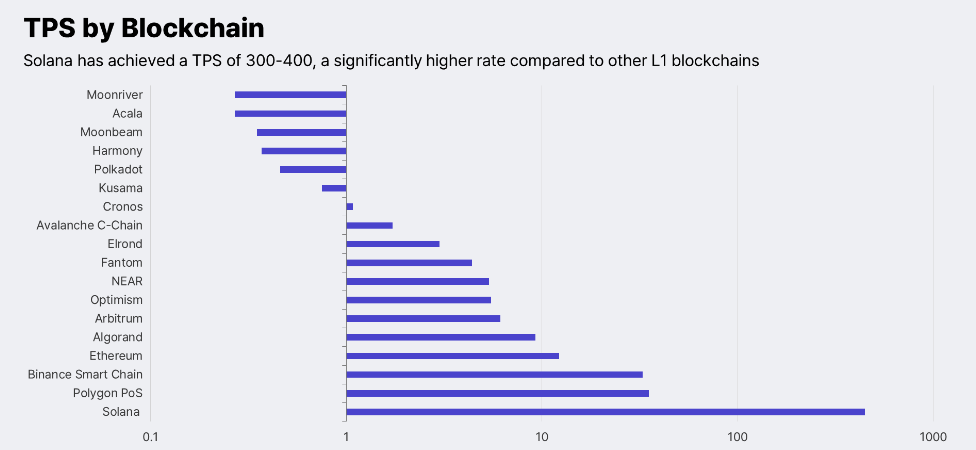 Source: Xangle
Bor and Heimdall Layers
The EVM-compatible commit chain has its own validator set, which is composed of three distinct layers: the staking contracts on Ethereum, the block production layer, and the validator layer. The Bor, or block production layer, is responsible for collecting transactions into blocks. The validator layer, referred to as the Heimdall layer, processes the aggregation of blocks produced by Bor into a Merkle tree and periodically publishes the root to Ethereum. The Heimdall layer is essentially the Tendermint consensus engine of the Cosmos blockchain with some modifications to the data structures and signature system.
In other words, the Heimdall layer predetermines the block that the validators will confirm for the commit chain based on the staked amount (i.e., the amount of MATIC held in an escrow-equivalent account). This is proportional to the blocks a validator is awarded to mine. The more MATIC that’s staked, the more blocks for which a validator is responsible. Additionally, the added security comes from that staked MATIC being vulnerable to slashing if it's found that the validator is acting maliciously. The block assignments themselves are awarded to validators in 64 block sets called sprints. Therefore, it's not just one block that each validator is responsible for, but 64 in a row until the next validator is chosen.
To summarize the structure of the PoS commit-chain, it can be visualized in three different layers:
- Staking and Plasma smart contracts on Ethereum: A set of smart contacts are maintained on Ethereum to manage staking and reward functions for the PoS layer as well as for delegation management
- Bor (Block producer layer): Responsible for aggregating transactions into blocks
- Heimdall (POS layer): Aggregates the blocks produced by the Bor layer, below, into a Merkle tree

Commit Chain, Checkpoints, and Connection to Ethereum
Polygon connects to Ethereum through a bridge with the use of a lock and mint mechanism. Users deposit funds into the bridge, which locks them into a smart contract on the Ethereum chain and mints the equivalent amount of tokens on the Polygon chain.
 Blockchain and sidechain, Source: Preethi Kasireddy
Polygon also maintains a secure relationship with the Ethereum main chain through periodic checkpointing by posting state changes to Ethereum and leading the Polygon team to characterize it as a “commit chain.” This differs from a sidechain, which instead only involves a two-way bridge that lets users use their bridged tokens on the sidechain ecosystem. The Polygon validator saves checkpoints with transaction data via the EVM contract. So, the validator submits the block to both Polygon and the checkpoint EVM contract on Ethereum side to save the Merkle root. If there's ever an issue and the chain is broken, validators have the ability to resume production with a fork to the last good block saved in the checkpoint. Any unsaved checkpoints that come after this checkpoint are discarded.
 Modular blockchain stack of Polygon, Source: twitter.com\100y_eth
As previously mentioned, users lock funds in a smart contract on Ethereum when bridging over the Polygon’s network. For funds to be transferred back to the underlying L1, the L1 smart contract must obtain proof that the bridged assets still actually exist. Polygon PoS accomplishes this via the checkpoints. Checkpointing provides finality on the Ethereum chain. In the Polygon commit chain, the Polygon PoS contract deployed on the Ethereum main chain is considered to be the ledger of truth, and thus, all validation is done by querying the Ethereum main chain contract. In this way, the commit chain operates adjacent to the Ethereum mainchain by bundling together transaction batches and confirming them en masse before returning data to the main chain.
 Matic chain, Source: twitter.com\Crypto_Texan
To withdraw funds, you must go back through the bridge. The Polygon PoS bridge (and funds) are secured by a 5/8 multi-sig scheme, making it incredibly more centralized than the Ethereum mainchain. This centralization factor should be considered when weighing the cost of transacting on an L2 solution.
The Polygon Modular Hub-and-Spoke Model
In addition to the Polygon PoS commit chain, Polygon operates a modular infrastructure via the Polygon product stack. This product stack is designed to be the Cosmos hub-and-spoke model equivalent for Ethereum, becoming an internet of blockchains. This model provides the architecture for developers to create custom, application-specific chains that can leverage Ethereum’s advanced security while being optimized for the application being constructed.
The Internet of blockchains model operates in contrast to a traditional monolithic architecture where there's a single blockchain for all applications. Monolithic designs end up being limited by what individual nodes can process. The more demanding the blockchain, the more powerful a node securing the network must be. There are obvious extended limitations with this, including restrictive governance to only powerful nodes, which leads to a more centralized network. Modular chains, such as Polygon, limit this due to computational power being spread across application-specific chains. There are less restrictive requirements to run a node, opening up the network to a much higher degree of decentralization.
Additionally, monolithic blockchains also face greater issues with scalability, affordability, and accessibility. Because all applications are competing for the same block space on a monolithic chain, this pushes user gas fees much higher. Plus, applications that require heavy resources to operate will naturally push gas fees higher for all applications on the monolithic network. This is where the advantage of modular blockchain design peaks. Polygon-supporting application-specific blockchains will allow more computationally expensive applications to remain in their own chains and isolated ecosystems (while still having direct connections with the greater Polygon and Ethereum ecosystem).
The problem of supply and demand for block space in a monolithic system is precisely what has been plaguing Ethereum since its inception. There have been numerous events that have demonstrated Ethereum’s inefficiencies, including when CryptoKitties clogged the network in 2017 or when Otherdeed released their virtual land plots for mint in 2022 that effectively spiked gas fees to extraordinary levels and made Ethereum unusable.
Polygon Product Stack
The following graphic represents Polygon’s product stack:
 Polygon's product stack, Source: medium.com\momentum6
 Polygon's Product Suite, Source: Blockworks
To read the entire FREE report, click here.