
You are reading an excerpt from our free but shortened abridged report! While still packed with incredible research and data, for just $20/month you can upgrade to our FULL library of 50+ reports (including this one) and complete industry-leading analysis on the top crypto assets.

Becoming a Premium member means enjoying all the perks of a Basic membership PLUS:
- Full-length CORE Reports: More technical, in-depth research, actionable insights, and potential market alpha for serious crypto users
- Early access to future CORE ratings: Being early is sometimes just as important as being right!
- Premium Member CORE+ Reports: Coverage on the top issues pertaining to crypto users like bridge security, layer two solutions, DeFi plays, and more
- CORE report Audio playback: Don’t want to read? No problem! Listen on the go.
BTC Mining
Bitcoin, like gold or oil, has a production cost, with units able to be brought to market through energy expenditure via purpose-built hashing devices called miners. Due to the asymptotic supply issuance of bitcoin combined with the difficulty adjustment, it has become exponentially harder to produce a unit of bitcoin for over a decade.
Central to Bitcoin's architecture is its mechanism to sustain a consistent block interval of 10 minutes — the mining difficulty adjustments. The significance of this mechanism extends beyond just maintaining regularity. It fundamentally steers the profitability compass for every Bitcoin miner across the globe.
Miners, forever in pursuit of profitability, venture into various strategies, from harnessing cost-effective electricity sources to acquiring cutting-edge ASIC technology. But amidst these varying operations, Bitcoin's decentralized nature ensures one commonality: every miner's incremental hashrate contribution garners equivalent compensation.
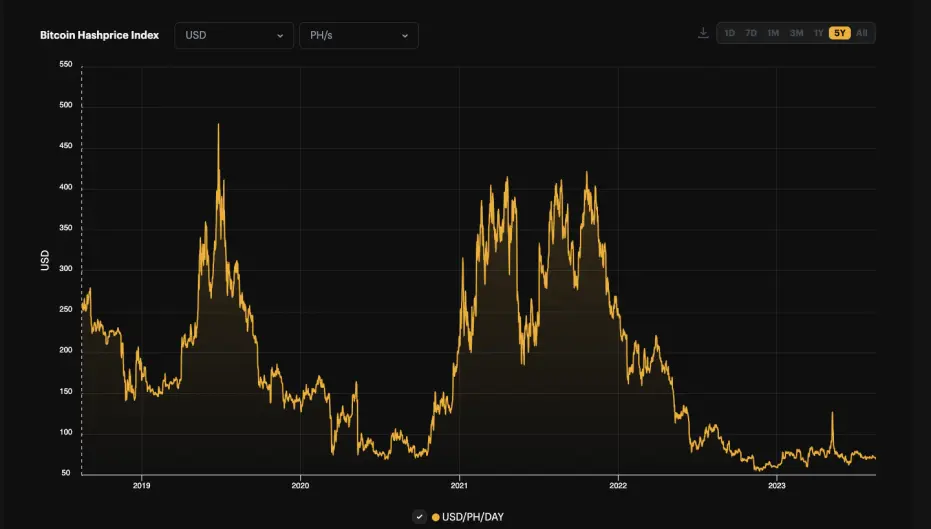
Metrics of Measurement: Hashvalue vs. Hashprice
Two prevalent yardsticks capture a miner's revenue capacity. The Bitcoin-denominated daily revenue per terahash per second (TH/s), often termed "Hashvalue," and its USD counterpart, "Hashprice."
Network hashprice ultimately depends on issuance, fees, the price of bitcoin and hashrate. Since BTC issuance is fixed within a halving period and fees are typically a small percentage of bitcoin-denominated revenue, the two most important variables are hashrate and BTC price. The two variables are related: miners who are operating unprofitably will shut off their machines, bringing down network hashrate and correspondingly increasing bitcoin-denominated revenue for miners who remain online. As a result, after difficulty adjusts, network hashprice can sometimes react more slowly to price declines than expected.
Given the notorious volatility associated with Bitcoin's price, Hashvalue emerges as the more stable metric. Its predictability is anchored in the fixed amount of new coins issued per block, presently set at 6.25 BTC. This means between sequential difficulty adjustments, a miner's daily Bitcoin earnings exhibit a steady pattern.
But block discovery isn't a deterministic event; it's steeped in probabilities. As a result, new coins might sometimes deviate from the targeted 10-minute interval, introducing slight variability into the Hashvalue. Nonetheless, a discernible trend is evident: negative difficulty adjustments usually uplift Bitcoin-denominated revenues, while their positive counterparts have the reverse effect.
Hash rate-normalized revenue has been in an exponential downtrend since 2010 as bitcoin exploded in popularity and miners began experimenting with GPUs. It seems fated that the decline will continue indefinitely due to the pre-programmed subsidy cuts, the ever-increasing adoption of cryptocurrencies and the permanent arms race for new and more efficient mining rigs.
Bitcoin's PoW and Difficulty Adjustment
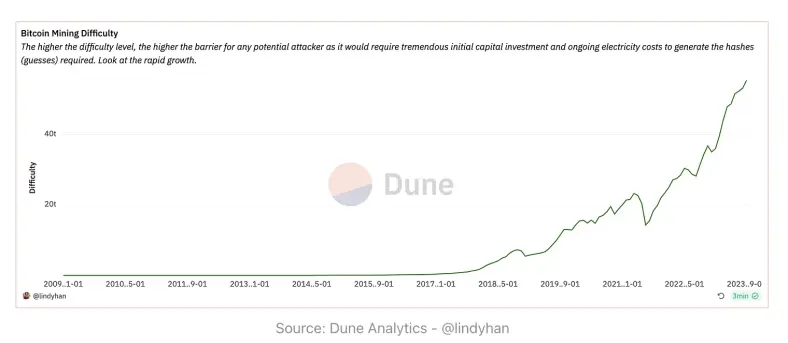
Approximately every ten minutes, a new block is mined, and new bitcoins are created. This consistency and predictability in the monetary policy is part of the magic of Bitcoin. The Bitcoin system was designed so that it becomes progressively more difficult to “mine” bitcoins as more computing power is added to the network. This is known as the Difficulty Adjustment and is a global ‘difficulty’ parameter that adjusts once every 2,016 blocks (~2 weeks) based on the overall computational power of the network. It does not matter if 100 computers are mining or 100,000,000. The Bitcoin network will dynamically correct itself thanks to the Difficulty Adjustment so that, on average, a new block is produced every ten minutes.
This adaptive structure of the network allows for a very predictable supply schedule, including predetermined “halvenings.” In May 2020, Bitcoin underwent its 3rd halvening in which the issuance rate of new bitcoins was reduced by 50% or halved. These will continue approximately every four years until all 21 million bitcoins have been created sometime around 2140. After that, the miners will no longer get new Bitcoin but will sustain their operations through transaction fees for their work.
Miners select pending transactions from the mempool to construct blocks. Because miners are profit-driven, they are incentivized to select the transactions with the largest transaction fee, which gets paid to them if they are successful in mining the next block. In times of high demand/network congestion, bitcoin users can manually increase the transaction fees they are willing to pay in order to increase the likelihood of being included in the next block. This is known as a first-price auction or pay-as-bid mechanism. When the spender’s transaction makes it into a block, the miner collects the included fee as a reward. This highest-bidder system enables high-time preference Bitcoin users to outbid low-time preference spenders, ensuring that the most economically important transactions get confirmed first.
Bitcoin is the only asset in the world with an immutable, predictable supply schedule. How is this possible? It works because of the difficulty adjustment (discussed above). As more (or sometimes less) hash rate joins the network, the difficulty algorithmically adjusts in order to keep new blocks being mined about every 10 minutes. As new blocks get mined, and full nodes validate these new blocks, the immutable supply schedule slowly issues new BTC over time.
In the long run, there will never be more than 21,000,000 BTC. For every other commodity, as the price moves higher, production increases, which inevitably pushes the price lower.
No matter how high the price of Bitcoin goes, you cannot increase production. Instead, the difficulty simply adjusts higher.
The foundations of Bitcoin's programmed supply strategy are the difficulty adjustment and reward halvings. The difficulty adjustment ensures that the production of blocks and, consequently, the supply of bitcoins remains constant as the network hash rate increases. In this regard, Bitcoin mining differs from the mining of natural resources, where production can be altered by final market pricing or improved extraction methods. Changes in the hash rate caused by increasing chip efficiency or machines being turned on and off have a short-term impact and are accounted for every two weeks by the Bitcoin protocol. In addition, reward halvings ensure that the production of bitcoins is stable in the short- to medium term but fully depleted in the long term. This ensures that the eventual supply of bitcoin is capped, a feature that is unique in both the natural and digital worlds. Because of this, bitcoin is sometimes labeled the "hardest asset" in the world.
Factors Influencing Bitcoin's Hashrate
There are several variables that can cause an increase in Bitcoin's hashrate, each bearing its unique influence on the asset's price:
-
Influx of Mining Investments: Predominantly observed during bull markets, the inflow of new mining investments has the most profound effect on the hashrate. As per evidence, these investments tend to amplify during upward market trends.
-
Existing Miners Expanding Infrastructure: While this factor also boosts the hashrate, its impact on Bitcoin's price is relatively muted compared to new investments.
-
Re-entry of Previously Unprofitable Miners: When older, less efficient ASIC miners rejoin the network, they have a minimal influence on the overall hashrate.
-
Introduction of Advanced ASICs: This factor represents the advent of newer, more powerful, and energy-efficient mining hardware. Surprisingly, it stands out as the sole driver of hashrate growth that correlates positively with Bitcoin's price.
The primary concern for Bitcoin's price dynamics arises from the first three factors. As the hashrate rises due to these influences, it consequently hikes the mining difficulty. This escalation, in turn, diminishes the profitability for each miner. A consequence of this reduced profitability is that a higher proportion of the mined Bitcoin needs to be sold to offset operating expenses.
Contrastingly, the integration of next-generation ASICs serves a dual benefit for the miners. Not only do these devices augment revenue via their contribution to the hashrate, but they also trim down operating costs due to their enhanced energy efficiency. This twofold advantage results in expansive profit margins for the miners, which then reduces the selling pressure on Bitcoin.





