
You are reading an excerpt from our free but shortened abridged report! While still packed with incredible research and data, for just $20/month you can upgrade to our FULL library of 50+ reports (including this one) and complete industry-leading analysis on the top crypto assets.

Becoming a Premium member means enjoying all the perks of a Basic membership PLUS:
- Full-length CORE Reports: More technical, in-depth research, actionable insights, and potential market alpha for serious crypto users
- Early access to future CORE ratings: Being early is sometimes just as important as being right!
- Premium Member CORE+ Reports: Coverage on the top issues pertaining to crypto users like bridge security, layer two solutions, DeFi plays, and more
- CORE report Audio playback: Don’t want to read? No problem! Listen on the go.
Intro
A spot Bitcoin ETF is an exchange-traded fund that tracks the price of Bitcoin. It would allow investors to buy and sell shares of a fund that holds Bitcoin, without having to purchase and store the cryptocurrency themselves.
A spot Bitcoin ETF would have a number of benefits for investors, including:
- Convenience: Investors would be able to buy and sell shares of a Bitcoin ETF just like any other stock, through their brokerage account. This would make it much easier and more convenient for investors to invest in Bitcoin.
- Liquidity: An ETF would provide investors with more liquidity than they would have if they were to purchase Bitcoin directly. This is because ETFs are traded on exchanges, and there is a large and active market for ETF shares.
- Regulation: An ETF would be subject to the same regulations as other ETFs, which would provide investors with some additional protection.
A spot Bitcoin ETF could bring in new users and money to the Bitcoin market in a number of ways:
- Attracting institutional investors: Institutional investors, such as pension funds and hedge funds, are currently restricted from investing in Bitcoin due to regulatory constraints. However, an ETF would provide them with a way to invest in Bitcoin in a regulated and compliant manner.
- Making Bitcoin more accessible to retail investors: Retail investors often find it difficult to invest in Bitcoin directly, due to the complexity of the process and the perceived risks involved. An ETF would make it much easier and more convenient for retail investors to invest in Bitcoin.
- Increasing the liquidity of the Bitcoin market: The increased liquidity from an ETF would make the Bitcoin market more attractive to both institutional and retail investors.
Comparison to the Gold ETF
Gold ETFs have been very successful in attracting investors and bringing in new money to the gold market. In 2022, the total value of assets invested in gold ETFs reached $290 billion.
A spot Bitcoin ETF could be just as successful as gold ETFs. Bitcoin has a number of advantages over gold, including:
- Divisibility: Bitcoin is divisible to eight decimal places, making it much more divisible than gold. This makes it easier for investors to invest in Bitcoin, regardless of their budget.
- Portability: Bitcoin is digital and can be easily stored and transferred electronically. This makes it much more portable than gold.
- Transparency: All Bitcoin transactions are recorded on a public blockchain, making the Bitcoin market very transparent. This is in contrast to the gold market, which is relatively opaque.
The Current Bitcoin ETF Landscape
The world of Exchange-Traded Funds (ETFs) is no small affair. With a valuation of $7 trillion, ETFs represent a crucial segment of exchange-traded products. As the crypto sphere evolves, there is an increasing emphasis on the introduction of spot Bitcoin ETFs. Unlike their counterparts backed by Bitcoin futures, these ETFs directly hold Bitcoin.
CryptoQuant, a well-regarded name in the crypto industry, has shed light on the possible implications of Bitcoin spot ETF approvals. Their analysis suggests that the green light for these ETFs could bolster the overall crypto market cap by an astounding $1 trillion. This projection is not unfounded, especially when considering the ongoing institutional adoption of Bitcoin. A growing number of institutional entities are now recognizing the value proposition of Bitcoin, leading to its inclusion on their balance sheets.
Drawing from the present dynamics, if ETF issuers were to dedicate a mere 1% of their Assets Under Management (AUM) to Bitcoin ETFs, the market would witness an influx of around $155 billion. To put this into perspective, this sum amounts to nearly one-third of Bitcoin's present market capitalization.
The final push to Bitcoin's current valuation is arguably linked to strong indicators suggesting the imminent approval of a spot Bitcoin ETF. In recent times, the momentum for such an ETF has intensified. Grayscale's legal triumph over the SEC necessitated a reconsideration of the firm's application by the regulatory watchdog.
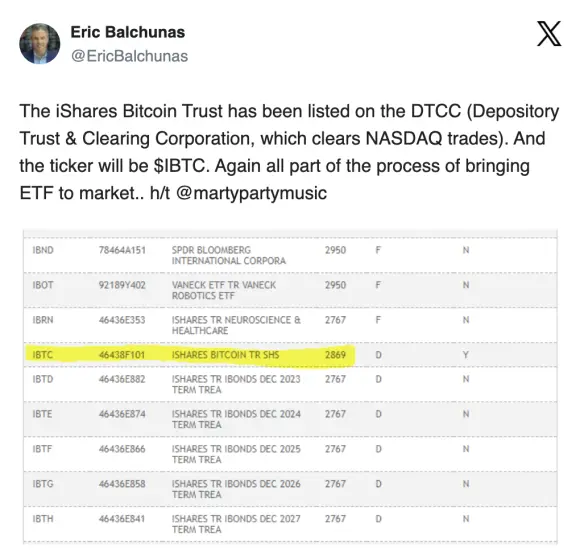
In a significant development, Blackrock listed its Bitcoin ETF on the Depository Trust and Clearing Corp. (DTCC) platform, endowing it with a unique identifier and the ticker symbol IBTC. While this doesn't equate to regulatory endorsement, it unmistakably signals Blackrock's optimism regarding the ETF's approval.
In sum, Bitcoin's present trajectory is shaped by multifaceted factors ranging from economic indicators and global uncertainties to evolving ETF landscapes. As these dynamics unfold, they are set to influence not only Bitcoin but the broader financial fabric.
A spot Bitcoin ETF would have a number of benefits for investors, including convenience, liquidity, and regulation. It could also bring in new users and money to the Bitcoin market by attracting institutional investors, making Bitcoin more accessible to retail investors, and increasing the liquidity of the Bitcoin market.






