If you want more cryptocurrency analysis including full-length research reports, trading signals, and social media sentiment analysis, use the code "Publish0x" when subscribing to CryptoEQ.io to make your first month of CryptoEQ just $10!
Macro
January 2022 ended as a tough month for all markets, even though the Fed left interest rates untouched. However, they have signaled—pretty convincingly—that hikes are coming, and thus, the markets reacted.
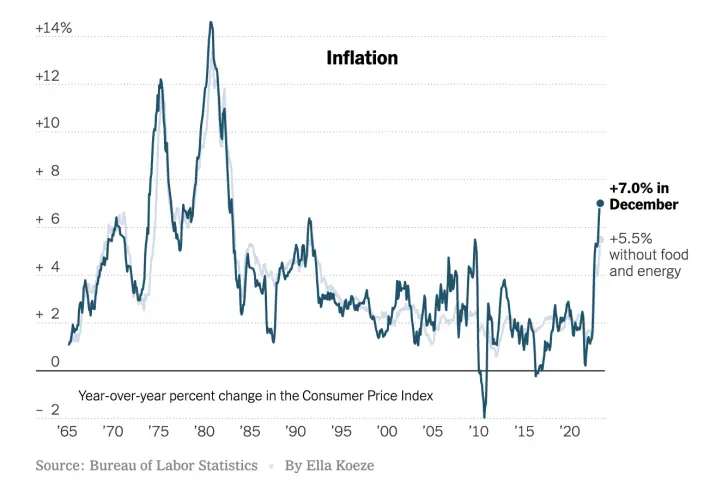
Federal Reserve Chairman Jerome Powell stated in a recent FOMC meeting that the US Central Bank stands ready to raise interest rates in March 2022 and could continue to raise rates several more times in order to mitigate high inflation. In December 2021, inflation in the US reached 7%, a 39-year high, in the government’s official CPI numbers. Given that inflation is ~3-4x the Fed’s target rate of 2% and there are more open jobs than unemployed people, the Fed feels comfortable the markets could absorb a rate hike without major disruption.
But can it? The Fed is having to walk a tight-rope: either raise rates (too) aggressively and push the economy into a recession or, act too dovishly and allow high inflation to persist. Due to the Fed’s messaging and perceived end of “cheap money” and the “Fed put” (formerly known as the Greenspan Put), investors are seeking safe, stable investment options versus high-risk, high-return investment options such as equities and crypto. Higher interest rates make borrowing more expensive and investing in risky assets, like crypto, less palatable. If investors believe economic growth will slow down, they are less likely to bet on high growth (but also highly uncertain) risk assets like tech and crypto, and instead take their “safe” returns.
This has been acutely observed in the markets with the stock market already off to its worst yearly start since 2016 with a major sell off in the tech industry. Meta (formerly Facebook) shed 20%, Zoom is down ~75% from pandemic highs, Peloton down ~80%, Netflix down ~40%, and Tesla down ~25%.
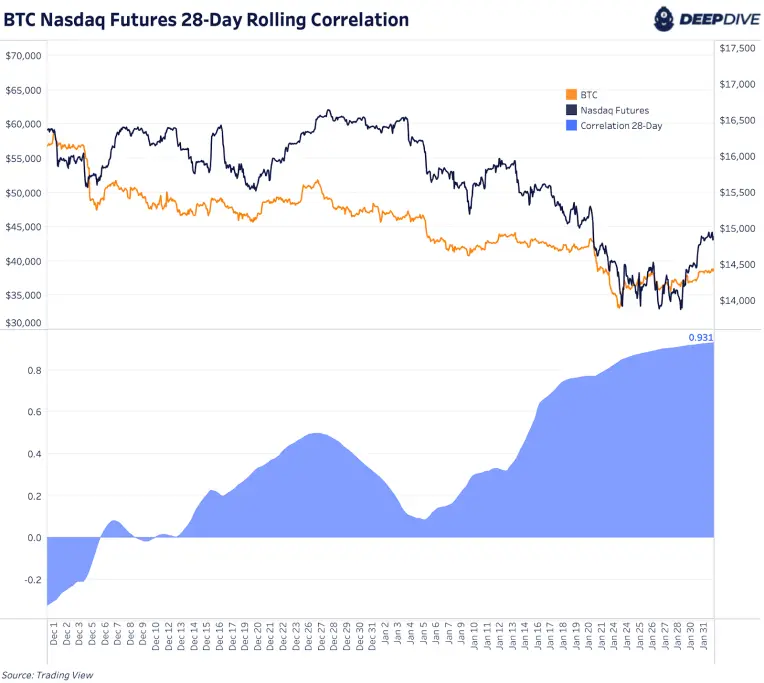
The crypto markets have seen its stock market correlation (and tech stocks, even more so) begin to reach a near all-time high. The crypto sector is down ~40% from November highs.
Moving forward in 2022, investors in both legacy and crypto markets will likely continue to be impacted by macro narratives such as inflation numbers, the Federal Reserve’s messaging, and the increasing likelihood of geopolitical tension stemming from Russia and/or China. Global debt has surged since 2020 due to the COVID response, amplifying vulnerabilities in the global economy. High debt levels (relative to GDP) limit a government’s ability to navigate a downturn and help support markets. Just last week, U.S. debt surpassed $30 trillion, meaning that every (seemingly) small increase in interest rates by the Fed also increases the burden of servicing the debt. To put it into perspective (and also just for fun!), watch this video on just how truly enormous one trillion is.
Outside the U.S….
- IMF directors urge El Salvador to remove Bitcoin as legal tender.
- Positive statements out of Russia - It’s estimated Russians own ~$214 billion (~12% of all crypto) worth of cryptocurrencies and helps explain why the government sees more value in regulating the sector than imposing an outright ban, as was recently proposed by Russian Central Bank.
- Rather than sticking to their plan to ban crypto, India reverses course and will now simply regulate the space, in addition to launching their own CBDC.
- The city of Rio de Janeiro, Brazil is investing 1% of its treasury into Bitcoin and cryptocurrencies.
- Kazakhstan, the second-largest producer of hash power in the world, faced civil unrest in January. The State declared a state of emergency, the country experienced an internet blackout, and the government was overthrown. During the internet blackout, Bitcoin mining farms were impacted. Top mining pools like F2pool, Antpool, and Binance pool were all affected by the outage and saw their percentage of Bitcoin hashrate slip. Violent protests in Kazakhstan have erupted in 2022 after the doubling of the price of liquified petroleum gas in the country.
Regulation
Last month, arguably the biggest news in a regulation-heavy month was a report that the Biden White House is preparing to release its own initial government-wide strategy for digital assets via executive order. Initial reports on the matter believe the White House is looking to make itself more central and powerful in regulating digital assets, rather than the scattered approach with various agencies like the SEC, CFTC, and the Department of Justice separately handling cryptocurrency-related legal issues in recent years.
Unveiling a cohesive, clear, and coherent government-level mandate around crypto could be the clarification and signaling many major industries need to finally feel comfortable entering the space. Alternatively, if the mandate is poorly written or overly restrictive, it could hamper the industry that is already reeling from the Fed’s new hawkish policies.
Earlier in the month, prior to that announcement,, the Federal Reserve released its long-awaited report on a U.S. digital dollar. Originally expected in the summer of 2021, the report was delayed until now. Many hoped the substantial delay meant the Fed was taking its time to deliver an impactful first step into the Central Bank Digital Currency (CBDC) conversation. However, if investors were looking for a “hot take” from the governing body, they were left whole-heartedly disappointed. The report explores the pros and cons of a U.S. CBDC, but ultimately, the report does not take a firm stance on either side of the debate. Rather, it discusses some of the benefits of a CBDC, like speeding up settlement times, and the downsides, like financial stability risks and user privacy protection.
Marketed as “the first step in a public discussion between the Federal Reserve and stakeholders about central bank digital currencies,” this report seems to be just the first in a long series of discussions around the topic. Meanwhile, China leads the way in beta testing its own digital yuan, including at next month’s Winter Olympics, while South Korea just finished a preliminary test.
Finally, also revealed last month were two separate government proposals that both looked to clamp down on cryptocurrency transactions. The proposed America COMPETES Act looks to give the U.S. Treasury the unchecked power to prohibit any and all types of transactions suspected of money laundering without public notice. If that wasn’t enough, the SEC proposed an amendment to the Exchange Act to expand the definition of a “securities exchange.” While it does not explicitly use the terms “blockchain,” “DeFi,” “automatic market-making protocols,” etc., written as is, it could use the expanded definition of securities “exchange” to give the SEC further dominion over the crypto DeFi industry.