
You are reading an excerpt from our free but shortened abridged report! While still packed with incredible research and data, for just $20/month you can upgrade to our FULL library of 50+ reports (including this one) and complete industry-leading analysis on the top crypto assets.

Becoming a Premium member means enjoying all the perks of a Basic membership PLUS:
- Full-length CORE Reports: More technical, in-depth research, actionable insights, and potential market alpha for serious crypto users
- Early access to future CORE ratings: Being early is sometimes just as important as being right!
- Premium Member CORE+ Reports: Coverage on the top issues pertaining to crypto users like bridge security, layer two solutions, DeFi plays, and more
- CORE report Audio playback: Don’t want to read? No problem! Listen on the go.
In January 2023, Avalanche introduced a new feature called Avalanche Warp Messaging (AWM) with the Banff 5 update. This trustless interchain messaging feature allows for efficient and reliable native communications across all Avalanche Subnets. Prior to this update, any project that wanted to transfer assets or data between Subnets had to set up and maintain its own bridges.
AWM allows for Subnet Validators to come together and create a BLS Multi-Signature, which verifies the authenticity of any message (such as a transfer or contract data) and can be confirmed by any other Subnet. This eliminates the need for Subnets to constantly communicate and exchange updates about changes in their validator sets in order to validate messages. This is a significant development in the roadmap for subnet adoption.
 Source: Ava Labs
Bridging
A significant portion of Avalanche’s adoption has been driven by EVM compatibility and relatively low costs for transacting on the network. Avalanche has leveraged the modular blockchain bridge ChainBridge to connect to Ethereum via the Avalanche Bridge (AB). The Avalanche Bridge allows for the transfer of ERC-20 and ERC-721 tokens between the Ethereum Mainnet and Avalanche’s C-Chain.
To connect to Ethereum, users can take advantage of the Avalanche Bridge, which is compatible with ERC-20 and ERC-721 tokens and links to Avalanche’s C-Chain. The bridge uses ChainBridge (covered more in General Purpose Cross-chain Bridge), a modular blockchain bridge that transfers data and funds. The bridge uses KYC’d intermediaries, known as “wardens,” to facilitate bridging. Users of the bridge may notice that assets on Avalanche can either be (using WETH as an example) “WETH” or “WETH.e.” WETH is native WETH to Avalanche, while WETH.e is wrapped WETH that has been bridged from Ethereum.
The Avalanche Bridge was designed by Ava Labs to enable users to bridge ERC-20 assets from Ethereum to Avalanche (and vice versa) with one single on-chain transaction. The AB has two main entities responsible for its security and efficacy: relayers, called “wardens,” and closed-source code that verifies the transactions sent by relayers called “Intel SGX.”
 Visualizing Avalanche Bridge. Source: Medium\ProtoFire
Wardens are responsible for:
- Monitoring the Avalanche and Ethereum blockchains via an AvalancheGO node, Ethereum Geth node, and an indexer that communicates with the AB.
- Relay bridge transactional information to the Intel SGX enclave (comprised of four wardens).
- Tracking the wrapping/unwrapping of assets on both chains.
- Relaying bridge information to the public since Intel SGX is closed-source and not publicly available.
Four of the most prominent stakeholders in the Avalanche ecosystem, Avascan, BwareLabs, Halborn and Ava Labs, operate as wardens. Recently, the warden set doubled from four to eight.
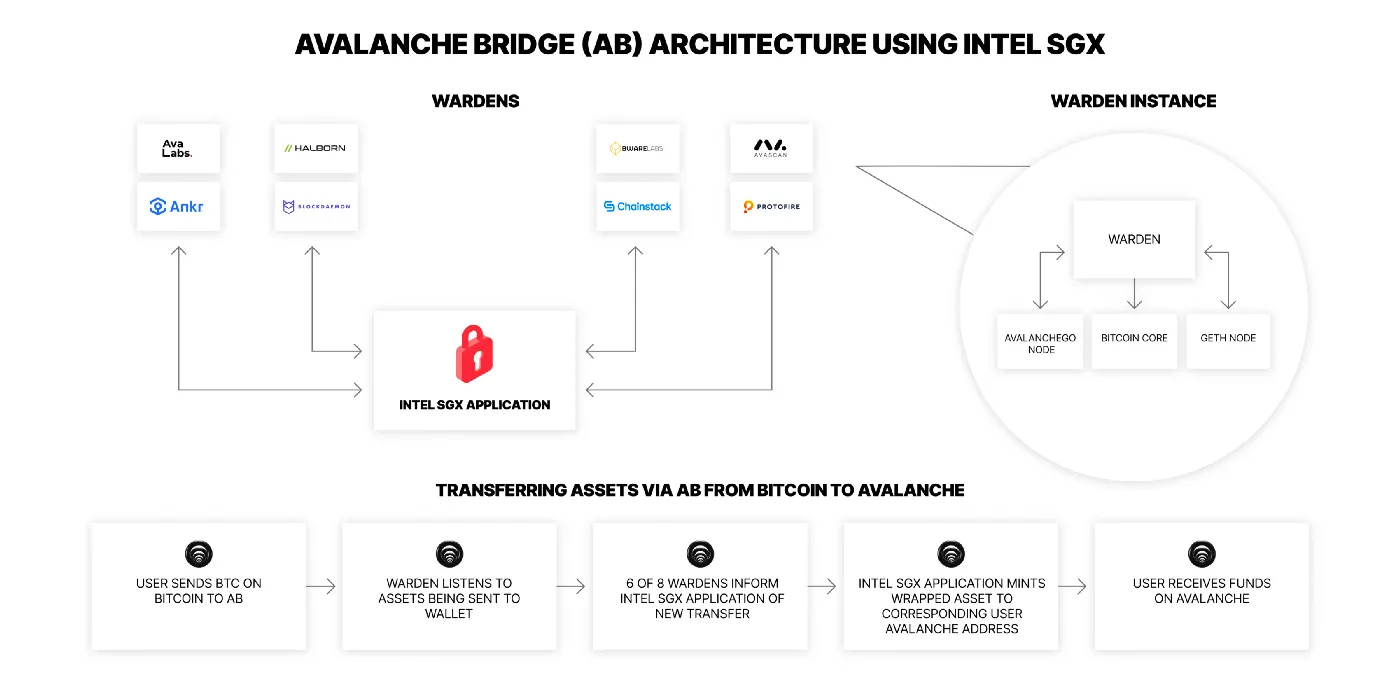 Avalanche Bridge (AB) architecture using Intel SGX. Source: Substack\Trader Joe
The other half of the AB, Intel SGX, is a private codebase overseeing bridging data that must have three of four wardens’ approval before approving cross-chain transactions.
The AB relies on “remote attestation” from wardens to attest that the Intel SGX is:
- Running the correct code and performing as the code dictates
- Able to prove its identity
- Updated for the latest security
The private key within the Intel SGX is split into four parts among four wardens. This division means the private key is recoverable if just three-fourths of wardens share their private key at one time.
The steps of an Ethereum-to-Avalanche bridge transaction:
- Send the ERC-20 token to the Avalanche Bridge address on Ethereum (the AB provides proof of assets)
- Wardens work with the Intel SGX to validate the transaction
- Once validated, a wrapped ERC-20 token is minted on Avalanche into your address
The steps of an Avalanche-to-Ethereum bridge transaction:
- Wrapped ERC-20 assets aren’t sent to the Avalanche C-Chain Bridge wallet
- They’re just “unwrapped” (burned) by the enclave via a smart contract
- A native ERC-20 token is unlocked on Ethereum and sent to the destination address
Avalanche Bridge’s security is based on trust in the wardens. Users must trust that six out of the eight wardens won’t act maliciously for the sake of their reputation and stake in the Avalanche ecosystem. Because there are only four (KYC’d) wardens, only three wardens need to collude or be compromised to control the network/mint new tokens. It makes sense (economical and practical) that a warden wouldn’t attack the network. However, one existential risk to the AB is the ability of someone to fake a private enclave and, thus, control the bridge.
Halborn (a warden) has audited the AB, and any changes to the AB must be audited prior to implementation.
Usage
The Avalanche bridge is one of the biggest within the ecosystem, with over $1 billion in TVL and ~$55M in BTC, thanks to its new Core wallet/bridge.
Assets with the highest total value on the bridge include:
- wETH / ETH
- USDC
- DAI
- WBTC
- USDT






