

If you want more cryptocurrency analysis including full-length research reports, trading signals, and social media sentiment analysis, use the code "Publish0x" when subscribing to CryptoEQ.io to make your first month of CryptoEQ just $10! Or simply click the button above!
Arbitrum vs Optimism
Arbitrum (by Offchain Labs) and Optimistic Ethereum (by Optimism) are the two primary OR projects on Ethereum. The Optimism team gets the distinction of having first created what we now call “Optimistic rollups.” Arbitrum came late with their own implementation. However, both implementations are still in their early stages with centralized companies (mostly) responsible for their success or failure. Both have plans to decentralize over time, but any timeline is simply a guess.
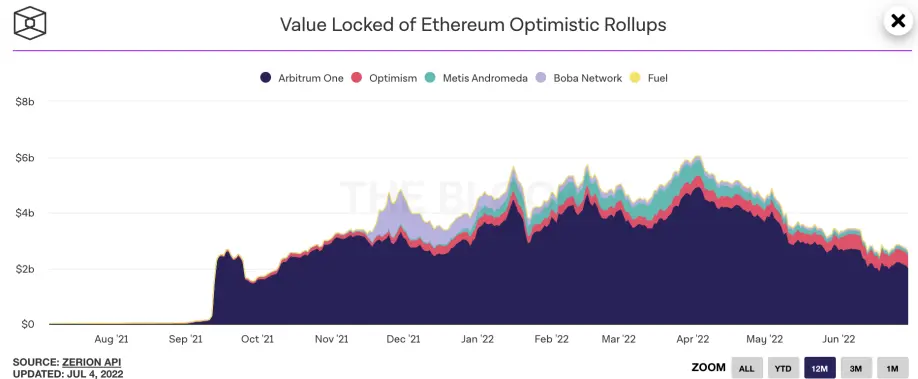
Total value locked in ORS. Source
One of the most critical differences between the two projects is their approach to fraud proof verification. Optimism uses single-round (non-interactive) fraud proofs executed on the L1, while Arbitrum uses multi-round (interactive) fraud proofs. Optimism's single-round fraud proof re-executes the disputed transaction(s) and performs the required computation on the L1 to ultimately source the truth, thereby making verification instant. Non-interactive fraud proofs are advantageous because they are significantly easier to develop and eliminate the need for parties to coordinate with one another, resulting in instant fraud proofs. The downside to this approach is it’s more expensive due to L1 gas costs.
Arbitrum, however, does multiple rounds, only stopping for a disagreement that is being disputed on the L1. The disagreement is examined and deconstructed until the precise cause of the conflict is identified. The sequencer and verifier perform the dissection, and only the stage at which the dispute is narrowed down will be computed on the L1 to establish the proper end state.
Currently, Optimism is the only L2 that offers Ethereum Virtual Machine (#EVM) equivalence. Accordingly, Optimism is the first L2 to fully comply with Ethereum’s protocol spec.
This EVM equivalence mitigates the need for a compiler and lets Optimism allow #DeFi and #NFT projects to “1-click deploy” to Optimism and, thereafter, still use all of the great Ethereum L1 tooling that’s available, e.g. Hardhat, Vyper, and beyond.
The EVM equivalence design philosophy is to produce an optimistic rollup with ‘minimal difference’ to Ethereum. EVM equivalence extends the properties of Ethereum into the L2 as well.EVM equivalent ORUs allows for the instant copy and pasting of codebases cross chains.
Development and innovation on a single EVM-equivalent ORU is seamlessly transferable to any other EVM-equivalent ORU and also to Ethereum itself.
Since everything is being developed on the EVM standard, the network effects of the L1 are extended to the L2s and innovations on an L2 reverberate back throughout the holistic ecosystem.
Another key difference is Optimism uses EVM (Ethereum Virtual Machine) and Arbitrum uses the AVM (Arbitrum Virtual Machine). This means if anything were to go wrong with reaching consensus on the Ethereum mainnet, Optimism (EVM) would be affected while Arbitrum (AVM) would not.
Both Arbitrum and Optimism launched in 2021, albeit both with self-imposed limits and restrictions in case any bugs were encountered. Over time, more battle-tested and less constricted versions will be released, further reducing fees for users. A big step forward happened for Optimism who launched its latest upgrade OVM 2.0 and Arbitrum’s next upgrade ‘Arbitrum Nitro’ promises to increase speed and reduce costs.
As far as adoption goes, the size of Arbitrum’s user base still isn’t as large as the Ethereum mainchain, however, Arbitrum boasts the largest adoption of all Optimistic rollups, and Optimistic rollups themselves boast the current largest adoption and TVL of all Ethereum Layer-2 scaling solutions.
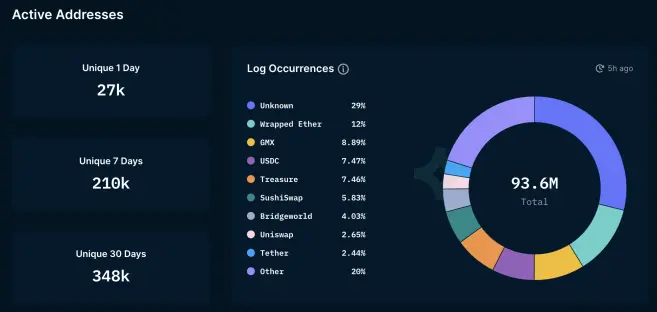
According to data from the Nansen Arbitrum dashboard, Arbitrum has hosted ~350K unique addresses over the last month while Optimism has done ~450k.
It’s estimated that, once mature, Optimistic rollups can offer anywhere from a 10–100x improvement in scalability and, at full scale, can possibly improve Ethereum transaction fees by ~50x.
Downsides
It’s important to note that as promising as rollup technology is, it’s still a very new technology not without risk. Arbitrum One, a specific kind of Optimistic rollup discussed later, experienced downtime for ~45 minutes in September 2021 when a bug caused a large burst of transactions to overload the system. Optimism (OΞ) also experienced a temporary outage (~one hour) in November 2021 in which its L2 transactions were halted. Also, in February 2022, it was discovered the Optimism rollup had a critical bug that would have allowed the repeated creation of ETH by triggering an opcode. Jay Freeman discovered the bug and alerted the Optimism team, who later awarded Jay a $2 million bug bounty. This bug was far more serious and was eventually patched with no loss of funds, but serves as a reminder to just how insecure all bleeding-edge technologies can be.
Rollups currently use sequencers to collect and order users' transactions in a mempool before they get executed and posted to the DA layer. This poses a potential issue regarding the MEV, as the sequencer is generally centralized in current implementations, meaning it’s not censorship-resistant. The current solution would be to decentralize the sequencers, which many rollups plan to do, although this presents its own challenges.
Additionally, ORs and their challenge period are also susceptible to 51% attacks. In this scenario, the attacker would try to introduce “bad” transaction data into the rollup and attempt to censor any attempts to challenge it during the challenge period. The attacker is ultimately trying to corrupt the state of the rollup (with fraudulent data for their own self interest) and stop anyone from challenging the submission.
This is why an adequately lengthy withdrawal/challenge period (one to two weeks) is needed. An attacker may be able to censor or sneak a transaction through if the window was short enough, but the longer the window, the harder it is to fool the rest of the chain.
Finally, one difference is Arbitrum lacks a native token, while Optimism has just announced one as of late April 2022. It’s not public knowledge whether or when Arbitrum also intends to eventually launch a token, but the general trend in the crypto industry would suggest so. Regardless, both projects have initially had to try to bootstrap their rollups without lucrative airdrops or incentive programs (yield farming). In an industry awash with 50%+ APY, five-figure airdrops, and eight-figure incentive programs/funds, rollups—thus far—had chosen to try and grow without a token, making adoption an uphill battle.





