

Access the full report here.
Summary
Blockchain bridges are base-layer infrastructures that attempt to securely connect different, isolated blockchain ecosystems by serving as the intermediary communication medium between them. Cross-blockchain (cross-chain) interoperability is extraordinarily difficult to accomplish without significant security trade-offs to the end user, as demonstrated by the seemingly never-ending string of bridge hacks in the crypto space. This is because most blockchains were not designed to interoperate with other chains. Nearly all blockchains are secured by their own crypto-economic security guarantees based on their native token and a specific consensus mechanism. Introducing any factors outside of those initial designs opens the chain up to edge case risk not initially considered in the design of the protocol. While connecting blockchains via bridges and bridged assets promises increased liquidity, more optionality for users, and potentially lower fees, these same security guarantees innate to each chain cannot be extended to the bridged assets from other chains.
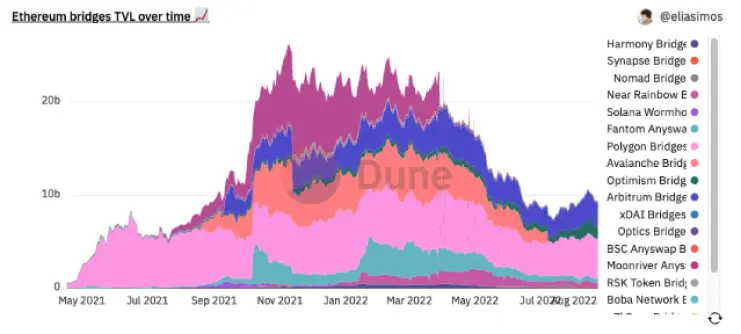
Despite the security trade-offs, bridges are inarguably big business, with over 100 bridging solutions on the market and $9 billion+ held in bridges just connected to Ethereum. With the rise of new alternative layer-1 protocols (alt L1s) and Ethereum layer-2 solutions (L2s) like rollups, a bridge is needed for every chain in order to stay competitive in the crypto landscape. This also means dozens of different bridging implementations with various trust assumptions, security guarantees, attack vectors, and economics.
Hackers and bad actors have feasted on bridges in recent years as they (typically) represent an enormous honeypot of crypto funds serving as a single point of failure between two blockchains. Whereas top blockchains can be secured by time-tested cryptography, hundreds or thousands of decentralized nodes and billions of dollars in crypto-economic security guarantees, many bridges in the crypto economy are compromised by immature/sloppy code, poor key management, underdeveloped validator sets, and much more.
Because of this, this report looks to investigate ~20 of the top bridging solutions of today, primarily focusing on security through the lens of:
- The “who”: the entities involved in the bridge process
- The “what”: the bridge architecture and what objectives it optimizes for
- The “how”: how does it facilitate communication between bridges and how does it secure funds
Despite the nuances specific to each bridge, at the most basic level, a successful bridge needs to do three things well:
- Ensure the integrity of state changes (verify the validity of transactions)
- Make those state changes publicly available for anyone to “check the work”
- Ensure censorship resistance
To better evaluate each bridge’s attempt at accomplishing these goals, this work utilizes established bridge nomenclature and heuristics in order to build off previous work, maintain consistency in language, and further cement how bridge design is evaluated. This includes differentiating between:
- Cross-chain vs. intra-chain vs. L1/L2
- Trust-minimized vs. trusted
- Token transfer vs. general messaging
- Verification process (Native vs. Local vs. External vs. Optimistic)
- Transfer mechanism (Lock-and-mint vs. atomic swap vs. liquidity pools)
- Alt L1 “official” bridges vs. general-purpose multi-bridge solutions
- And more
Much like crypto assets/protocols, no two bridges are exactly alike, making their quality and security a spectrum based on end-user preferences. Unfortunately, as the industry has seen time and again, security is typically an all-or-nothing consideration that can wipe out a project in mere minutes. Shining a light on these potential vulnerabilities should only further empower each potential user to make the most informed decision based on their risk preferences.
The report begins with general bridge considerations before diving into each ~20 solutions individually. Each section can be enjoyed on its own, but there is a natural progression, including key definitions and concepts, from start to finish. While there are many different ways to categorize bridges, this report chose, at its highest level, to bucket them into:
- L1-to-L1 Cross-chain Bridges (beginning with EVM-compatible chains)
- Ethereum L1-to-rollup bridges (optimistic vs. zero-knowledge)
- General-purpose Multi-chain bridges (generalized solutions looking to connect numerous blockchains)

If you want more cryptocurrency analysis, including full-length research reports, trading signals, and social media sentiment analysis, use the code "Publish0x" when subscribing to CryptoEQ.io to make your first month of CryptoEQ just $10! Or simply click the button above!
Why Bridge at All?
As the number of Layer 1s (L1s) and their ecosystems grow, there's an even greater need for managing composability and interoperability across chains. Cross-chain bridges allow otherwise siloed ecosystems to interact in a meaningful way—analogous to how new trade routes helped connect otherwise disparate regions, ushering in a new era of information-sharing and greater opportunity space.
Three common reasons a crypto user may need to use a bridge:
- Higher yields elsewhere: Competing L1s and their dapps try to offer higher yields than competitors to incentivize user participation and provide liquidity
- Lower fees, but same EVM experience: $30 Ethereum mainnet fees can hurt your profit margin in DeFi so that you can bridge over to Avalanche, Polygon, Fantom, to do similar DeFi activities for lower fees
- Wrap or unwrap a native asset: To take possession of a native token, you may need to bridge a wrapped version of that token to the native network
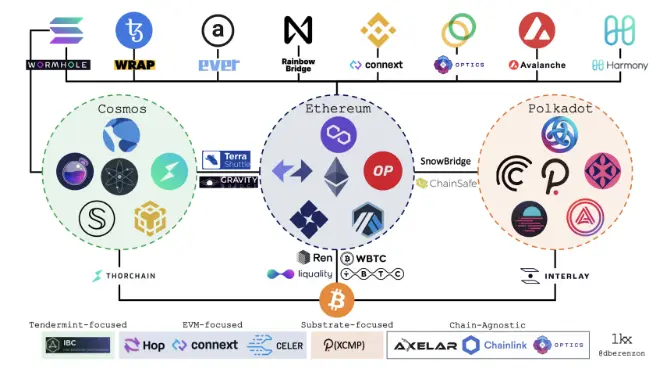
Several L1 ecosystems connect to the Ethereum network and can host ERC-20 tokens. Some examples are depicted in the graphic below.
To put the cross-chain bridge opportunity into perspective:
- As of Q3 2022, the total value locked (TVL) in bridges is only ~$9 billion. This is just a fraction of the ~$63 billion of assets locked in DeFi protocols
- The number of unique wallets that have deposited on an Ethereum bridge is ~1 million or ~21% of the ~5 million unique wallets that have ever used a DeFi protocol
Wormhole, Layer Zero, and other bridging solutions support generalized messaging, allowing various forms of data and information, including that describing tokens, to be moved across ecosystems. General messaging is more complex than simple connections that enable token transfers but can be far more powerful, as well.
With two blockchains that can communicate via general messaging, dapps can make contract calls across chains, allowing them to launch their product simply on one chain and communicate with others rather than needing to launch on every chain. This gives dapps access to more users than just on that one siloed blockchain network.
A contract call is different from a token transfer in that it is initiated by a user to execute a very specific function of a smart contract and is not recorded on-chain. Enabling contract calls from the source chain to a destination chain allows for more cross-chain optionality for dapps and eliminates their need to deploy their dapp on multiple chains.
If a bridging protocol has smart contracts on multiple blockchains capable of executing contract calls, users could enjoy less friction when operating across chains. A hypothetical includes sending DAI from Fantom into an ETH-MATIC liquidity pool on Ethereum.
Bridge Use Case
All blockchains have their limitations. For Ethereum to keep up with demand, it's required rollups to scale. Alternatively, L1s like Solana and Avalanche are designed differently to enable higher throughput, albeit at the cost of some decentralization.
However, (nearly) all blockchains develop in isolated environments and have different rules and consensus mechanisms, meaning they need bridges to connect them to other chains, allowing the transfer of information and tokens between them.
Bridges enable:
- the cross-chain transfer of assets and information.
- dapps to be interoperable across blockchains–thus enhancing their capabilities (as protocols now have more design space for innovation).
- unlocking liquidity between and across ecosystems.
- developers from different blockchain ecosystems to collaborate and build new platforms.
Ideally, a bridge can facilitate generalized messaging instead of just token transfers. The ability to send generalized messages/data creates the underlying communication foundation supporting data transfer and smart contract calls. This is incredibly powerful as it enables increased interoperability between dapps, new DeFi infrastructure, and distinct applications—including token bridges—to be built on top. Imagine using Ethereum’s MakerDAO from Avalanche or being able to put Yearn deposits into a Solana farm.
The simple transfer of assets between different blockchain networks is one of the most common features of cross-chain communication. This can occur between layer 1 networks, at the protocol level or the application layer, through dapps such as those enabled by Ren’s VM. Within the network of L1-to-L1 bridges, there are simple custodial bridges (WTBC) or more sophisticated multi-sigs, third-party validators, light client relays, and more. We will discuss more in the following sections.
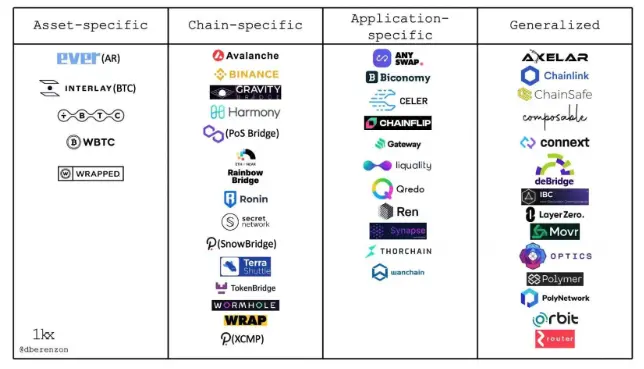
In practice, bridges enable a higher degree of scalability for potential market capture as the limitations of being in an isolated network are eliminated. For example, consider the interoperability between different cellular network carriers (e.g., Verizon, T-Mobile, AT&T). Without this ability, Verizon users wouldn’t be able to communicate with AT&T users.
This same problem exists in emerging cryptoeconomics, with trillions of dollars in value spread across many different blockchain networks, protocols, and applications. Bridges have begun tackling this problem from two broad approaches: custodial L1-to-L1 bridges and L1/L2-to-L2 bridges. Ethereum Bridges hold over $9 billion in TVL as of Q3 2022. This value is split between bridges that go to external ecosystems such as Avalanche, Polygon or Axie Infinity.
To continue reading about bridge security as well as the top ~20 bridging solutions on the market, click here.





