
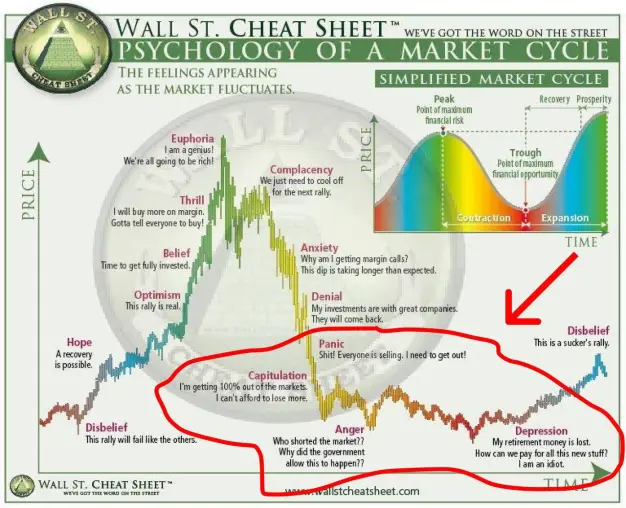
The image shows classic market psychology. I've specifically circled the bottom part: this is precisely where most people lose money, even though they think they're acting rationally.
It's important to establish right away: this is not a forecast or a trading signal. These are my observations and the logic through which I view the market.
When the market falls, the bottom almost always has the same structure. Not in terms of price—in terms of psychology.
True bottom formation almost never happens in one step.
It goes through several stages.
The first is panic and capitulation.
A sharp downward move, fear, closing positions, the desire to "just get out and forget." This is where most people break down emotionally. But it rarely ends here.
This is usually followed by relief.
The market bounces back. Sometimes strongly—by 20-40%. A feeling emerges: "Phew, it seems we got through it. I managed to catch the bottom."
This is where one of the most costly mistakes is made—confusing relief with a true reversal.
Then comes frustration.
The market starts declining again and wipes out part or all of the bounce. Those who bought the "bottom" find themselves at a loss. The desire to buy completely disappears. Only irritation and apathy remain.
And only after this does the depression phase begin.
A long, sluggish sideways or downward drift. No drive, no interest, no faith. Even strong holders begin to doubt. It is this stage that most often lays the groundwork for the real bottom.
Key takeaway:
Capitulation without a subsequent exhaustion phase often creates a false bottom. The market needs time to "burn out" expectations.
Translating this to the current situation with Bitcoin, here's how I see it:
— The sharp bounce after the fall is just relief for now, not confirmation of a bottom.
— A strong continuation of the rise without a pause increases the risk of a trap.
— A ranging, boring phase after sharp moves is where the real structure will be decided.
I'm not rushing to conclusions or trying to fit the market to my wishes. Right now, it's more important for me to understand the phase than to guess the exact point.
If you're interested, I can further break down:
— how to distinguish relief from a reversal
— what the signs of a true depression phase are
— or go through the chart and structure in more detail
Leave a reaction if this topic resonates with you, and write in the comments which phase you feel you're in right now.






