
Forget about flashy price charts for a moment. To understand the current state of the crypto market—and risk assets in general—you need to look deeper, at the fundamental engine of modern markets: liquidity.
The picture, once you see it, is simple yet unsettling. Historically, Bitcoin's major rallies have shown an incredibly tight correlation with the expansion of the Federal Reserve's net liquidity. It's a straightforward mechanism: when liquidity accelerates, money flows into risk assets, and they thrive. When liquidity is restrained or actively contracted, the market begins to suffocate. No formal "crisis" is needed; the lifeblood is simply flowing slower.
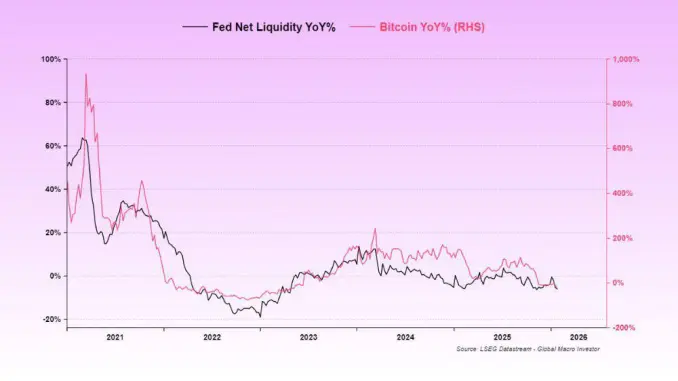
Right now, we are firmly in the latter phase. Liquidity hasn't collapsed, but it hasn't been set free either. It's being held on a tight leash.
What This Means for Your Portfolio
-
This is Macro, Not Micro. The current pressure on crypto isn't about "Bitcoin being broken" or "the market being wrong." It's a macro constraint. The fuel (liquidity) is being metered out, and an insufficient volume is reaching the riskiest segments of the market. The problem isn't the destination; it's the pipeline.
-
Perception vs. Reality. During these periods, the market looks worse than it fundamentally is. Price action starts to feed on itself, driven by technical factors and sentiment. It becomes a mechanism for shaking out weak hands and amplifying fear, creating distortions that don't reflect the underlying long-term thesis.
-
The Parking Brake Analogy. Trading in this environment is like driving with the parking brake slightly engaged. The car (the market) can still move, but it's jerky, noisy, and feels fundamentally wrong. You instinctively know something is off. The issue isn't the engine's power (innovation, adoption); it's the artificial constraint on its transmission.
The Critical Mindset Shift
I'm intentionally avoiding dramatic calls or price predictions here. This is not a trading signal or a promise. This is context. Without this framework, every price movement is misinterpreted as a standalone event.
If you're feeling anxiety right now, the most useful thing you can do is not just "HODL blindly," but to understand why this is happening. This knowledge is what separates reactive emotion from a strategic response.
The key takeaway: The market is currently not in a phase of euphoria, nor is it in a phase of final collapse. This is the phase of compression, waiting, and a test of investor maturity. It's a grinding period that separates short-term speculation from long-term conviction.
Looking Ahead: Signals and Asymmetries
Understanding the context is the first step. The next is knowing what to watch for:
-
What signals would indicate that liquidity is being loosened? A shift in the Fed's balance sheet trajectory, changes in key monetary facility usage, or a pivot in treasury general account dynamics could serve as early indicators that the leash is being lengthened.
-
Why do these periods often create the best long-term asymmetries? Compression phases wash out excess and reset expectations. They allow value to accumulate quietly, often setting the stage for the most powerful moves when conditions eventually change. For the disciplined investor, this is the time to research, to plan, and to position strategically—not emotionally.
In the end, markets breathe to the rhythm of liquidity. Right now, we're in a period of held breath. Recognizing that changes everything.






