
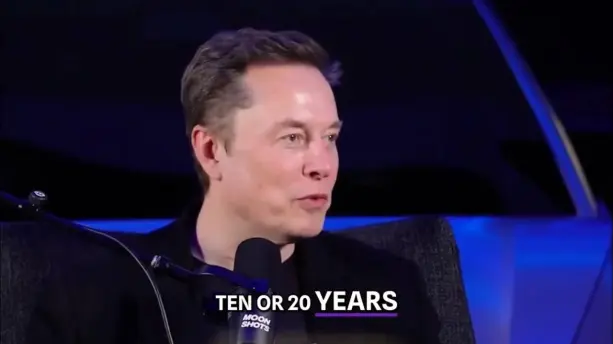
Elon Musk stated that in 10-20 years, saving for retirement will become meaningless. He claims we've already passed the "event horizon." AI and robotics will render the value of labor obsolete, production will become nearly free, scarcity will disappear, and therefore money will lose its significance. The age of abundance. Universal High Income. A global reset of the rules of the game.
It sounds beautiful. Almost like a law of physics.
But let's engage our critical thinking.
Yes, automation reduces costs. That's a fact. But price isn't just about labor. It's about energy, raw materials, land, logistics, infrastructure, politics, taxes, and control over distribution. A robot isn't free. A data center isn't free. Electricity isn't free. Chips require rare earth metals. Production can become cheaper. But "zero" is a philosophical category, not an economic one.
History has been through this before. Industrialization, the assembly line, the internet. Productivity grew exponentially. The world became cheaper. But money didn't disappear. Capital didn't disappear. On the contrary — concentration intensified.
The key question isn't whether labor will disappear. The key question is: who owns the machines? If AI and robots produce everything, but they are owned by corporations and states, then the owners of capital will become even more powerful. Scarcity will simply shift. It won't dissolve.
Imagine: food is almost free. Good. But what about land in the city center? What about the best medical technologies? What about access to computing power? What about the right to govern algorithms? Meaning, status, power — all of this will remain limited.
Even if the cost of goods plummets, assets become even more important. Because an asset is a claim on a stream. On infrastructure. On control.
A 14-year horizon is far too aggressive a timeline for a global structural transition. The internet didn't nullify money in 30 years. Crypto hasn't nullified banks in 15 years. Technology can be exponential. Politics is not. Geopolitics is not. Social adaptation is not.
So personally, I don't see this as "the pension is dead." I see it as "the model is changing."
Rather, what awaits us is increased productivity, deflationary pressure on goods, cheaper services in some areas, and simultaneously — a strengthening of the role of capital and infrastructure. This doesn't negate saving. It changes the form of saving.
Holding everything in cash is a risk.
Ignoring the technological shift is a risk.
Betting on the complete collapse of money is also a risk.
I look at this as an investor, not as a techno-optimist. If transformation accelerates — the owners of infrastructure, energy, computing power, and networks will win. If it slows down — the classic logic of capital remains. In both scenarios, owning assets is more important than abandoning strategy.
The question isn't whether you need to save for retirement. The question is: what should you save in, and what should you invest in?
And that's where the real discussion begins.






