
An interesting idea popped up in the feed recently.
The idea is this:
Bitcoin supposedly solves the quantum threat.
And in the future, AI agents might start buying up BTC because it grants them "cyber-sovereignty."
It sounds like science fiction. But let's break it down without the emotion.
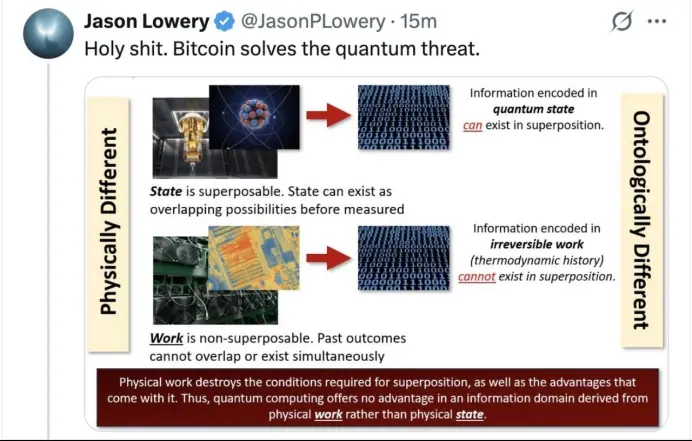
The core of Lowry's argument is simple:
There's a physical state — it can be held in superposition.
There's physical work (proof-of-work) — it's irreversible, it has already happened.
Quantum computers offer an advantage where you can manipulate states.
But they cannot "undo" thermodynamic work that has already been performed.
The conclusion of proponents:
Information anchored by physical work (PoW) is ontologically different from ordinary bits.
Therefore, the quantum threat is supposedly not as scary.
Now, for a冷静分析 (sober analysis).
1️⃣ The quantum threat doesn't concern hashing itself, but cryptography (ECDSA).
Shor's algorithm has the potential to break public keys.
This isn't philosophy — it's mathematics.
2️⃣ Bitcoin can be upgraded.
A transition to post-quantum signatures is technically possible.
This is a matter of consensus, not "ontology."
3️⃣ Proof-of-Work doesn't magically make the system immune to quantum attacks.
It makes attacks economically expensive.
And that's a different category of defense.
Now, the second thesis — about AI.
If AI agents become autonomous economic subjects, they will need to:
— receive payment
— pay for resources
— operate 24/7
— function without banks
The banking system is closed to AI.
A crypto wallet is open.
This is where things get genuinely interesting.
If AI operates at machine speed, it needs a unit of account that:
— doesn't require KYC
— doesn't sleep on weekends
— isn't dependent on a specific state
— is programmable
Crypto fits the bill perfectly.
But will it specifically be BTC?
Or stablecoins?
Or separate AI-oriented networks?
That question remains open.
My view as an investor:
The "quantum invulnerability" narrative is more philosophy.
The story of AI as an economic agent is far more serious.
If AI truly becomes an independent player, it will need native digital property.
And Bitcoin is the most liquid, most secure, and most neutral asset in the digital space.
This isn't a forecast.
It's a scenario.
And markets always laugh at scenarios first, then start to price them in, and eventually bake them into valuations.
Where is this all heading?
We might be at a stage where BTC ceases to be just an "investment asset"
and gradually becomes the base layer of the digital economy.
My question to you:
Do you believe AI will become an independent economic subject within the next 10–15 years?
And if so, where will it store its capital?






