
Investors often view AI through the lens of applications: ChatGPT, Midjourney, Perplexity, various AI agents.
But if you dig deeper, it becomes clear: the real economy of AI is structured very differently.
One of the most precise breakdowns of this was provided by investor Anish Moonka, who described a five-layer AI stack—the infrastructure upon which the entire industry is built.
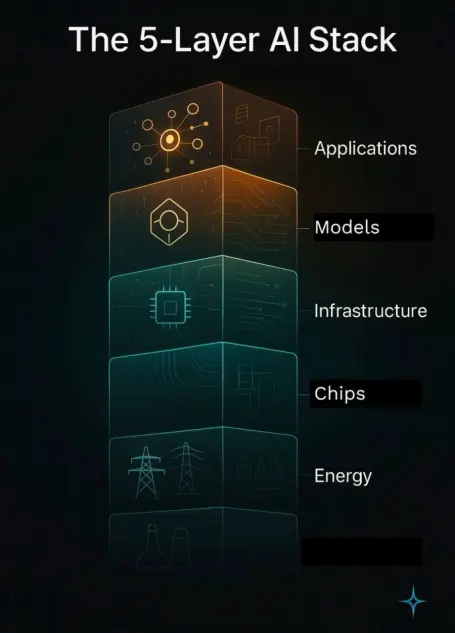
And the most interesting part is that the major money is currently flowing not where everyone is looking.
1. Energy
The most fundamental layer of the entire system.
AI models require colossal amounts of electricity for both training and inference.
The main risk in the coming years is a simple shortage of energy.
That's why processes that are hardly being talked about are now underway:
-
Construction of new power plants
-
Development of small modular reactors (SMRs)
-
Geothermal projects
-
Gas turbines
-
Long-term power purchase agreements (PPAs)
Hyperscalers are already reserving tens of gigawatts of capacity for years in advance.
Effectively, AI is beginning to reshape the world's energy infrastructure.
2. Chips
The backbone of the entire industry.
Main players: NVIDIA, AMD, Intel, Groq, Cerebras, Amazon (Trainium / Inferentia).
This is where you find:
-
The highest margins
-
The biggest investments in R&D
-
The industry's tightest bottlenecks
Key constraints:
-
Manufacturing at TSMC
-
CoWoS packaging
-
HBM memory shortages
Jensen Huang isn't just being rhetorical when he calls accelerators the new industrial machine of the AI era.
3. Cloud / Infrastructure
The third layer is the infrastructure.
Main players:
-
AWS
-
Azure
-
Google Cloud
-
Specialized companies: CoreWeave, Crusoe, Lambda, Together.ai
In 2026 alone, the four giants—Amazon, Microsoft, Alphabet, and Meta—are planning to spend $650–700 billion on AI infrastructure.
And the majority of that money flows down to the two lowest layers: energy and chips.
4. Models
This is the layer that gets the most attention, but not the most money.
OpenAI, Anthropic, Google DeepMind, xAI, Meta, Mistral, DeepSeek.
The industry is gradually shifting from the race of "who will build the smartest model" to the question of who can run it cheaper and faster.
In other words, the battle is no longer just about intelligence, but about inference cost.
5. Applications
This is the tip of the iceberg.
What the user sees: Cursor, Perplexity, Midjourney, Devin, Replit Agent, Character.AI, thousands of AI startups.
And here’s the paradox:
-
Competition is immense
-
Margins are still low
-
Many companies are unprofitable
But this is likely where the primary value capture will occur in 3–7 years.
What does this mean?
Today, most people view AI through the top layer—applications.
But trillions of dollars are currently flowing into the lower layers:
-
Energy
-
Chips
-
Data centers
Whoever controls cheap electricity, accelerator production, and scalable infrastructure gains a structural advantage for decades to come.
Looking at the bigger picture, it becomes clear:
AI is not just a technological revolution.
It's a restructuring of energy, chip manufacturing, and global infrastructure.
And that’s where the biggest game is currently playing out.
Investors, if you're interested—I can break down each layer of the AI economy separately and explore where the investment opportunities are emerging.






