
63,352 Validators With An Average Balance Of 31.74 ETH Have Been Activated On The Medalla Testnet
The long-awaited Ethereum 2.0 network update has been under development for four years now, but the recent reveal of the Medalla testnet and the amount of staked ETH shows serious interest in ETH 2.0.
According to data from beaconcha.in, over 60,000 validator nodes have been activated on the Medalla testnet, with a total amount of staked Ethereum being close to 2 million. Beaconcha.in data shows an increased appetite for the proof-of-stake algorithm upgrade.
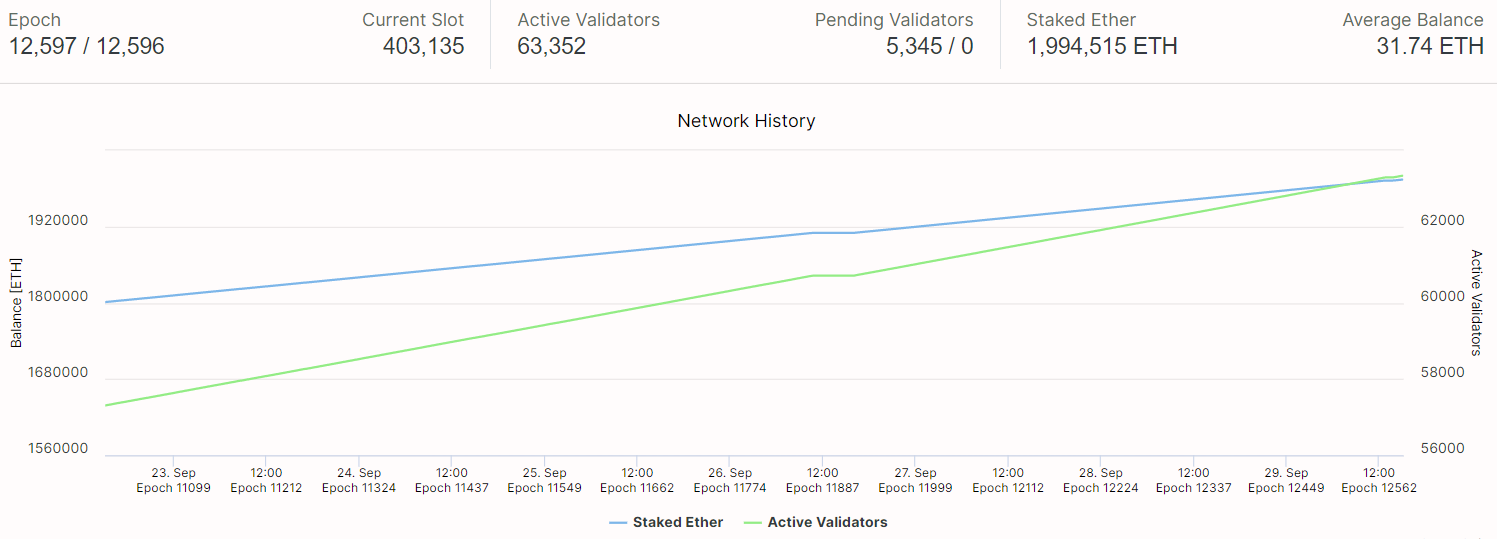
Source: Beacon Chain
Ethereum’s community has been eager about the algorithm update because ETH 2.0 would come with a dramatic increase in transaction speed – from a current value of 15 transactions per second to reaching over 100,000. The low throughput of Ethereum’s network has been one of the greatest bottlenecks behind scalability, and also managed to skyrocket transaction fees, with records of as much as $14,583 for a single transaction as of 2nd September 2020.
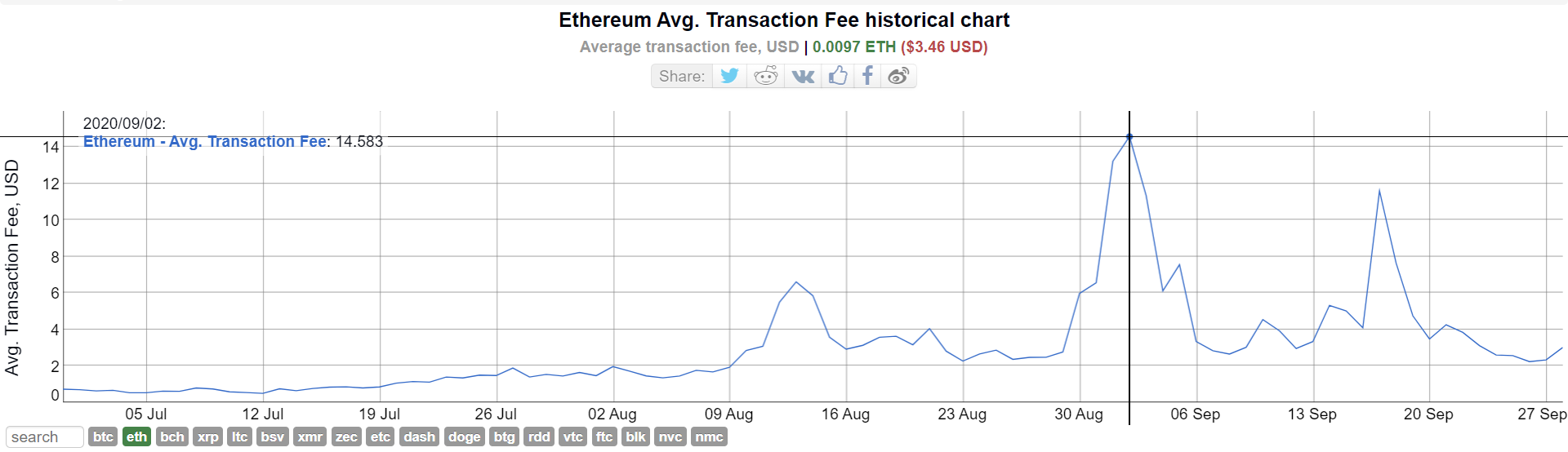
Source: BitInfoCharts
Currently, both Ethereum’s and Bitcoin’s networks are operating under a proof-of-work consensus mechanism, which uses computing power in order to validate transactions. The computing power is delivered by “miners” which receive a reward for successfully validating transactions on the blockchain.
Transitioning to proof-of-stake, Ethereum will no longer need miners. Instead, validators would stake their ETH holdings in order to vouch for the addition of a given block to Ethereum’s blockchain. However, if the network of validators disagrees with a validation vouch, the staked ETH could be “slashed”, resulting in a risk for validators.
On the other hand, validators would receive a staking reward if the block is accepted throughout the network.
In addition to Medalla, Ethereum’s developers are working on a short-term testnet, dubbed Spadina, which gives developers and validators a glimpse of what ETH 2.0 would look like. Also, Spadina’s goal is to streamline the transition from the current algorithm to ETH 2.0, despite only running for three days.
Ethereum’s 2.0 network upgrade is expected to launch in November 2020, but the launch would be more of a trigger of a staged rollout, extending to 2022.






