
What you will find here is a small introduction to my thesis of the masters' degree in economic science. It's a summary of all the things that remained unexplained in my mind for a while. The purpose is to start making the right questions about the essence of the economics' life and to connect the dots, I hope, in an enlightening way. These resources are for everyone who wants to understand clearly the basis of the economic machinery, to help to build a better world. I also hope that the reader could understand why we are all connected and why cryptocurrencies are important even if one is not an economist. As promised, after this summary, I will share weekly a chapter of the thesis containing the main elements to correctly understand money and cryptocurrencies. Finally, I will publish the entire thesis, which comprises a statistical part (in PDF). Hey! I've not the truth in my pocket! Please share your opinion :)
Why cryptocurrencies are important even if you don't care about them? The short answer is that because cryptocurrencies are money. Are you sure to know what is money?
(I know you are aware of most of these arguments, but maybe your friends are not! Share with them and help them to change their opinions!)
I ask you because at one point in my life I realized that I had a completely wrong idea about what is money. Most people think that banknotes and coins are the largest part of the money and that's for a good reason. However, they represent only 5% of the total monetary base. What's about the other 95%?
"[...] Few economic subjects are more tangled and more confused than money. If we immerse ourselves wholly in day-to-day affairs, we cease making fundamental distinctions, or asking the really basic questions. Soon, basic issues are forgotten, and aimless drift is substituted for firm adherence to principle. This is particularly true in our economy, where interrelations are so intricate that we must isolate a few important factors, analyze them, and then trace their operations in the complex world" (Rothbard)
Basically, this work is born upon a curiosity. Money is the most essential tool of our economy while at the same time the less investigated. We all wake up every day to earn money and that's not because we are greedy. That's because money, to some degree, is the reflection of what we do, is part of ourselves. Money is so particular, that it's the part of ourselves that could be transformed into all other goods. In some sense, it is able to connect the profane with sacredness because it gives us the ability to share intangible value and to save it. It gives us the ability to exchange our gifts and, because exchanges are essential to people, money is essential. This does not mean that money is a substitute for happiness. Money is a tool that helps to build goods and services, which in turn, may be helpful for happiness. And even so, a small chapter is dedicated to money in books, which then are forgotten on some shelf.
It seems natural to give money to someone that does something that we appreciate and, in turn, if we do something that is good for others we wish that our work is recognized. That's how the economy works! Money helps in facilitating exchanges and material relationships. But have you ever questioned yourself how money is created and distributed? Have you ever asked yourself why do you wake up every day to hardly gather some money? What does give sense to our works? What is value? Are you in control of your money? Do you know why money helps us to mitigate the uncertainty of the future and why the economy suffers without money?
If not, this and future lectures maybe are suitable for you because I bet that when you work, you do it in exchange for money!
"It is well enough that people of the nation do not understand our banking and monetary system, for if they did, I believe there would be a revolution before tomorrow morning." (H.Ford, 1930)
Maybe, in the vast scale of the cosmos, "tomorrow morning" was in 2008. Maybe, this time, the silent revolution of cryptocurrencies would be faster than human stupidity. I mean, the stupidity to repeat the same errors and not learn from past mistakes. Throughout history, money has shown to be a capricious God, manifesting the world its devastating force. The reason is that few economic subjects are more tangled and more confused than money. It's not easy to understand money, because it seems a contradiction. It's what unifies all of us within society and the economy but, at the same time, it's what separates us from each other.
"Give me control of a nation's money supply and I care not who makes its laws" (M. Rothschild)
When I've started my journey to discover money, I found that money is a tool that should give us the possibility to express our gifts. By facilitating trade and allowing us to save the value that we are able to create, money should help enrich our daily lives, while giving us the time necessary to undertake more important projects. Then, it should give us ease, leisure, freedom from anxiety, and a fair distribution of wealth. Indeed, conventional economic theory explained in economics' books predicts all of these results. Instead, when I compare these assumptions on what I observe, I find a quite different picture. Money has become an agent of the opposite: anxiety, uneasiness, and polarization of wealth. The fact that money has become an agent of the opposite presents us with a paradox (C. Einestein).
"The top 1% of people possess nearly 50% of the world resources. (Forbes)"
There is something that doesn't work anymore, and it's not just a sensation, it's concrete, it's systemic. Too many people have too few resources. Did you know that half of the world lives with less than 2$ per day? Half! And, even if in some parts of the world they might be happier without our consumerist model of life, poor people are deprived of the possibility to develop their skills and learn. They have not too many choices if they decide to improve themselves and their societies. They don't need our help for this, they need a reliable economic system that allows them to work and grow properly. And we need it too because too few people have too many resources. What's missing is a more fair economic system, a system that could be more resilient in difficult situations, a system more resistant to corruption and more clear than ever!
If only one could invent it for free, give it openly so that anyone could check the correctness of the system....
Summary of the essentials of money
I would start from the point of view of who uses money. When someone uses money is to buy some goods or services or to sell them. You have to know that this is only one of the three ways in which you could entertain an exchange within the society and it's called "market exchange". This has nothing to do with emotions, but it's related to the need for humankind to cooperate with people that don't have to trust. Feelings and market exchanges should be separated. So if you need a pencil you have two ways: you build it from yourself, or you go to the store and if you like it, you buy it. And in exchange for it, you waive some of your money, that previously you earned from another work that you've done, say, you like to grow trees and sell apples. Exchanging pencils for apples may be inconvenient, thus money is used as an indirect medium to serve three purposes:
- Medium of exchange: money allows you to exchange value of goods and services. So in our example, if you are good at selling apples, you exchange them for money that you will use in future exchanges.
- Reserve of value: money allows you to store the value that you are able to produce. Apples may not last long, even if we want apples!
- Unit of account: money allows to compare the value of objects. Maybe with two goods it's easy the comparison, "1 pencil for 3 apples", but how could you compare apples, pencils, phones, cars, shirts, etc? Do you remember all the ratios? And what if you want to exchange your goods for a cow? "I give you my phone for half of your cow". That's not fair, at least for the cow. With money the economic calculation it's easier, that is "a pencil is worth one unit of money, 3 apples are worth one unit of money, half a cow is worth n units of money, etc".
Money resolves all of these problems, because it allows you to do these three things contemporaneously. But let's make a step back. What is the value? To understand value think about this short story: "You can decide between a bottle of water and a big diamond. Easy choice. But if you are in a desert? And if in this landscape there is a shop that sells water for diamonds?" The moral of the story is that value is subjective and depends on the circumstances. If you give it a value it has value. The sure thing is that it's difficult to convince the dehydrated person to accept diamonds in a desert. Value is constantly changing as people have different concepts of value. The confusion arises because the same happens to money, because money derives its value from the things it could purchase, a.k.a. purchasing power. Money it has value because it's chosen spontaneously by people as an object of value, to be able to exchange it for goods and services, in the present and in the future. I've said object of value because objects have the feature to be finite in this world, which puts a limit on the purchasing power. Note, however, that money is a special good because it's not consumed directly. Money is acquired with the aim to consume later, thus, it needs to preserve its purchasing power.
Here's the tricky part. Because money is chosen as a medium of exchange that maintains value through time, it acquires the value of all the exchange ratios of all the goods in the market. Then, the price of money is its purchasing power and its an infinite array that points to all other goods and services.
With these respects, we should think of money as the complementary counterpart of the market. When we sell goods for money, we shift our purchasing power in the future, while if we buy goods we do the opposite. There is no loss in total welfare. If the chosen money is good, we store value and we count on that unit, but with the principal aim is to exchange it on future occasions. The sum of all good and services represent the value that money indirectly acquires.

From what follows, how difficult could be to impose that money has value through a legal tender for the seek of stability of prices? What is "good" money?
First of all, like all other objects of value, money is exchanged in markets, that simply are the places where people buy or sell things. There is no other way in which you could assign value while considering peoples' willingness. In the market, people want to do the opposite things: buy or sell. The price, then, is the result of the supply (made of people who wants to sell that good) and the demand (made by people who desire that good), which means that prices are decided by people and not by the market.
Now, have you ever wondered why gold has become the money layer for over 3000 years? The only reasons are that gold is difficult to counterfeit (alchemists tried hard to create gold in past times), it can take any shape, it does not stop to shine after being melted and finally because gold is finite. It's not a case that gold was traded in terms of weight. You cannot cheat on weight! If one sells you a coat for 1 ounce of gold in England or 28.35 grams in Italy, the price is exactly the same. Gold had all the characteristics to become money: divisible, easy to transfer, easy to store, difficult to counterfeit, and so on. Nevertheless, to become money it had to pass a long process of market scrutiny, because money works only if it's good money. This will take time, as long as the only way to prove that money is good, is by not being able to prove the contrary. Only the history of that money tells if it's able to maintain its purchasing power or not. Who wants money that loses value? If money does not "betray you" along time, you can trust that it will fulfill the three functions above; exchange, store, and assess value. Otherwise, maybe, it's not so good as money. When more people share a money layer such as gold, the object becomes more saleable and more "liquid" because there are more people that use the same money. The sum of all people that uses that money increases the size of this market. As a consequence, the object increases its purchasing power and value, leading to a self-reinforcement process, until the market reaches an equilibrium.
Here, we should make a distinction between money and wealth. Money is the most liquid asset because it can be always exchanged for other goods. Liquidity is the ease and speed in which you can exchange your object without losing value. Wealth instead, such for instance owning a house, even if represent value, it's not good as money and I let you imagine why. An object is elected as money because it's able to maintain expectations of relative stability and liquidity on the market.
But the story is not ended yet. Suppose now that we, as population, decide that gold is good to represent money because it has a lot of useful characteristics. Then suppose that the total stock is 100. How could vary the price of the gold-money? How it could happen that we have "a generalized increase in prices", a.k.a inflation? You have to know another thing: there are two ways in which we could experience inflation. The first one is that more people demand goods and services, which means that prices of goods in the market are rising with respect to money. That is, if you buy a lot of apples with your money, more than can be produced, their price would rise, until the production of apples by other growers is adjusted. No money is created, only apples. The second type of inflation happens when the monetary base is increased. For instance, if a large mine containing a lot of gold is found, say 50 units, the new flow of gold will dilute the purchasing power of the previous monetary units. That is because now the stock of money is 100+50, so you have lost 50% of your initial purchasing power. We have to understand that money is a special good because an increase in its supply doesn't add benefits to the society, it only dilutes the purchasing power of its units and hence, it decreases the utility and the scope of money. If it loses value could it be a store of value? Money that it's easily reproduced or created will not perform very well as money.
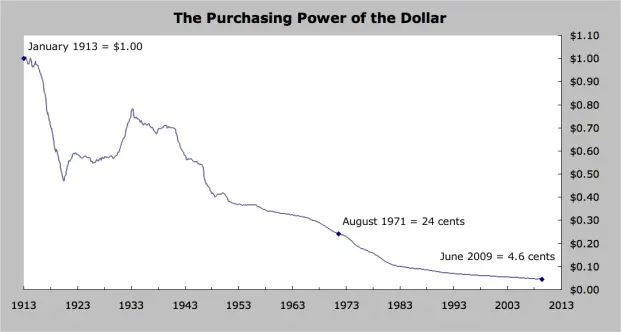
To convince you, think to another example: imagine that overnight a mysterious entity doubles all of the reserves of money that we have saved. We will be twice as rich? Only in numbers, because the richness is given by the possibility to consume goods and services and it's not derived by money itself. Money does not produce interests by itself. It could be used productively. But money it's only an object which reflects the value of all the goods in the market. If there are a lot of goods and the production is distributed we have a healthy economy.
Inflation should create ethical concerns because when the monetary base is multiplied, it has to be decided who deserves the new currency. The other part will automatically lose. To make matters worse, do you know how money is created nowadays? Money is created "out of thin air" by clicking a button. How much that button can be clicked depends on cramps on the fingers, but also on an arbitrary percentage (today is towards 1%) of reserves held as deposits. This is called fractional reserve banking system. Once, these reserves were backed by gold so when one asked for their money to a bank, the bank gave in return the gold, real money. But because not all people asked for gold at the same time, bankers thought well to earn profits by money itself, issuing promissory notes, a.k.a. banknotes, more than gold in reserves. Furthermore, money deposited in a bank allowed that bank to increase its reserves and hence, the ability to issue more credits. This is called the money multiplier. The problem here is that when banks issue new money through credit and the money multiplier, they lend you money they don't really have, it's only the projection of a reserve. But, in turn, they ask you for real goods, real guarantees and the time hard spend to work to produce goods and services. All this machinery creates monetary cycles, starting from irrational gains of entrepreneurs and concluding with painful recessions.
Have you ever played monopoly? We can play, but the rules are that I can create 90% more money than you without efforts. I bet that I will win, but I don't know.
We should carefully divide money created from credit and debts and commodity money (hard cash, sound money). Also because commodity money cannot fail because it's itself the measure of last resort, as long it can always buy things and services in the market. Sound money is the last resort for citizens who buy and sell things, not for systems "too big to fail".
Money gives us the power to decide. Moreover, money gives us the power to stop ourselves in times of crisis, reflect, and take a more appropriate decision in such circumstances. But to work, we need its property. Not your property, not your money. With our decisions, we give the direction of society, so maybe it's time to work harder on our decisions!
Whether you believe it or not, Bitcoin and cryptocurrencies try to adjust some of this mess, or at least they are born with that purpose. Bitcoin gives you back the property of money. Bitcoin is not created easily. It cannot be counterfeited. It's independent and decentralized. Bitcoin is sound money. And of course, it has a lot of other characteristics needed for money, such as divisibility, transportability or easy to store. In conclusion, Bitcoin and cryptocurrencies can be thought to be "money" much more than what people, in general, believe in what is money.
Did I manage to make you connect some dots? If it still seems all confusing don't worry! If you are interested, every week I would publish one chapter of the thesis, which will cover in more detail all of these aspects. Keep in touch!
The complete thesis is structured in such a way to have firstly a general overview of the reasons why some events have happened, specifically looking at their roots. Then, the intent is to gradually accompany the reader in more detailed problems that concerned the institution of money. Often, previous concepts are taken again to immerse more deeply in other subjects, but in such a way as to cover all the main aspects concerning the field of cryptocurrencies. In the course of the analysis, I've used different sources. Some books are used extensively to explain a particular chapter, while other sources are just taken once. To convey some concepts, I borrowed different thoughts from some great economic thinkers and used them to express this new point of view. Several sentences are reported as they were, but always with the intention of giving credit to those who wrote them and hoping, in the spirit of open-source, that they can be useful for their content as a whole and not for the form. This is because I didn't found any utility in changing these sentences, as they were perfectly fitted for what I would propose. The index of chapters would be something like:
- Money and society
- History of money
- Characteristics of money
- Economic thought
- Technological development before Bitcoin
- The white paper
- Building blocks of the blockchain
- The Nakamoto consensus
- Some crypto-economics
Nevertheless, there should be a lot more to say. Bitcoin and cryptocurrencies are a world that is constantly developing, so that even the most recent news could quickly become obsolete. Fortunately, some variables remain constant for longer periods of time and these are the ones to start with. There is a lot of excitement about Bitcoin and cryptocurrencies, so that it has divided public opinion into two groups. Enthusiasts claim that Bitcoin would change the economy, the monetary system and even politics, while skeptical people claim that Bitcoin is useless and it is a fraud, therefore it will suffer an inevitable collapse. I hope that looking differently to the economy with these new elements will help you to distinguish who is in good faith and who is not. Unfortunately, you will not find good news. It will be something like "This is a liar, he's a liar, she's liar, liar, liar, liar". But, at least, the framework will be clearer.
With these regards, I would tell you another short tale, which may be helpful in your decisions: "Everyone has two wolfs inside him. One wolf is bad and one is good. The wolf that will survive is the wolf you feed more". The cryptocurrency revolution will be silent. Don't feed and do not consider the old system, with some sacrifices you will feel better.
In conclusion, this work is the start of a journey. A journey that, I hope, could get to the core of what makes for me Bitcoin unique. I also hope that it could benefit others in understanding a little bit more about money and to make known some instruments so as not to submit to its force.






