Understanding Sections of Market
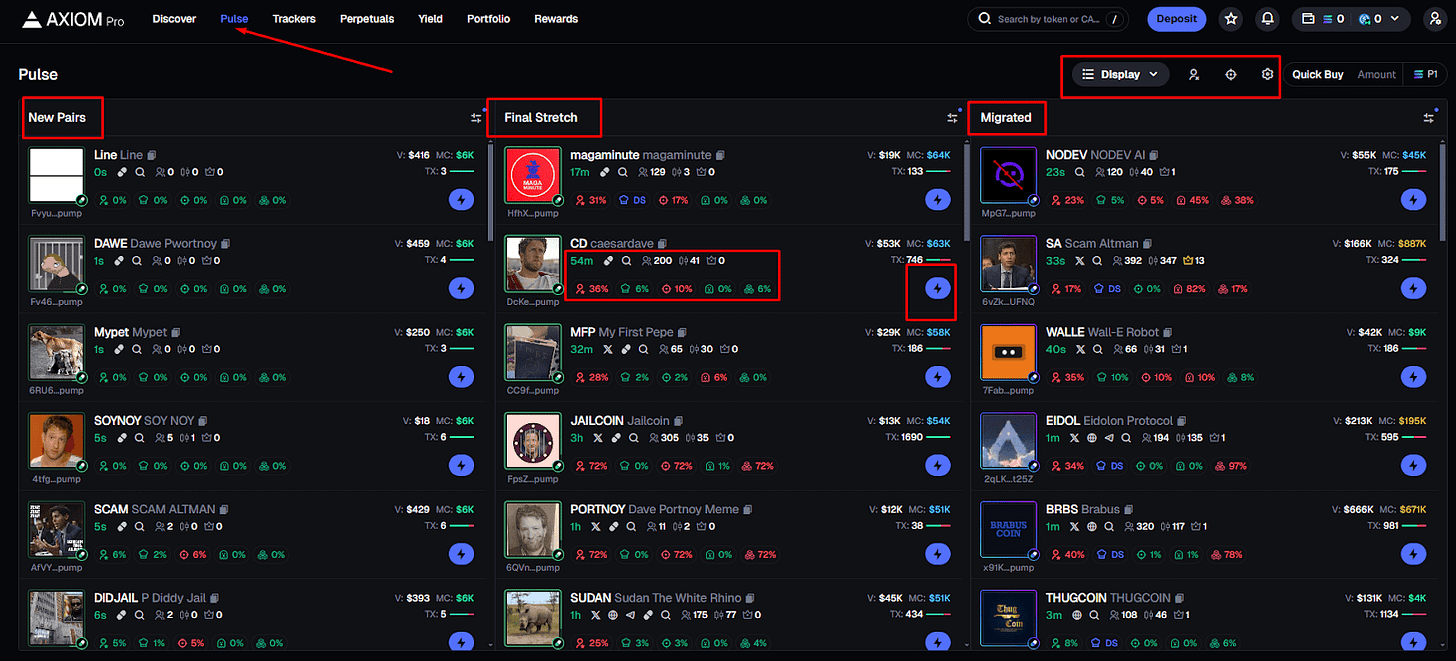
A lot of meme-coin exchanges sort coins under groups like New Pairs, Final Stretch as well Migrated. These kinds of categorizations are kind of important for people trading.
New Pairs: These coins are coming live just some seconds before. Their entry price could be lowest, but they bring a top risk level. In this area bots, sniper accounts, bundles and manipulation from developers are regular issues.
Final Stretch / Migrated: Most of the time, these categories are better for new starters or portfolios that are small. Coins have more background. Usually their holder patterns look more settled and trading volume is cleaner as well.
People who have just a small number of coins or a small amount invested, trading in these middle categories is mostly a wiser choice than just betting in an extremely new launches.
Bundles Explained
A bundle means several wallets are owned by one individual or the group. Instead of having single wallet owning a big part of the whole supply that makes traders scared, they break it up between different wallet addresses.
Example:
If a wallet has 20 percent, instead you could see four wallets that carry like 3 to 6 percent each.
Each of them looks safe, but when joined, is dangerous.
Big bundle owners can break a price chart very fast. Even holders with 3 to 5 percent can make 20 to 30 percent difference in prices when selling, depending how much liquidity is there.
Why There Are Bundles
One wallet that controls lots of supply is obvious for everyone. Most people will avoid that coin. Bundlers use several tactics to stay not noticed:
-
Splitting coins in number of wallets
-
Buying coins at same time for “organic volume” look
-
Entering side wallets before their main wallet buys
-
Copying usual buy amounts so they seem to be normal traders
The main goal for them is showing as if supply is spread fairly although they still control everything.
Difference: Insiders and Bundlers
Insiders and bundles have similarities but not fully the same.
Insiders: Transfers are made from one wallet to many wallets; anyone can see that since origin is easy to track.
Bundles: Each wallet purchases by itself. Nothing gets transferred. That is why bundles are harder to notice and is the more common way used currently.
How to Spot a Bundle
1. Holder Spread
You need to check who has the most coins. Ignoring vaults and liquidity pools pay attention to these things:
-
If wallet owns over 4 to 5 percent, this is probably not good.
-
A group of wallets that all have near the same value is sometimes a sign to be cautious.
-
When you see “big” wallets are almost equal (such as 3.4 percent, 3.3 percent, 3.5 percent), probably they are working together.
2. Buying Time Patterns
If wallets buy:
-
Same size coins
-
Exactly the same time
-
Amounts that look weird (for example 1.3721 SOL or 0.8345 SOL)
…This can mean the bundle is coordinated. Some people use strange decimals to try to look natural but it actually can show what they are doing.
3. Chart Movements
Coins with bundles often make:
-
Sharp, exact buy-ins
-
Immediate step-selling
-
Quick exits from many wallets all together.
Manipulation is usually seen early.
After seeing it enough times, you start noticing if a chart is manipulated even before you run advanced analytics.
Some Tools Used to Find Bundles
Each tool has limits but if you use more together, there is higher chance to be sure.
1. Bubble Maps (including Magic Nodes)
These show wallet groups that connect visually. If many big holders are close together this is often a bundle.
2. InsideX
Shows groups and links, looking how wallets transact with one another.
3. Magic Nodes (with date filters)
Allows you to look back at the original distribution. If start was dense but then spread out, someone could be hiding how they collected early.
4. Cabal Spy
Reveals remarkable traders, whether they are performing well or poorly, that are interacting on the coin, and you can see what is their entry size too. This is helpful when you try to notice groups that are making coordinated pushes.
Not Ignoring Snipers and Copy-Traders
A lot of snipers has a tendency to mean unstable price activity at start. A large number of copy-traders results in charts that track major wallets.
Traders who are large and have a followers can be labeled as “bundles” but it is not that they are actually bundles; instead their audience just ends up buying whatever they pick. If one of these traders sells off, quick chain reaction goes off that gives temporary bottom which is sometimes favorable for scalp traders.
What You Want To Watch For
A more healthy coin is with following:
-
Not a high percents of bundlers
-
Holder distribution that seems reasonable enough
-
Real volume stays steady
-
Having various medium and small-sized holders
-
Buys come off as organic
-
No bizarrely timed buys happening
Most importantly; coin needs to have the volume required. No volume makes impossible to exit.
Skill Develops Through Repetition
Even if you have perfect tools or filters, some intuition is probably needed. Try train to:
-
Read the buy and sell flows
-
Find abnormal movement patterns
-
Detect if manipulation is occurring
-
Notice when a coin does not feel normal
-
Resist entering due to FOMO
-
Stick to scalp method avoid chasing luck
Do paper-trading if still unprofitable. Watch the charts, track wallets and see how the coin moves. Eventually, patterns look clearer.
Meme-coin trading is not just pressing buy hoping for an 10x. It becomes a skill that will add up over time.
May your candles be forever green. See ya tomorrow
Support the creator
💼 C Wallet: The easiest place to store and swap crypto with VERY low fees + Free reward upto 10 USD
🤖 Telegram Bot: Tracks your portfolio, 0 fees, sends token alerts, and saves you hours of scrolling