
So, if you've read my previous metal detecting articles, you'll know I've been practicing detecting in a lot of the city parks in my neighborhood. I know the area was originally farmland, bought and then developed to become yet another suburbia sprawl of homes and recreation areas. That transition happened over approximately 25 to 30 years, which I watched having lived in the area for about the same amount of time.
No surprise, most of what I dig up and detect tends to be pretty modern. Regular currency coins after 1970, odd metal toys and hardware, an occasional vaping thingamading, and lots of scrap metal from broken athletic equipment, picnicking (kids and teens seem to love burying aluminum cans), broken zippers, an occasional kitchen knife (yah, that was a bit scary being found next to a basketball court).
Given the level of local development, I would have fully expected any leftover farm equipment, parts or similar from decades earlier would have been long gone or buried much deeper, like two or three feet down. My metal detector is a basic one, at best getting penetration down to about six inches. So I was shocked and confused when a literally dug up a big honking cast iron metal bracket in the photo below.
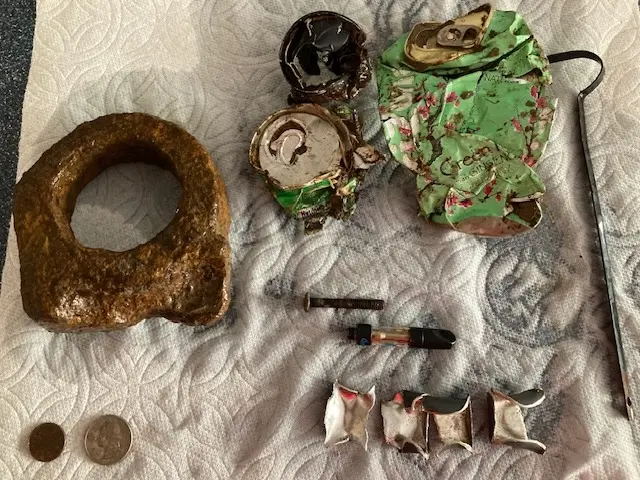
This fellow (the big troll ring thing on the left) was buried about two feet from a sidewalk path, in the front decorative area of a park, closest to the street. Given the amount of development, how this piece got missed or left so close to the surface is beyond me, but it was probably under just enough dirt to be missed, and when the park people came in to set the turf, they probably just layered right over it.
The next step was trying to figure out exactly what it is. I generally tend to throw unknowns from detecting onto Reddit, leveraging the collective mind there. The first ideas that came back were an irrigation pipe bracket (which would make sense), and a shackle (umm...wrong side of the country, historically-speaking and wrong time period). While California settlements were active well before the Civil War, and some slaves did make it out West prior, the high majority of forced labor was indigenous people, and this far north they were being wiped out or forcibly moved to reservations. Additionally, the structure of the ring had no hinge, no bolt point for securing the ring or anything elses that looked like a shackle apparatus, so that got ruled out.
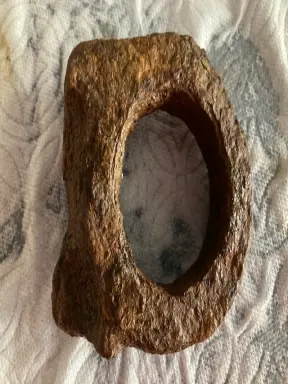
One bright character took the image I provided and handed it over to AI. The response he posted was that it was some kind of agricultural hitch. I had to see this for myself, so I took the same image above, posted it in ChatGPT and basically queried, what is this? Here's what I got back:
Most Likely Options
- Old eyelet / lifting ring (eye bolt head without the bolt)
- The circular opening and thicker “lug” area suggest it may have once been part of a lifting point used on machinery, engines, or heavy equipment.
- Hinge or pivot component
- The reinforced side could be where a pin or shaft passed through, making it part of a gate hinge, barn door hinge, or industrial pivot.
- Tow or anchor point
- Similar shapes are used in tow hooks or anchor rings, especially older forged ones where one side is thicker for stress handling.
- Agricultural equipment part
- The rough casting/forging and corrosion are consistent with old farm machinery hardware.
Visual Clues Supporting These Ideas
- Uneven thickness → designed to handle directional stress
- Large central hole → meant for a pin, bolt, or hook
- Heavy corrosion → likely exposed outdoors for a long time
- No visible threads → suggests it wasn’t a screw-in part (or they’ve completely rusted away)
So, that gave me some idea of possibilities. Then I queried it again, with a bit more detail, given the location, the history of the area that I was aware of, and where it was found. That detail allowed the AI program to narrow things down a bit.
Most Probable Identification:
Farm implement hitch / clevis-style ring mount
What you likely have is the ring portion of a hitch point or a pivot/anchor lug from older farm equipment (plows, harrows, tow implements).
Why this fits very well:
- Farmland history → tons of older equipment parts get lost/buried over time
- Depth (~6 inches) → consistent with decades of soil turnover (plowing, grading, landscaping during park construction)
- Shape:
- The round hole → for a pin, hook, or shackle
- The thicker “bulge” side → reinforcement where stress was highest (pulling force direction)
- Material → looks like forged or cast iron/steel, typical of pre-modern farm gear
- No threads → meant for a pin connection, not a bolt-in fastener
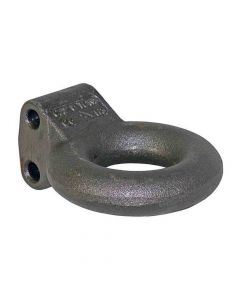
That allowed me to do some Google searching for different likely candidates. What I've concluded is that I found some form of a very early 20th century pintle ring hitch/connector, typically used for heavy load bearing pulling, i.e. farming equipment most likely. It makes sense why the piece was chucked off; the connector part broke with classic cast iron behavior. Enough stress and a minor fracture became a critical failure as the cast iron cracked and broke erratically.
Anyhoo, just another dug up adventure down history's lane.






