
The media has been throwing around the term of "economic collapse" quite a bit the last two weeks, with most of the articles being clickbait that end up providing nothing in terms of content. They might resurrect in a sentence or two the 1929 Great Depression, but that's about it. Why is this such a mystery? Part of the reason is due to the fact that the country has never really had a real economic crash since 1929. There's been the 1970s inflation spike as well as the 1987 October Crash and the 2009 Recession, but these are not actual economic crashes. They are pimples on the behind of such an event. A true economic crash would be far more pervasive and impactful, especially on those who depend on others for everything they get. Let's go through the big factors.
Historical Comparisons
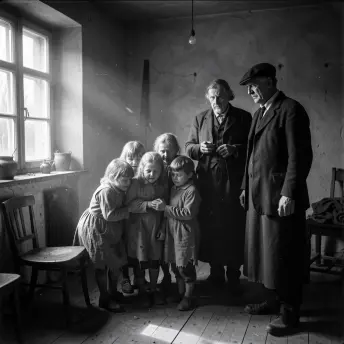
Again, the Big Depression in the 1930s is often thrown around, with images of the Dust Bowl from the book and movie, the Grapes of Wrath flittering in peoples brains. That's probably a very inaccurate scenario since much of the 1930s was investor and bank-driven. The more likely comparison of what would happen to the average person could instead be seen in Argentina during the early 1970s as well as post-war Germany in the 1920s after World War II. Things still functioned, just very miserably and to different levels depending where and who you are in society.
Banking and Stocks
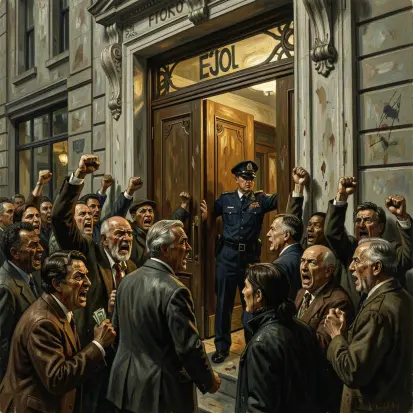
You can pretty much expect that banks become worthless in a crash. Every holding, savings account, CD or investment they manage would be worthless, and worse, the banks themselves would be wiped out by panic bank runs from thousands trying to get their worthless cash out before the doors are locked. The smart ones would be trying to get to their deposit boxes to get gold or anything precious out before the banks crack them open and steal the contents to have liquidity. Think that's made up? Go back a reread the gold confiscation trend that happened under President Nixon as well as earlier during the 1930s.
Stocks would be probably worthless as well. With companies foundering and investment getting pulled, the markets would be in a freefall and stock prices would plummet. There would be no or little loss if 1) the company survives and keeps operating, and 2) they don't sell. But try telling a panicked room of investors that. SELL SELL SELL would be the mantra all the way down, again for useless cash.
Why useless? Because inflation would skyrocket. A funny thing happens in an economic crash, at least historically. Governments start printing mass amounts of cash to pay bills and wipe out debts at meaningless old liability levels. The government absolves the debt, but the debtor is screwed with a bunch of cash that isn't worth anything on the market. The debt can't be restructured to actual market value; it can only be called in. So the debtor takes the hit if a borrower pays off the debt during a crash. This would be widespread, and the printing of cash supply skyrocketing would send inflation into the 1000s of percent.
In a sick way, an economic crash and hyper-inflation would be a great way to pay off a big debt like mortgage or car loan. All one would have to do is get a lot of useless cash, count it up to match the loan amount due, go into the lender and pay it, and legally the loan would be satisified. Crazy.
Manufacturing Production
Here's where an economic crash would really hurt; production would shut down as companies have no credit anymore and no means by which to pay suppliers, workers or vendors. That has a ripple effect across multiple universes, from individual wallets to business solvency. Most big company run on borrowed cash flow until big payments come in, they pay off liabilities, take profit and the cycle starts again. When that cash flow support gets broken, assembly lines and production stop and everything goes cold. People no longer work, and consumers no longer get goods or services. That creates real disruption.
Aside from water and food supply, fuel is probably the next big critical factor. When gas stations and fuel supplies cut off, convenience transportation shuts down. Even those who stocked up eventually run out and join the masses with useless cars that go nowhere. It is quite possible for able-bodied folks to shift to other means of movement, like wagons and bicycles, and many will. But it won't make the overall transportation problem disappear. The vast majority of people today travel 30 to 100 miles for daily work, school and needs. You can't do that quickly on a bike and definitely not in a wagon.
Food, Shelter and Medical
For those who depend on a paycheck week to week or month to month, an economic crash has huge ramifications towards the negative. Fiat money and cash flow are a lifeline, so when that gets disrupted, the consumer is suddenly out in the cold without any means by which to survive. They can't pay rent, buy food or travel to other opportunity without their own savings, assets, service or help. They get evicted, become homeless and suffer on the streets. Where people own their own home, have stored assets and supplies and have an independent support system, they last longer and stay comfortable. This is why people in smaller towns and villages can easily switch to barter and keep functioning where people in big urban centers go into panic and rioting. The system that supports the urban center can't be quickly replaced by barter. There's too many heads to deal with in too many diverse skills, trades, needs or similar, so standardization of a trade doesn't work. People then turn to scavenging and pawning what they can for simple survival. That leads to victimization and crime, which explodes in urban centers.
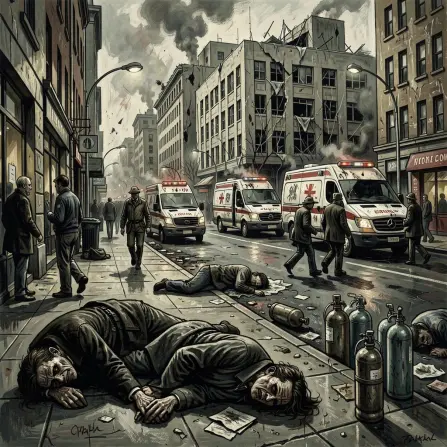
Medical would be the hardest hit within weeks of a crash, where people can't eat well, are at risk of losing shelter and under extreme stress, sickness begins to skyrocket. With no way to provide medical service and no way to pay for it, medical centers go into triage mode only dealing with the most important and worthy. Thousands get turned away from help they need. The elderly and disabled would be the first to become mortalities in this situation. It's not gaslighting; we've seen clear evidence of this trend during the Katrina Hurricane and during the COVID Pandemic.
Law & Order
The growing unrest, protesting and panic created by an economic crash would begin to percolate and become unmanageable within a week or two, triggering the need for martial law to control the streets. Again, in urban centers, this would be extreme, with all civil rights being wiped out and people arrested, attacked or even shot for being remotely a risk to restoring order. Government employees, for the most part, would be insulated from the immediate problems of private-side workers, especially those in law enforcement and the military, because their support system would continue while everything else seems to fall apart. It would only be after one or two payroll periods where people are still expected to work without pay that friction would begin to occur, starting with walkouts and absences on the miscellaneous side and then erosion of the uniform side. This played out in full detail during the Katrina Hurricane as government continued to operate from a distance and law enforcement stayed functional until it became detrimental to their personal safety and interest. Then New Orleans officers walked off the job and disappeared in some cases, leaving things to the National Guard weeks later.
Where the government and order are vacant, criminal elements as well as survivalists would likely band and cordon off territories, but these are temporary. Even anarchists and criminals have to eat and live. So unless they are reaching out further and further from the base of operations, ultimately they could not stay long where they start without some way to generate food and support systems. That would become exacerbated as people migrate away from trouble areas. Criminal elements would then shift to traveling bands looking for opportunity to keep operating off of refugees or lone stand-out opportunities holding on. The TV show, The Walking Dead, plays on this theme regularly showing strength in numbers is the only realistic survival when things fall apart.
Migration
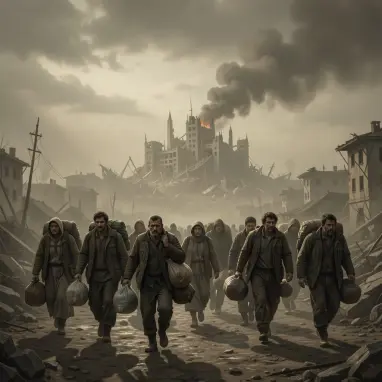
When people have nothing left to help them survive locally, the smart ones get out and go where they think there might be a better place to survive and live again. Human migration has been driven by calamity and disaster for centuries. In an economic crash today, however, this migration would spread out from urban centers and towards rural centers. First, it would be anyone who has a family or friend connection. Later it would general searching for help. Most migration would be families and able-bodied. Later would come stragglers who left late usually streaming out of refugee centers that would burst apart like blisters when reaching critical mass. Again, we saw this in Katrina.
Time is the Defining Factor
How long an economic crash lasts generally defines how bad it gets. Unlike a natural disaster, system erosion and degradation take time to fall apart during an economic break. However, when order disappears, the system begins to fall apart in a cascade fashion very quickly. Riots, crime, theft and violence can wreak a nightmare in neighborhoods very quickly, making even surburbia look like a battlezone in days. The craziness of a money-based collapse doesn't happen right away, it slowly picks up pace, but by two to four weeks, urban centers are getting stretch as the panic rises to serious levels and law enforcement becomes desperate to keep order. Anyone sticking around by then is just asking to get caught up in a bad mess.
Preparation
Unless you're a billionaire and expecting to support yourself for 5 years independently on an island (notice big names buying up plots on Maui and similar?), the high majority of people are not going to be able to sit out an economic crash if it occurs. Instead, what you can do is plan in multiple ways how to sustain yourself in the interim until the initial shock and crash wear off. This can take anywhere from 1 to 3 months before order is generally restored. Living in a rural areas with a secure shelter and supplies is definitely staying well ahead of the curve. Having alternative transportation versus just a car is a good plan for long-term movement needs when fuel runs out. Means for self-defense when order fails is a must. Most importantly, however, is the mindset to be flexible, not dependent on current conveniences and be willing adjust how you live to get through the worst of things. Most people who will become victims are those who freeze when they don't know how to live without modern life's amenities, rules, conditions and assumptions. Be ready to break from that when you have to. That applies financially as well as pragmatically. Learn skills, stock supplies, secure a safe remote location, and be ready to be alone for a while until things blow over.






