
This morning I went to drop off two flat packages at my local post office station before heading off to work. This should have been a simple matter of drive up, hop out of the truck, put them in the outside box, and drive off. The postage cost was already paid online via electronic shipping labeling and electronic payment. There was no line to deal with, no weird packaging involved or any other type of headache. Yet, to my surprise, the box would not open. It was locked, basically making it impossible to do a quick drop. Instead, I had to park my vehicle, walk inside the station, find the chute that actually was opened (only doable 10 minutes for desk opening for some reason), and then walk out again. That cost me an additional 10 minutes in my commute because someone in the local station didn't want mail dropped outside.
There's been a lot of chatter about how the U.S. Post Office (USPS) is failing as a business model, will be bankrupt and will need seismic changes to its business model. And the whole discussion is laughable at how much of farce that is. There is actually nothing wrong with the business model on the income side of the house. In fact, well over 80 percent of the U.S. Post Office's income comes from parcel and package shipping, not first class mail that we've been so inculturated with for decades.
Go to the Numbers, Ignore the Chatter
When you look at the agency's operation in terms of volume, it can seem logical why the coal mine canary seems to be signing about losing income. Clearly, volume has been going down in the traditional mail category of letters and large envelopes.

But let's have a bucket of cold water thrown on here: the cost of sending even a large envelope is at best $1. The cost of sending a package is, at a minimum with media mail for example, is $4.47 plus a pending 20 cent bump this month due to fuel impacts. On average, a regular 1lb package will cost closer to $6 in practice. That's a lot more than a $1 envelope, and it isn't just consumers and eBay sellers using the Post Office for shipping; both Fedex and UPS contract out to the USPS to move their ground packages, skimming a markup but letting the agency deal with the actual shipping workload. You'll notice this when you realize the shipping tag for ground economy with Fedex actually uses the USPS tracking, but you still have to make sure to drop the package at the Fedex office or drop for "correct" routing.

So, who's actually losing money here? Guess what, it's not on the income side at all. The Post Office is actually making more money than it did in recent years, to the tune of another $5 billion or so since 2016. Even more noticeable, package shipping, which includes things as simple as media mail, is easily double the size of gross income than it was in the early 2000s.
Yet we continue to keep seeing tidings of doom regarding the fate of the USPS, particularly in the cost of operations, driving the need to charge more in postage. This is based on the logic that operations are untenable in their current service paradigm. The federal General Accounting Office (GAO) makes the point that overall operations are down due to losses in first class mail and marketing. Again, this hides the fact that packaging is not only replacing this lost revenue but adding to the system when you compare the two perspectives. Why the seeming shell game? Well, the first reason seems to be to create such a bad scenario, no one will resist raising the cost on first class mail. Then, with that raised, the domino effect comes along and raises rates on every other form of shipping service offered as well. The USPS only jumped the gun on packaging costs due to the impact of fuel costs at the end of April 2026.
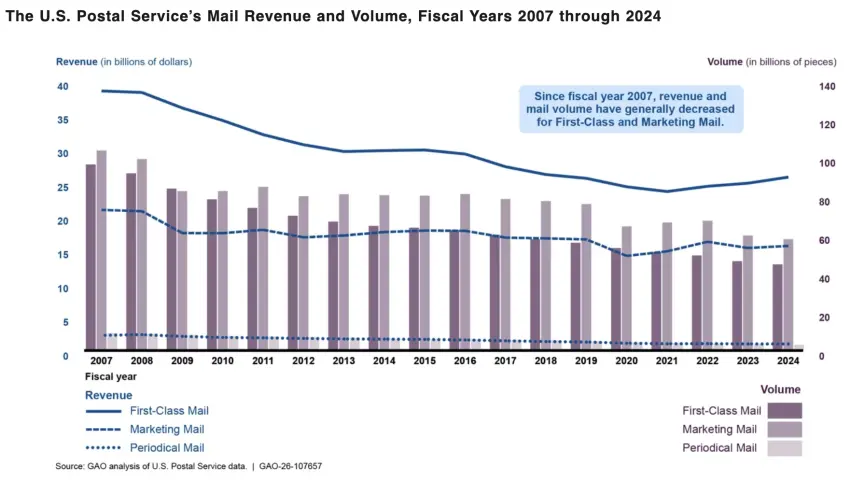
Now, if you're not a regular users of the USPS, then the above charts and back and forth might seem like the matter just needs to be straightened out on the income side of things and maybe prioritizing attention on where the money is, like packaging instead of first class mail (honestly, most companies and people are using email and electronic signature now, like Docusign; it's not surprise first class mail and marketing mail are dying off).
The Real Money Drain is not in Sales
In reality, from a regular user perspective, it's the USPS operations that have been steadily killing the agency. First, this operation is supposed to be a fee-driven program. It's not supposed to be operated on any funds from elsewhere in government. The feds make a big deal about that, and in practice it would make sense then that the operation should be capped on what it brings in the door. However, as you've seen above, that's not where the problem is. The income side is growing.
Instead, the operation side has three big categories of costs: labor, facilities and fleet, and administrative costs. According to available data, this has never been set right since the early 2000s at least.
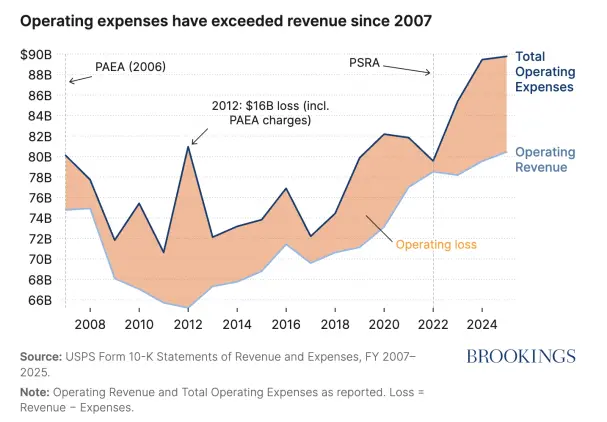
Like many private-side companies, the USPS has tried to rein in costs with shifting postage generation to online platforms, reducing staffing through attrition, reducing staffing schedules, contracting out transportation and other services, managing field staff on temporary status for extended periods before hiring, and already raising postage costs in the past. However, what's been driving cost increases has been labor rates (compensation), unfunded debt/liabilities, and actual operation costs already being used increasing (inflation), according to the GAO.
What the Heck is Unfunded Debt?
Digging a bit, unfunded debt turns out to be primarily the classic boogie monster of labor retirement and pension health plan costs. These are "unfunded" because they don't come due until the employee actually retires. One would think that a federal employee's retirement should be part of a bigger pot associated with the federal government in general, but with the USPS, it comes out of hide at the time of charge. This is not surprising; it's actually a common model across different levels of government, and it hits the annual budget of an agency as an unfunded deficit/cost directly to core operation budgets. Worse, retirements come in waves. The assumption is that attrition helps deal with the cost, with vacancy savings as people leave until filled and hired again with new people at lower cost. In reality, a bunch of workers tend to retire at once, and the retirement cost hits the agency as a wave and can be to the millions of dollars at at time.
The other big unfunded liability driver turns out to be workers' compensation. Again, this is not a surprise factor. Much of the USPS work is manual, moving mail and packages, driving, lifting, pushing and sorting as well as working with machinery. Injuries are going to happen. How they are managed as a cost, however, seems to generate a large portion of unfunded cost as well. Part of this could be due to the cost of workers' compensation coverage, but it can also be due to actual injury costs too. I've seen in the past as much as $10 million costs per quarter for agencies with heavy manual work and high frequency of physical injury risks.
The USPS can't immediately just make the administrative costs of pensions and workers' compensation disappear tomorrow, but they can do a lot to redesign operations to be more responsive. Numerous steps can be taken to enhance folks taking care of themselves so that the USPS field staff are focused on shipping and less on the transactional side. That includes marketing and making the online side of shipping much easier. The agency has been making great strides in partnering with e-commerce companies to provide seamless shipping postage for packaging. Everything is bar-coded making labeled packages easy to process.
The availability of pickup points and drop off points should be enhanced, letting consumers and small business handle their traffic and consolidating exchange points better than the traditional post office station with limited hours. The typical post office station continues to be limited to less than normal business hours of 9am to 4:30pm, which simply doesn't match shipping outside of company trucking. Instead, hours should be extended similar to Fedex, that either provide easier access after classic business hours or makes it easy to do self-service drop offs. Kiosks were a great idea, but they fail when they are locked up after hours (what's the point of the kiosk then?). Self-servic access points could also be increased with larger drop-off containers in neighborhoods to, but the USPS has to tighten up it's security with master box keys that keep getting stolen and used by thieves raiding neighborhood clusters.
Make Shipping Easier, Stupid
Where there continue to be hiccups is in the point of package receipt, slowing things down with confusing counter services that conflict with online services. It's a very common problem that really pisses people off when they weigh something, get an online label at cost, and then goes to the USPS counter to ship only to be told they have to use a different retail service that costs far more than what was already paid. These instances are covered up as consumer mistakes, but in reality there tends to be a practice of arguing with the consumer and telling them a package can only be shipped at the counter with another more-expensive channel. For example, media mail is used for shipping books and CDs. However, if one puts a book in a large envelope and folds it over to reduce gap, it's no longer treated at the counter as an envelope. Now it becomes a package per retail rules. So the user, expecting to pay $4.47 for media mail gets hit with $6 something for a package shipping, depending on destination. This kind of problem seems miniscule, but it happens everyday. If in fact there is a shipping variance on an already paid channel, like miscalculated weight, it's quite doable for the USPS to chargeback electronically to a user's online account. I see this occasionally on my eBay packages and it takes care of the problem. Instead, the counter nonsense creates a lot of frustration for no reason except to gouge a customer for a few more pennies.
Another opposing argument is that the counter contact forces bigger packages to get checked for miscalculation. Again, this is easily solvable online. Simply require anyone dropping of a pre-paid bigger package to have an online USPS account for potential chargeback solutions. Problem solved, package shipped, counter price-switching avoided.
Enter Another 800 lb Gorilla
Now, with Amazon opening up it's logistical network to customers, the USPS is going to see further direction competition on smaller packages, the bread and butter of its growing income side. Amazon will likely integrate this service with buyers and sellers on the e-commerce platform, practically eliminating the need to deal with the USPS, Fedex or UPS altogether, the latter two which handled bigger packages and will feel the pinch as well. Amazon, before this week's announcement, already moved a market share on par with the USPS and bigger than the other two major courier services per Capital One statistics from 2024.
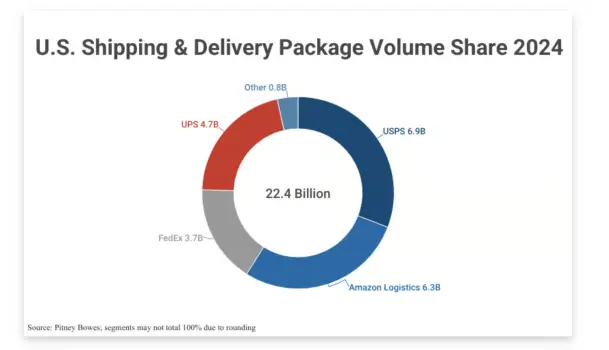
If the USPS doesn't get its act together after moving the retirees out with attrition and simultaneously dealing with the its service side operation bloat, that would be the real doom spelled out on the wall. And maybe that's what management wants. We may very well be sending our daily mail through Amazon via federal contract in the future as a result.






