
I first caught the topic of “tech cities” on one of those late night jaunts through YouTube stuff, the kind of mindless search down the rabbit hole where you say to yourself, “Who watches this conspiracy crap and generates ad money for these people?!?” Yet, there it was, a fully documentary on a nascent movement that’s been quietly developing in the background – the concept-building of tech cities for the near future.

The Nitty-Gritty
The idea is essentially the creation of a self-contained, tech-driven modern future city state, like ancient Athens, that governs and controls itself without any outside influence per se. And, not only were there plans, but people were signing up for early club membership and conferences to serious discuss these ideas further. My initial reaction, oh here we go with the next cult scam. Since passing asteroids that take us to heaven didn’t work so well, now tech city states will be the next religion to suck up people’s money and well-wishes.
Tech city chatter uses a “smart-city” concept as its foundation – everything in terms of infrastructure operations is rooted in tech, from residential climate control to food delivery to transportation systems to public safety to plumbing and economic management. Sounds great, right? However, each tech city is run and owned by a given tech company/CEO, and its residents are 100 percent dedicated to the company or they have to leave. Uh, wait what?
You are not Eligible to be a Member, Off You Go
Now this point right here is where people should stop and really think about what a tech city membership really means. First off, the resident doesn’t get to decide their worth; the tech city management deems them worthy, or not. So, put that in the context of the current job market and its blatant agism as well as the push for the lowest dollar cost for skill and you get a model where the young, beautiful and naïve get to be city citizens and everyone else who doesn’t cut the mustard or is too old or expensive gets the boot. There’s no appeal or second-guessing because, that’s right, there’s no public government. You’re in a tech dictatorship. Magnify corporate ruthlessness times 1 million.

Of course, there will still be politics, but they all that networking activity centers around jockeying for positioning within the tech city hierarchy. How well you kiss arse to the tech CEO or even your immediate boss dictates whether you get to stay in the joyous tech city for the next month. Ouch.
Whose Backyard?
But let’s put the social part of the idea aside for moment. Focusing instead on the actual mechanics of a tech city, a tech city idea assumes the entity has a primary location already determined. One of those tech boys actually has to buy the physical land or build a sea platform to locate the enterprise to get it going. This is not as fictional as it sounds; Mark Zuckerberg and Larry Ellison already own significant portions of Hawaiian islands as their own private property now. Whether they are planning a city or not, they have the physical potential to do so, and the ownership is real.
Running the Machine Takes a Mechanic, Not a Dreamer
Second, there needs to be critical infrastructure in place, both to run a city as well as to maintain and support it. That means power, water, plumbing, shelter, monitoring, production, climate management and a whole lot more. It’s not as if someone waves a magic wand and a finished city appears. The amount of money to just set up and maintain a basic factory city alone is in the billions, so a full-fledged community with amenities in exponentially more. Then, once built, there needs to be a steady supply of resources to keep the entity going. Food and water alone are a gargantuan challenge. Modern regular cities rely on age-old markets and existing systems to deliver those basics alone, which includes thousands of different businesses and agencies working collectively. Given that a tech city is all owned by the company running it, the outlay for this kind of operation without an immediate return is astronomical. A small village would be insanely easier than trying to build a city from scratch.
Is it Really Independent After All?
Third, who exactly is going to tolerate a city-state in their backyard as an existing country? Let’s be frank on this – no one. No country government would currently entertain the sudden creation of a governmental entity in its own jurisdiction that it can’t control, take over and take advantage of. It definitely would be ludicrous to allow such an entity to exist with its own security as well, a necessity for a functioning city-state. More than likely, a successful city-state would not be autonomous and would instead have to rely on the protection of a big brother government, giving some kind of critical benefit in exchange for protection and uninterrupted growth. That’s where the tech part comes in – sell the critical service to pay for the city-state.
The more likely scenario for a tech-city creation is really under sea or off-world (i.e. the moon or Mars). Both environments provide ample room and location that is free of existing jurisdictions and ripe for colony creation. And, if there are enough survivors in the future Jamestown to live through the initial establishment without cannibalizing themselves (true story that early Jamestown problem), it would be possible to sustain and grow a city-state going forward without conflicting with existing governments. But again, there is the cost just to get it to start.
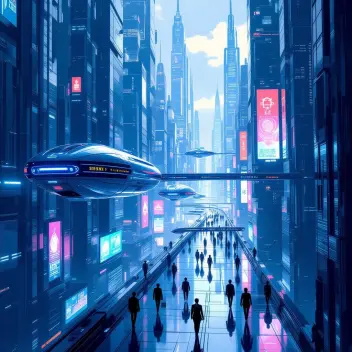
Tell Me When Noah's Ark Actually Starts Getting Built
In short, the tech city idea is a utopia of ideal utility and ignorance to the reality of running a municipality. Tech doesn’t solve everything running a city right; in fact, it doesn’t solve 95 percent of the existing problems at all. Half of them are social, just getting people to cooperate with each other long enough to sustain a safe community for all. Economy, health, education and much more also need to be in place; tech cities won’t thrive for long on a military camp model, which is usually the quick, gut response how to operate. Tech cities make for great sci-fi movies and books, but they are nowhere near readiness for even prototyping in the real world.





