Ripple is often considered a disruptive digital currency due to its unique features and potential to revolutionize the global financial system. Here are some of the reasons why Ripple is considered disruptive:
-
Focus on Cross-border Payments: Ripple's primary focus is on facilitating seamless and efficient cross-border payments, which are currently hindered by inefficiencies and complexities in traditional banking systems. RippleNet, Ripple's global network of interconnected financial institutions, has the potential to significantly reduce the time, cost, and complexity of cross-border transactions.
-
Scalability and Efficiency: Ripple's XRP Ledger consensus mechanism is designed to be highly scalable and efficient, allowing for a large volume of transactions to be processed quickly and securely. This scalability makes it well-suited for handling the growing demand for cross-border payments, particularly in emerging markets.
-
Partnerships with Financial Institutions: Ripple has established partnerships with numerous prominent financial institutions, including MoneyGram, SBI Holdings, and Santander. These partnerships demonstrate the growing interest in RippleNet and its potential to disrupt the traditional banking system.
-
Regulatory Acceptance: Ripple has been working closely with regulators in various jurisdictions to gain acceptance for its technology and services. This regulatory acceptance is crucial for Ripple to achieve mainstream adoption and expand its global reach.
Total Supply and Distribution:
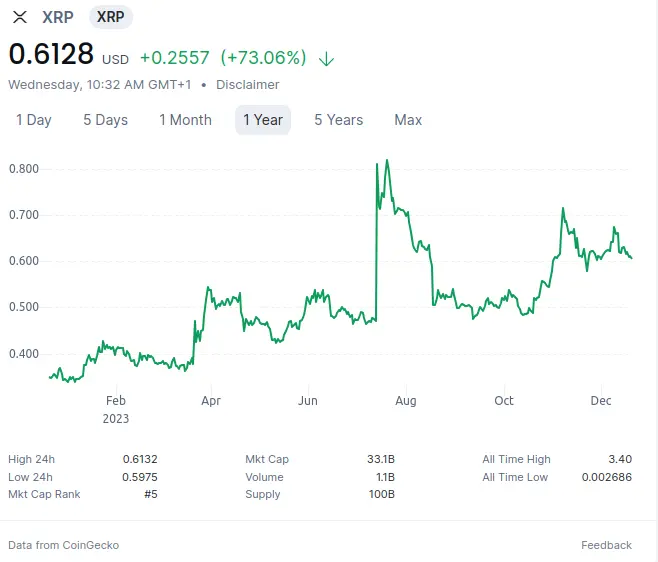
XRP Price Evolution in a Year (CoinGecko)
Companies that collaborate with Ripple in Real World Solutions:
Ripple's total supply is capped at 100 billion XRP tokens. The majority of XRP tokens, around 61.34%, are held by Ripple Labs and its founders, Jed McCaleb and Chris Larsen. The remaining XRP tokens are distributed among RippleNet members, Ripple's ecosystem of financial institutions and partners. Ripple has partnered with a wide range of companies across the globe to explore and implement its technology for real-world solutions. These partnerships demonstrate the growing interest in RippleNet and its potential to revolutionize the financial industry.
Financial Institutions:
-
MoneyGram: RippleNet has partnered with MoneyGram, a leading money transfer company, to facilitate faster and cheaper cross-border payments.
-
SBI Holdings: SBI Holdings, a Japanese financial conglomerate, has invested in Ripple and is a key partner in developing RippleNet in Japan.
-
Santander: Santander, a Spanish multinational banking group, is using RippleNet to streamline cross-border payments and reduce costs.
Technology Companies:
-
AWS: Amazon Web Services (AWS) offers RippleNet as a managed service, making it easier for financial institutions to integrate the technology into their systems.
-
Microsoft: Microsoft Azure also offers RippleNet as a managed service, providing businesses with access to the technology's capabilities.
-
SAP: SAP, a global enterprise software company, is working with Ripple to integrate RippleNet into its enterprise resource planning (ERP) systems.
Telecommunications Companies:
-
Telefonica: Telefonica, a Spanish telecommunications company, is using RippleNet to enable faster and cheaper cross-border payments for its customers.
-
SoftBank: SoftBank, a Japanese multinational conglomerate, is also a Ripple partner and is exploring the use of RippleNet for international remittances.
-
Vodafone: Vodafone, a British multinational telecommunications company, is working with Ripple to enable cross-border payments and micropayments for its customers.
Government Agencies:
-
United Arab Emirates Central Bank (CBUAE): The CBUAE is collaborating with Ripple to explore the use of blockchain technology for central bank digital currencies (CBDCs).
-
Brazil Central Bank (BCB): The BCB is also exploring the use of RippleNet for international trade finance and cross-border payments.
-
South Korea Financial Services Commission (FSC): The FSC is working with Ripple to develop a regulatory framework for blockchain technology in the country.
These partnerships highlight the potential of RippleNet to transform the financial industry and make cross-border payments faster, cheaper, and more efficient for businesses and individuals around the globe. As Ripple continues to expand its network and build partnerships with key players in the financial sector, it is poised to play an increasingly significant role in shaping the future of global payments.
XRP's Role in Price Stability:
Ripple's tokenomics aim to promote price stability by:
-
XRP Escrow: Ripple maintains an escrow reserve of approximately 45 billion XRP, which is released gradually over time to prevent excessive inflation.
-
On-Demand Liquidity (ODL): ODL is a mechanism that allows financial institutions to access liquidity for XRP payments using RippleNet. This helps to reduce reliance on centralized exchanges and promote price stability.
-
Community Management: Ripple's community plays a crucial role in advising the company on tokenomics decisions, ensuring alignment with market dynamics and investor sentiment.
Overall, Ripple's tokenomics are designed to balance network stability, utility, and price appreciation, making XRP a valuable token within the Ripple ecosystem. While Ripple faces challenges such as regulatory scrutiny and price volatility, its innovative technology and growing ecosystem of partners position it as a potential disruptor in the global financial landscape. If Ripple can overcome these challenges and continue to expand its reach, it has the potential to reshape the way we conduct cross-border payments and revolutionize the global financial system.
Do you HODL XRPs? What do you expect for Ripple in 2024?
**************************************************************
TO SUPPORT MY WRITING:
- Earn daily Bitcoin with Surveys and games Cointiply
- Join Binance: Start blogging and monetizing content.
- Buy Me Coffee
- Use Referral CODE: ztrg7mb4dy to Complete Missions Crypto.com