
Introduction
When I was a child, I used to train my brain to hold seven different thoughts for the maximum time possible. I believed multitasking was the ultimate skill to develop. Now, as a college student, I can’t remember who I should Venmo request after a night of drinks.
Whether I record the expenses of my alcoholic binges accurately or not, I certainly won't be able to do the same for billions of people living on Earth. This would require a global system of transparency and trust; two qualities that are hard to find in alcoholics. The good news is that the system has been in development since 2009 with the release of Bitcoin. The bad news is that blockchain has nothing to do with alcohol.
Blockchain Technology
Blockchain falls under the category of foundational technology, not to be confused with disruptive technology. Foundational technology is built throughout decades and targets large economic, political, and social problems. Disruptive technology is built in a shorter time and targets small consumer & business problems. Currently, blockchain targets our legacy voting, healthcare, finance, and supply-chain systems. A digital upgrade in each category will take many years to develop as blockchain technology improves.
Blockchain Structure
A blockchain is a digital ledger that stores information inside "blocks" of data, strung together in chronological order. A digital ledger can be a powerful tool when its creators decide to build a form of money that is a decentralized, peer to peer, censorship resistant network. I know, it's a lot to take in, so I created a diagram for you to look at.
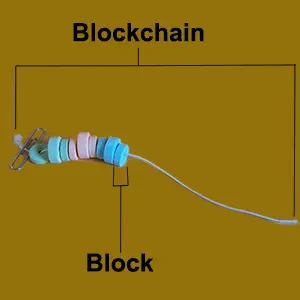
If a candy bracelet were a blockchain, then the individual candies would be the blocks on the chain. Depending on the industry that uses a blockchain, data may be stored publicly or privately. When transactions are submitted to the blockchain, they are validated or rejected through a process of independent validation across all the nodes. These rules govern how consensus is reached internally and secure the blockchain from double spending.
Blockchains can also be coded to exhibit many properties found in nature, such as scarcity, decentralization, and competition. For example, Bitcoin uses a reward every 10 minutes to incentivize competition. Participants all over the world compete for the reward to justify the electricity and graphics processors it takes to run the protocol. At the time of this writing, Bitcoin is about 800,900 blocks in length, which has taken around 15.3 years to build from block 0.
Here are a couple of tools to help close the learning gap.
Visual Tools
- IOHK, the Japanese research company behind the Cardano blockchain, developed an online visualizer for the Bitcoin blockchain called "Symphony". Using their 3D software, you can analyze on-chain transactions since the start of Bitcoin.
- “Bitnodes” is an online map that shows the density of Bitcoin nodes in every country.
- “Daily Blockchain” is a visualizer that shows unconfirmed transaction relationships on the Bitcoin network.
- “Bitcoin Supply” shows the estimated amount of bitcoin held in large categories.
My name is Nathan Pease. I'm currently studying Finance at the University of South Florida. My passion is blockchain/cryptocurrency technology. I am driven to make it my career.
If you leave this page with a bit more knowledge than before, you can support me by leaving a tip below and connect with me on social platforms. A donation to my wallet address is not required but greatly appreciated because college is expensive.
Socials:
- Linkedin:
https://www.linkedin.com/in/nathanpease941/
- Twitter:





